


Efficacy of Intrathoracic Intercostal Nerve Block on Postoperative Acute and Chronic Pains of Patients Undergoing Video-Assisted Thoracoscopic Surgery
- PMID: 35967470
- PMCID: PMC9365024
- DOI: 10.2147/JPR.S369042
Efficacy of Intrathoracic Intercostal Nerve Block on Postoperative Acute and Chronic Pains of Patients Undergoing Video-Assisted Thoracoscopic Surgery
Abstract
Background: Patients undergoing video-assisted thoracoscopic surgery (VATS) frequently suffered postoperative acute and chronic pains. In recent years, intrathoracic intercostal nerve block (INB) is regularly used thanks to its safety and accuracy, especially under the circumstance of lacking ultrasound or in face of the contraindications of the thoracic paravertebral block (TPVB). However, clinical evidence of comparing TPVB and INB for pain management after VATS has been limited and the observation of the chronic pain has been less than clear.
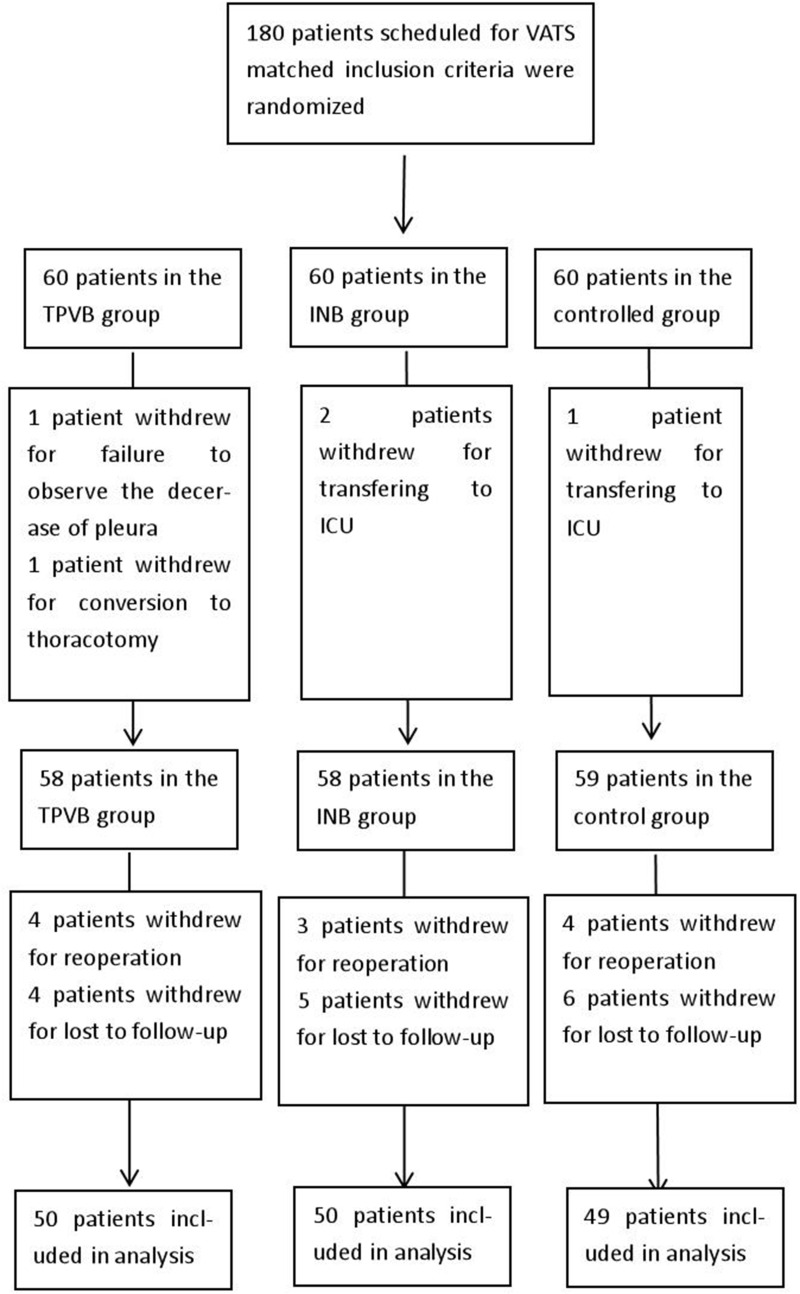
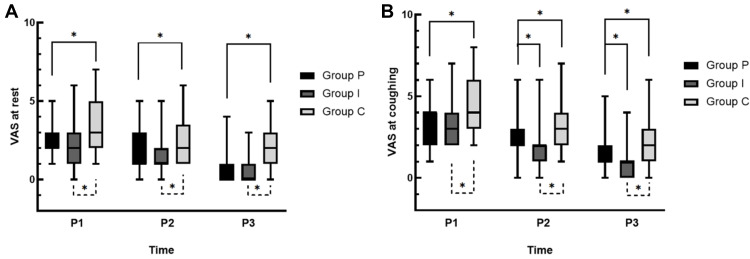
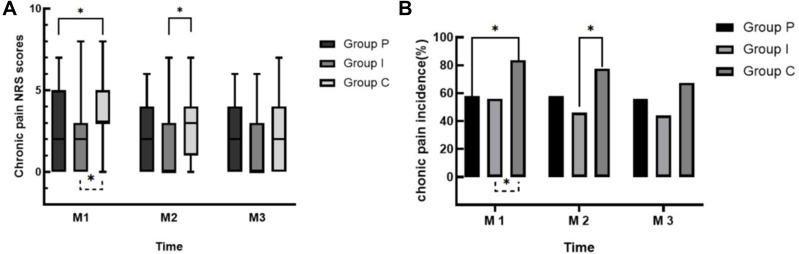
Methods: A total of 180 patients undergoing VATS were randomly divided into three groups: A single multi-point paravertebral nerve block (Group P), intrathoracic intercostal nerve block (Group I), and general anesthesia without any regional block (Group C). Postoperative acute pain was scored at rest and coughing by the Visual Analog Scale (VAS) for recording 24h, 48h and 72h after VATS. All patients were interviewed 1, 3 and 6 months after the surgery to investigate both the incidence and intensity of chronic pains.
Results: There were significantly less incidence and intensity of acute pain in Group P and Group I, compared to those in Group C. The patients in Group I showed the least incidence and intensity of chronic pain after 3 months compared with those in Group P and Group C. There are 89 of 98 patients suffering pains after 1 month, which grew into chronic pains after 3 months and 78 of them still suffered chronic pains even after 6 months.
Conclusion: The intrathoracic INB offers excellent relief from acute and chronic pains, which does as effectively as TPVB. Besides, one-month postoperative pain could increase the risk of a chronic one.
Keywords: acute pain; chronic pain; intrathoracic intercostal nerve block; paravertebral nerve block; video-assisted thoracoscopic surgery.
© 2022 Zhao et al.
Conflict of interest statement
The authors report no conflicts of interest in this work.
Figures
References
-
- Moon S, Lee J, Kim H, Kim J, Kim J, Kim S. Comparison of the intraoperative analgesic efficacy between ultrasound-guided deep and superficial serratus anterior plane block during video-assisted thoracoscopic lobectomy: a prospective randomized clinical trial. Medicine. 2020;99(47):e23214. doi:10.1097/MD.0000000000023214 - DOI - PMC - PubMed
-
- Moorthy A, Eochagain AN, Dempsey E, Buggy D. Ultrasound-guided erector spinae plane catheter versus video-assisted paravertebral catheter placement in minimally invasive thoracic surgery: comparing continuous infusion analgesic techniques on early quality of recovery, respiratory function and chronic persistent surgical pain: study protocol for a double-blinded randomised controlled trial. Trials. 2021;22(1):965. doi:10.1186/s13063-021-05863-9 - DOI - PMC - PubMed
-
- Wang L, Wang Y, Zhang X, Zhu X, Wang G. Serratus anterior plane block or thoracic paravertebral block for postoperative pain treatment after uniportal video-assisted thoracoscopic surgery: a retrospective propensity-matched study. J Pain Res. 2019;12:2231–2238. doi:10.2147/JPR.S209012 - DOI - PMC - PubMed
-
- Hsu DS, Ely S, Alcasid NJ, et al. Reduced opioid utilization and post-operative pain in Asian vs. Caucasian populations after video-assisted thoracoscopic surgery lobectomy with liposomal bupivacaine-based intercostal nerve blockade. Ann Palliat Med. 2022;11:1635–1643. doi:10.21037/apm-21-2269 - DOI - PubMed
Publication types
LinkOut - more resources
Full Text Sources
