


Renal Lymphoma Diagnosed on Kidney Biopsy Presenting as Acute Kidney Injury
- PMID: 35967526
- PMCID: PMC9364996
- DOI: 10.4103/ijn.ijn_345_21
Renal Lymphoma Diagnosed on Kidney Biopsy Presenting as Acute Kidney Injury
Abstract
Introduction: Renal manifestations associated with hematolymphoid malignancies are known. Primary or secondary involvement of the kidney by lymphomatous infiltration has various clinical presentations. Acute kidney injury is not an uncommon finding in relation to lymphomatous interstitial infiltration proven on kidney biopsy. However, diagnosing it solely on renal biopsy remains a challenge and needs expertise and aid of immunohistochemistry as the prognosis is dismal.
Methods: This is a retrospective study of kidney biopsy-proven cases of renal lymphoma presenting with acute kidney injury.
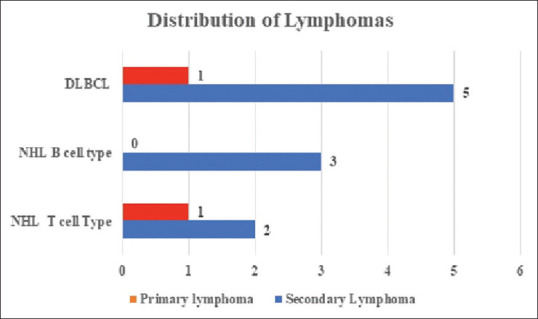
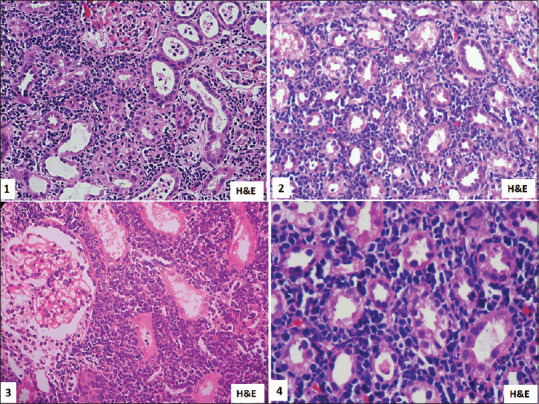
Results: The study included 12 patients with ages ranging from 4 to 50 years who presented with serum creatinine ranging 2.1-9.6 mg%. Renal biopsy findings showed interstitial lymphomatous infiltrate. Two cases were diagnosed as primary lymphoma and the other 10 as secondary lymphomas. Among the 12 cases, nine were B-cell non-Hodgkin lymphoma, of which diffuse large B-cell lymphoma was diagnosed in six (50%), low-grade B-cell type in two (16.6%), chronic lymphocytic leukemia in one (8.3%), and three were T-cell-type. Two were acute T-cell lymphoblastic lymphoma and one other was a high-grade T-cell lymphoma. Four patients succumbed. The other four patients are alive; one is on chemotherapy, while two of them are on hemodialysis.
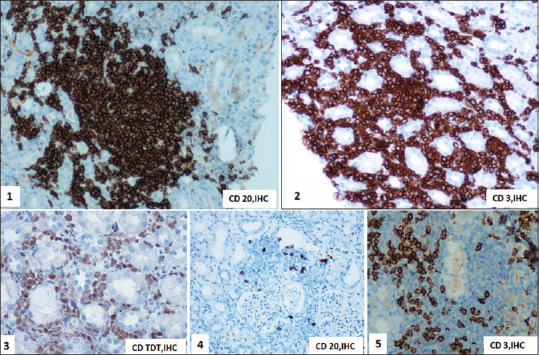
Conclusion: Acute kidney injury as a presenting feature with lymphomatous infiltration of renal parenchyma is not uncommon. The patchy involvement makes it challenging on kidney biopsy with definitive diagnosis being made with the help of immunohistochemistry. Appropriate multidisciplinary involvement improves patient outcome.
Keywords: Acute kidney injury; lymphomatous infiltrate; renal lymphoma.
Copyright: © Indian Journal of Nephrology.
Conflict of interest statement
There are no conflicts of interest.
Figures
Similar articles
-
Lymphomas diagnosed by percutaneous kidney biopsy.Am J Kidney Dis. 2003 Nov;42(5):960-71. doi: 10.1016/j.ajkd.2003.08.004. Am J Kidney Dis. 2003. PMID: 14582040 Review.
-
Spectrum of renal involvement in hematolymphoid neoplasms: Renal biopsy findings of 12 cases.Indian J Nephrol. 2015 Jul-Aug;25(4):201-5. doi: 10.4103/0971-4065.139093. Indian J Nephrol. 2015. PMID: 26199470 Free PMC article.
-
[Renal infiltrate by a plasmocytoïd chronic B lymphocytic leukaemia and renal failure: a rare occurrence in nephropathology. A case report and review of the literature].Nephrol Ther. 2011 Nov;7(6):479-87. doi: 10.1016/j.nephro.2011.02.001. Epub 2011 Mar 25. Nephrol Ther. 2011. PMID: 21439927 Review. French.
-
Lymphoblastic lymphoma presenting as bilateral renal enlargement diagnosed by percutaneous kidney biopsy: Report of three cases.Indian J Nephrol. 2016 Jul-Aug;26(4):298-301. doi: 10.4103/0971-4065.179368. Indian J Nephrol. 2016. PMID: 27512306 Free PMC article.
-
Renal Dysfunction in Patients With Direct Infiltration by B-Cell Lymphoma.Kidney Int Rep. 2019 Feb 12;4(5):688-697. doi: 10.1016/j.ekir.2019.02.008. eCollection 2019 May. Kidney Int Rep. 2019. PMID: 31080924 Free PMC article.
Cited by
-
Polycythemia secondary to bilaterally enlarged kidneys in T-Cell acute lymphoblastic leukemia: a case report and literature review.BMC Nephrol. 2025 Mar 6;26(1):121. doi: 10.1186/s12882-025-04032-3. BMC Nephrol. 2025. PMID: 40045259 Free PMC article. Review.
-
Case report: Acute kidney injury as the initial manifestation of chronic lymphocytic leukemia/small lymphocytic lymphoma.Front Med (Lausanne). 2023 Oct 20;10:1279005. doi: 10.3389/fmed.2023.1279005. eCollection 2023. Front Med (Lausanne). 2023. PMID: 37928472 Free PMC article.
References
LinkOut - more resources
Full Text Sources