


Is good more alike than bad? Positive-negative asymmetry in the differentiation between options. A study on the evaluation of fictitious political profiles
- PMID: 35967663
- PMCID: PMC9368193
- DOI: 10.3389/fpsyg.2022.923027
Is good more alike than bad? Positive-negative asymmetry in the differentiation between options. A study on the evaluation of fictitious political profiles
Abstract
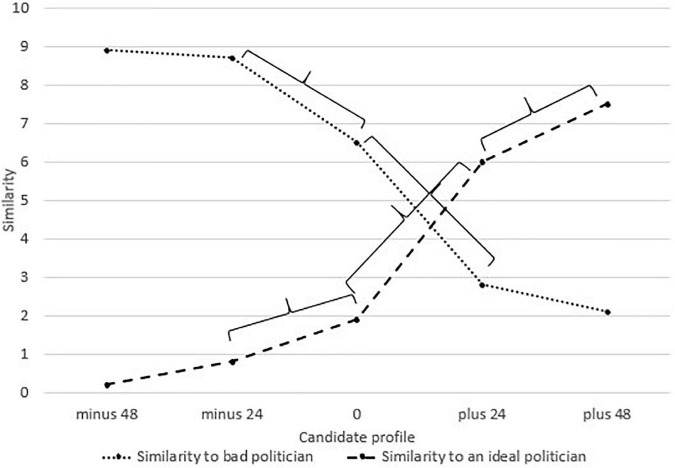
Our research focuses on the perception of difference in the evaluations of positive and negative options. The literature provides evidence for two opposite effects: on the one hand, negative objects are said to be more differentiated (e.g., density hypothesis), on the other, people are shown to see greater differences between positive options (e.g., liking-breeds-differentiation principle). In our study, we investigated the perception of difference between fictitious political candidates, hypothesizing greater differences among the evaluations of favorable candidates. Additionally, we analyzed how positive and negative information affect candidate evaluation, predicting further asymmetries. In three experiments, participants evaluated various candidate profiles presented in a numeric and narrative manner. The evaluation tasks were designed as individual or joint assessments. In all three studies, we found more differentiation between positive than negative options. Our research suggests that after exceeding a certain, relatively small level of negativity, people do not see any further increase in negativity. The increase in positivity, on the other hand, is more gradual, with greater differentiation among positive options. Our findings are discussed in light of cognitive-experiential self-theory and density hypothesis.
Keywords: candidate evaluation; negativity effect; object differentiation; positive-negative asymmetry; positive-negative asymmetry in social discrimination; similarity judgments.
Copyright © 2022 Jablonska, Falkowski and Mackiewicz.
Conflict of interest statement
The authors declare that the research was conducted in the absence of any commercial or financial relationships that could be construed as a potential conflict of interest.
Figures
References
-
- Alves H., Koch A. S., Unkelbach C. (2016). My friends are all alike – the relation between liking and perceived similarity in person perception. J. Exp. Soc. Psychol. 62 103–117. 10.1016/j.jesp.2015.10.011 - DOI
-
- American Psychological Association (2010). Ethical Principles of Psychologists and Code of Conduct. Washington, DC: American Psychological Association.
-
- Barker D. C. (2005). Values, frames, and persuasion in presidential nomination campaigns. Polit. Behav. 27 375–394. 10.1007/s11109-005-8145-4 - DOI
LinkOut - more resources
Full Text Sources
Research Materials
