


A Novel Osteoporosis Screening Protocol to Identify Orthopedic Surgery Patients for Preoperative Bone Health Optimization
- PMID: 35967749
- PMCID: PMC9364193
- DOI: 10.1177/21514593221116413
A Novel Osteoporosis Screening Protocol to Identify Orthopedic Surgery Patients for Preoperative Bone Health Optimization
Abstract
Introduction: Osteoporosis is highly prevalent in elective orthopedic surgery. While preoperative bone health optimization decreases osteoporosis-related complications, there is an unmet need to establish who may benefit from preoperative dual-energy x-ray absorptiometry (DXA). This study assesses a novel, simple screening protocol to identify orthopedic surgical patients for preoperative DXA.
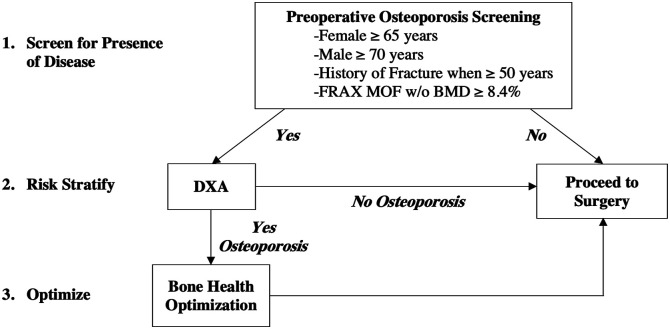
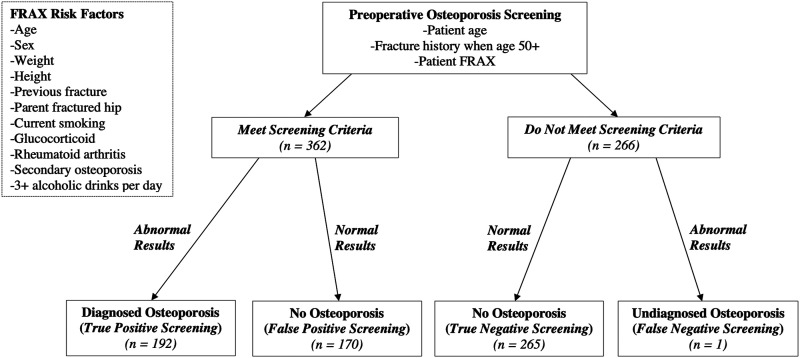
Materials/methods: This retrospective cohort study included 628 patients undergoing total knee, hip, or shoulder arthroplasty or thoracolumbar spine fusion. Inclusion criteria were ≥40 years undergoing primary elective surgery. Screening criteria defining who should obtain DXA due to high osteoporosis risk included: female ≥65, male ≥70, fracture history when ≥50 years, or FRAX major osteoporotic fracture risk (without bone mineral density [BMD]-adjustments) ≥8.4%. Osteoporosis was defined by World Health Organization criteria [T-score ≤ -2.5], clinical National Osteoporosis Foundation (NOF) criteria [T-score ≤ -2.5, elevated BMD-adjusted FRAX risk, or prior hip/spine fracture], and modified clinical criteria [NOF criteria simplified to include any non-traumatic prior fracture and FRAX without BMD].
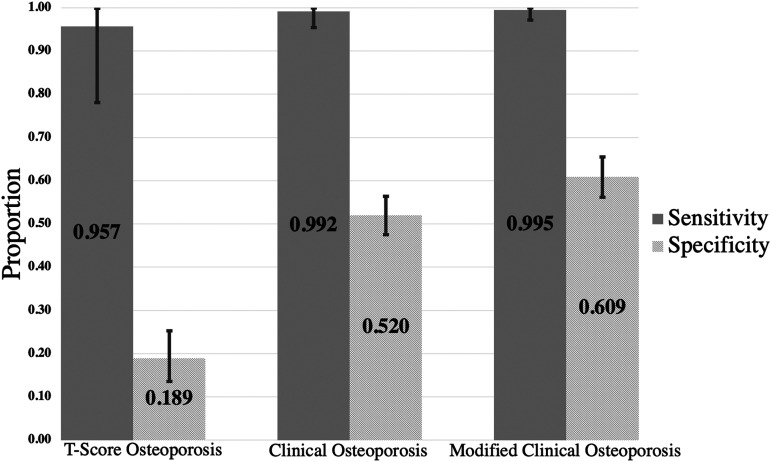
Results: The study included 100 TKAs, 100 THAs, 251 TSAs, and 177 spine fusions, average age 65.6 ± 9.8. DXA was available for 209 patients. Screening criteria recommending DXA was met by 362 patients. For those with DXA, screening sensitivity was .96 (CI: .78 to .99) and specificity was .19 (CI: .14 to .25) for identifying T-score osteoporosis. Similar sensitivity of .99 (CI: .91 to .99) and specificity of .61 (CI: .56 to .66) were found for modified clinical osteoporosis. For modified clinical osteoporosis, 192 patients with osteoporosis met criteria (true pos.), 1 patient with osteoporosis did not meet criteria (false neg.), 170 patients without osteoporosis met criteria (false pos.), and 265 patients without osteoporosis did not meet criteria (true neg.).
Discussion/conclusion: A simple screening protocol identifies orthopedic surgical candidates at risk of T-score or clinical osteoporosis for preoperative DXA with high sensitivity.
Keywords: adult reconstructive surgery; bone health optimization; bone health screening; bone mineral density; fragility fractures; metabolic bone disorders; osteoporosis; spine surgery.
© The Author(s) 2022.
Conflict of interest statement
Declaration of Conflicting Interests: The author(s) declared no potential conflicts of interest with respect to the research, authorship, and/or publication of this article.
Figures
References
-
- Maier GS, Kolbow K, Lazovic D, Maus U. The importance of bone mineral density in hip arthroplasty: Results of a survey asking orthopaedic surgeons about their opinions and attitudes concerning osteoporosis and hip arthroplasty. Advances in Orthopedics. 2016;2016:1-5. doi:10.1155/2016/8079354 - DOI - PMC - PubMed
LinkOut - more resources
Full Text Sources
Miscellaneous
