


Association between the mediterranean diet and cognitive health among healthy adults: A systematic review and meta-analysis
- PMID: 35967772
- PMCID: PMC9372716
- DOI: 10.3389/fnut.2022.946361
Association between the mediterranean diet and cognitive health among healthy adults: A systematic review and meta-analysis
Abstract
Background: An increasing prevalence of cognitive disorders warrants comprehensive systematic reviews on the effect of diet on cognitive health. Studies have suggested that the Mediterranean (MeDi) diet has protective effects against metabolic diseases. However, comprehensive systematic reviews on the effect of the MeDi diet on the cognitive decline are limited. We investigated whether adherence to the MeDi diet could lower the risk of the cognitive disorder or improve cognitive function in older adults.
Methods: In this systematic review and meta-analysis, PubMed, Web of Science, PsycINFO, Scopus, and Cochrane databases were searched from inception to June 2021. Cohort studies and randomized controlled trials (RCTs) were included. The effect sizes were estimated as log risk ratios and standard mean differences (SMDs) with 95% confidence intervals (CIs). The Newcastle-Ottawa score and Cochrane Collaboration's tool were used to assess the risk of bias in cohort studies and RCTs, respectively.
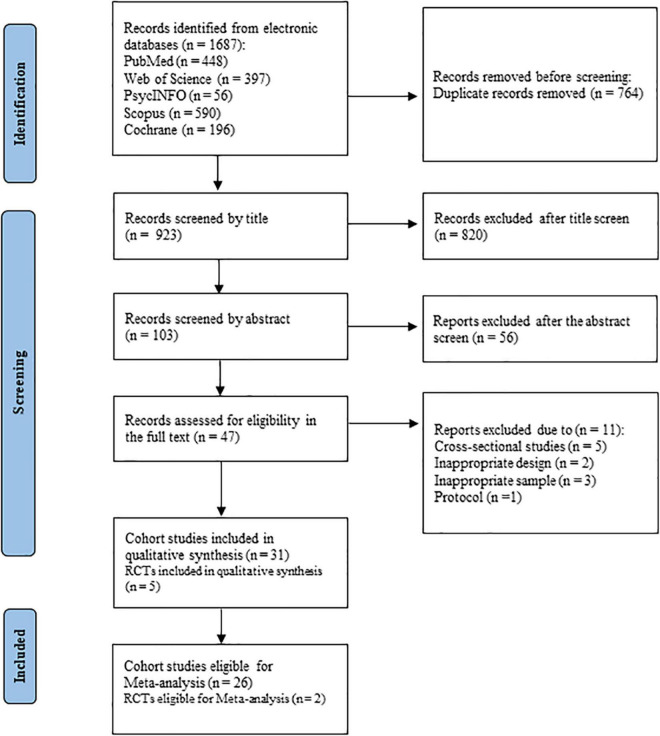
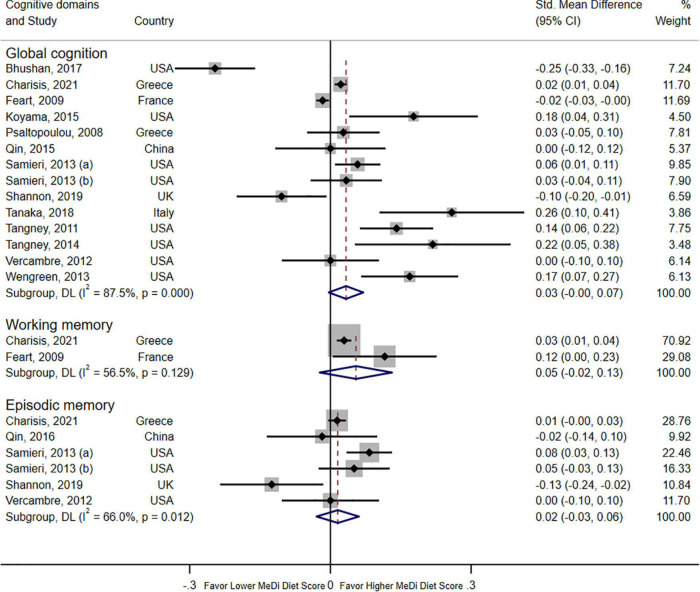
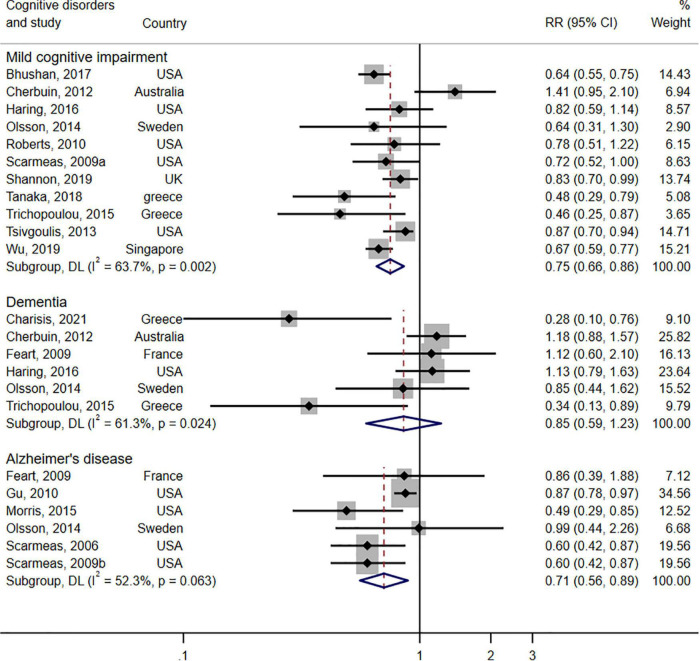
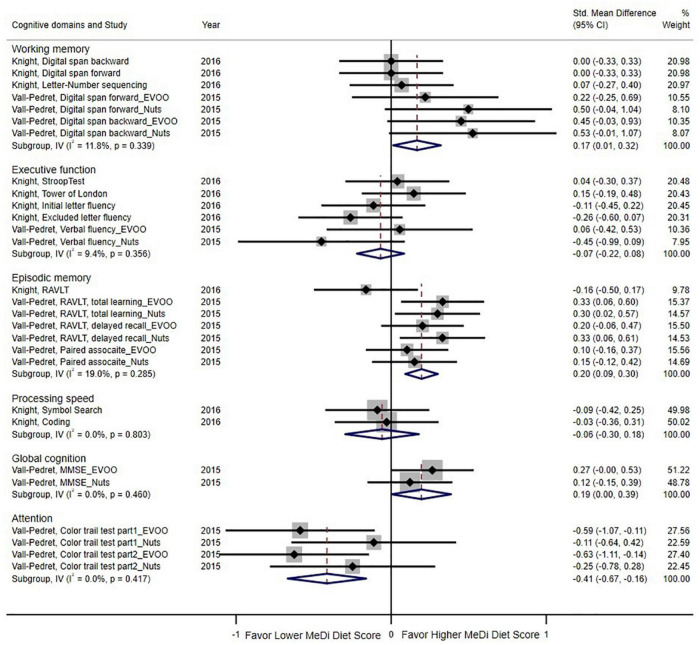
Results: Of the 1,687 screened studies, 31 cohort studies and five RCTs met the eligibility criteria for qualitative analysis; 26 cohort studies and two RCTs were included in the meta-analysis. In the cohort studies, high adherence to the MeDi diet was associated with lower risk of mild cognitive impairment (MCI) [risk ratio (RR) = 0.75 (0.66-0.86)], and Alzheimer's disease (AD) [RR = 0.71 (0.56-0.89)]. In the RCTs, high adherence to the MeDi diet was associated with better episodic [SMD = 0.20 (0.09-0.30)] and working memories [SMD = 0.17 (0.01-0.32)] than lowest group.
Conclusion: Adherence to the MeDi diet may reduce the risk of MCI and AD. However, other associations with cognitive outcomes (global cognition, working memory, and episodic memory) remain open to interpretation. Overall, the MeDi diet is recommended to prevent or delay cognitive disorders and improve cognitive function. Further, long-term RCTs are warranted to strengthen the evidence.
Systematic review registration: [https://www.crd.york.ac.uk], identifier [CRD42021276801].
Keywords: Alzheiemer’s disease; Mediterranean diet (MD); cognitive function; dementia; mild cognitive impairment.
Copyright © 2022 Fu, Tan, Lee and Shin.
Conflict of interest statement
The authors declare that the research was conducted in the absence of any commercial or financial relationships that could be construed as a potential conflict of interest.
Figures
References
-
- WHO. Dementia. (2021). Available online at: https://www.who.int/news-room/fact-sheets/detail/dementia (accessed November 29, 2021).
-
- Monica Moore M, Díaz-Santos M, Vossel K. Alzheimer’s disease facts and figures. Chicago, IL: Alzheimer’s Association; (2022).
Publication types
LinkOut - more resources
Full Text Sources
Miscellaneous
