


Integrative Model of Human-Animal Interactions: A One Health-One Welfare Systemic Approach to Studying HAI
- PMID: 35968006
- PMCID: PMC9372562
- DOI: 10.3389/fvets.2022.656833
Integrative Model of Human-Animal Interactions: A One Health-One Welfare Systemic Approach to Studying HAI
Abstract
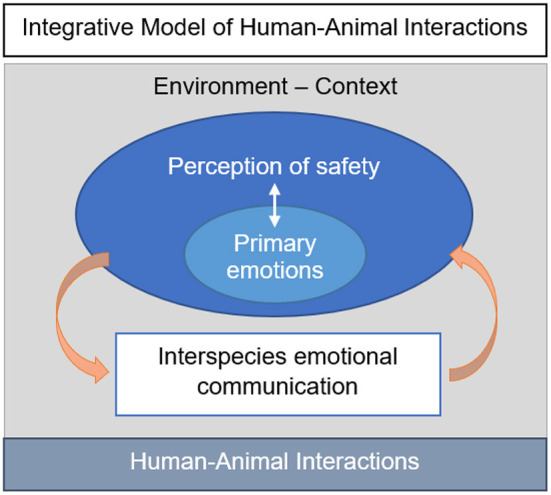
The Integrative Model of Human-Animal Interactions (IMHAI) described herewith provides a conceptual framework for the study of interspecies interactions and aims to model the primary emotional processes involved in human-animal interactions. This model was developed from theoretical inputs from three fundamental disciplines for understanding interspecies interactions: neuroscience, psychology and ethology, with the objective of providing a transdisciplinary approach on which field professionals and researchers can build and collaborate. Seminal works in affective neuroscience offer a common basis between humans and animals and, as such, can be applied to the study of interspecies interactions from a One Health-One Welfare perspective. On the one hand, Jaak Panksepp's research revealed that primary/basic emotions originate in the deep subcortical regions of the brain and are shared by all mammals, including humans. On the other hand, several works in the field of neuroscience show that the basic physiological state is largely determined by the perception of safety. Thus, emotional expression reflects the state of an individual's permanent adaptation to ever-changing environmental demands. Based on this evidence and over 5 years of action research using grounded theory, alternating between research and practice, the IMHAI proposes a systemic approach to the study of primary-process emotional affects during interspecies social interactions, through the processes of emotional transfer, embodied communication and interactive emotional regulation. IMHAI aims to generate new hypotheses and predictions on affective behavior and interspecies communication. Application of such a model should promote risk prevention and the establishment of positive links between humans and animals thereby contributing to their respective wellbeing.
Keywords: affective neuroscience; affects; animal welfare; behavior; emotions; feeling of safety; human-animal interactions (HAI); primary emotional systems.
Copyright © 2022 Leconstant and Spitz.
Conflict of interest statement
The authors declare that the research was conducted in the absence of any commercial or financial relationships that could be construed as a potential conflict of interest.
Figures
References
-
- Hosey G, Melfi V. Human-animal interactions, relationships and bonds: a review and analysis of the literature. Int J Comp Psychol. (2014) 27:117–42. 10.46867/ijcp.2014.27.01.01 - DOI
-
- Waiblinger S, Boivin X, Pedersen V, Tosi MV, Janczak AM, Visser EK, et al. Assessing the human-animal relationship in farmed species: a critical review. Appl Anim Behav Sci. (2006) 101:185–242. 10.1016/j.applanim.2006.02.001 - DOI
-
- Rodriguez KE, Guérin NA, Gabriels RL, Serpell JA, Schreiner PJ, O'Haire ME. The state of assessment in human-animal interaction research. Hum Anim Interact Bull. (2018) 6:63–81.
-
- Shoesmith E, Shahab L, Kale D, Mills DS, Reeve C, Toner P, et al. The influence of human-animal interactions on mental and physical health during the first COVID-19 lockdown phase in the UK: a qualitative exploration. Int J Environ Res Public Health. (2021) 18:976. 10.3390/ijerph18030976 - DOI - PMC - PubMed
-
- Wells DL. The state of research on human-animal relations: implications for human health. Anthrozoös. (2019) 32:169–81. 10.1080/08927936.2019.1569902 - DOI
LinkOut - more resources
Full Text Sources
