. 2022 Aug 11:2:101.
doi: 10.1038/s43856-022-00161-0. eCollection 2022.

Molecular epidemiology and antimicrobial resistance phenotype of paediatric bloodstream infections caused by Gram-negative bacteria

Affiliations

Molecular epidemiology and antimicrobial resistance phenotype of paediatric bloodstream infections caused by Gram-negative bacteria

Sam Lipworth et al. Commun Med (Lond). .

Abstract

Background: Gram-negative organisms are common causes of bloodstream infection (BSI) during the neonatal period and early childhood. Whilst several large studies have characterised these isolates in adults, equivalent data (particularly incorporating whole genome sequencing) is lacking in the paediatric population.

Methods: We perform an epidemiological and sequencing based analysis of Gram-negative bloodstream infections (327 isolates (296 successfully sequenced) from 287 patients) in children <18 years old between 2008 and 2018 in Oxfordshire, UK.

Results: Here we show that the burden of infection lies predominantly in neonates and that most infections are caused by Escherichia coli, Klebsiella spp. and Enterobacter hormaechei. There is no evidence in our setting that the proportion of antimicrobial resistant isolates is increasing in the paediatric population although we identify some evidence of sub-breakpoint increases in gentamicin resistance. The population structure of E. coli BSI isolates in neonates and children mirrors that in adults with a predominance of STs 131/95/73/69 and the same proportions of O-antigen serotypes. In most cases in our setting there is no evidence of transmission/point-source acquisition and we demonstrate the utility of whole genome sequencing to refute a previously suspected outbreak.

Conclusions: Our findings support continued use of current empirical treatment guidelines and suggest that O-antigen targeted vaccines may have a role in reducing the incidence of neonatal sepsis.

Keywords: Antimicrobial resistance; Diseases; Neonatal sepsis.


Conflict of interest statement

Competing interestsThe authors declare no competing interests

Figures
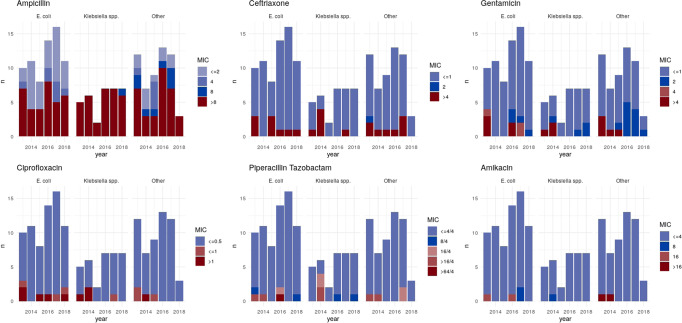
Fig. 1
Fig. 1. Change in minimum inhibitory concentrations (MIC) of isolates over time.
MIC is shown for each drug in mg/L.
Fig. 2
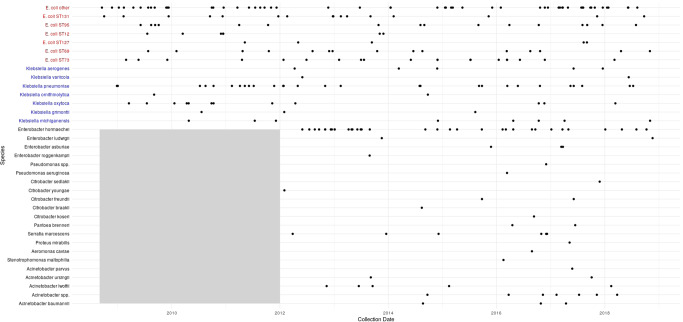
Fig. 2. Species (and sequence type, ST, where shown) for sequenced isolate over time.
Each point represents the isolation date of a sequenced isolate. The grey shaded area represents the fact that sequencing of non-E. coli/Klebsiella spp. isolates did not begin prior to 2012.
Fig. 3
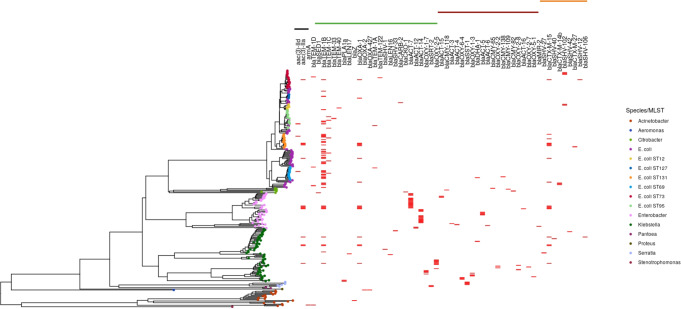
Fig. 3. Carriage of antimicrobial resistance genes by isolates sequenced in the study.
The tree was created using mashtree and gene presence is shown in red. The black/green/maroon/orange bars at the top represent the carriage of genes producing enzymes with activity (as predicted by Resfinder) against aminoglycosides/amoxicillin/cefotaxime (+amoxicillin)/ceftriaxone (+cefotaxime/amoxicillin) respectively.
Fig. 4
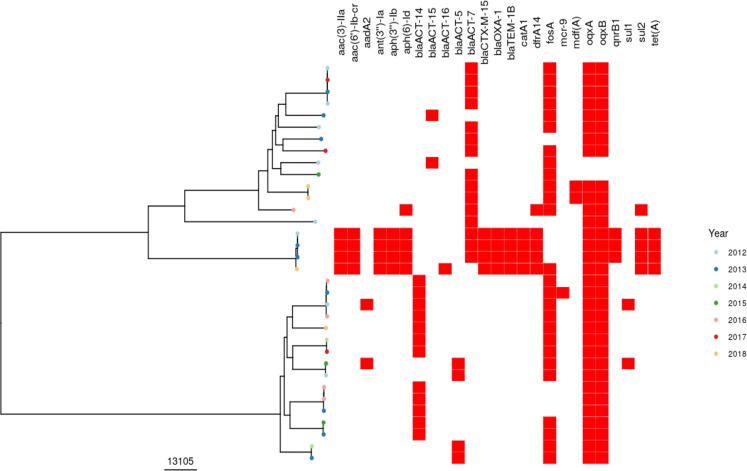
Fig. 4. Recombination-corrected phylogeny of Enterobacter hormaechei isolates sequenced in this study.
Tree tip colours show the year of isolates, red bars denote the presence/absence of antimicrobial-resistance genes. The scale of the tree is shown in SNPs.

References

    1. Malande OO, Nuttall J, Pillay V, Bamford C, Eley B. A ten-year review of ESBL and non-ESBL Escherichia coli bloodstream infections among children at a tertiary referral hospital in South Africa. PLoS ONE. 2019;14:e0222675. doi: 10.1371/journal.pone.0222675. - DOI - PMC - PubMed
    1. Powell EC, et al. Epidemiology of bacteremia in febrile infants aged 60 days and younger. Ann. Emerg. Med. 2018;71:211–216. doi: 10.1016/j.annemergmed.2017.07.488. - DOI - PMC - PubMed
    1. Shakur SM, Whitehall J, Mudgil P. Pediatric bloodstream infections in metropolitan Australia. World J. Pediatr. 2019;15:161–167. doi: 10.1007/s12519-018-00221-3. - DOI - PubMed
    1. Agyeman PKA, et al. Epidemiology of blood culture-proven bacterial sepsis in children in Switzerland: a population-based cohort study. Lancet Child Adolesc. Health. 2017;1:124–133. doi: 10.1016/S2352-4642(17)30010-X. - DOI - PubMed
    1. Stoll BJ, et al. Early-onset neonatal sepsis 2015 to 2017, the rise of Escherichia coli, and the need for novel prevention strategies. JAMA Pediatr. 2020;174:e200593. doi: 10.1001/jamapediatrics.2020.0593. - DOI - PMC - PubMed