


Assessing Canadian women's preferences for cervical cancer screening: A brief report
- PMID: 35968487
- PMCID: PMC9366717
- DOI: 10.3389/fpubh.2022.962039
Assessing Canadian women's preferences for cervical cancer screening: A brief report
Abstract
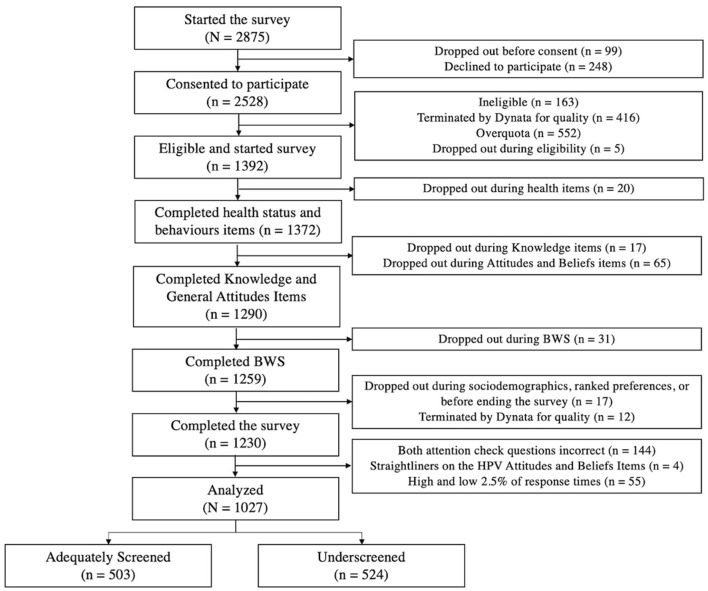
Human papillomavirus (HPV) testing is recommended for primary screening for cervical cancer by several health authorities. Several countries that have implemented HPV testing programs have encountered resistance against extended screening intervals and older age of initiation. As Canada prepares to implement HPV testing programs, it is important to understand women's preferences toward cervical cancer screening to ensure a smooth transition. The objective of this study was to assess Canadian women's current preferences toward cervical cancer screening. Using a web-based survey, we recruited underscreened ( > 3 years since last Pap test) and adequately screened (< 3 years since last Pap test) Canadian women aged 21-70 who were biologically female and had a cervix. We used Best-Worst Scaling (BWS) methodology to collect data on women's preferences for different screening methods, screening intervals, and ages of initiation. We used conditional logistic regression to estimate preferences in both subgroups. In both subgroups, women preferred screening every three years compared to every five or ten years, and initiating screening at age 21 compared to age 25 or 30. Adequately screened women (n = 503) most preferred co-testing, while underscreened women (n = 524) preferred both co-testing and HPV self-sampling over Pap testing. Regardless of screening status, women preferred shorter screening intervals, an earlier age of initiation, and co-testing. Adequate communication from public health authorities is needed to explain the extended screening intervals and age of initiation to prevent resistance against these changes to cervical cancer screening.
Keywords: Best-Worst Scaling; HPV test; cancer prevention; cervical cancer screening; cytology; human papillomavirus; women's preferences for cervical cancer screening.
Copyright © 2022 Zhu, Tatar, Haward, Griffin-Mathieu, Perez, Smith, Brotherton, Ogilvie and Rosberger.
Conflict of interest statement
JB's employer, the Australian Centre for the Prevention of Cervical Cancer, has received donated tests from HPV test manufacturers for research and validation studies. The remaining authors declares that the research was conducted in the absence of any commercial or financial relationships that could be construed as a potential conflict of interest.
References
-
- Canadian Cancer Society . Cervical Cancer Statistics (2022). Available online at: https://cancer.ca/en/cancer-information/cancer-types/cervical/statistics (accessed April 28, 2022).
-
- US Preventive Services Task Force . Cervical Cancer: Screening. Available online at: https://www.uspreventiveservicestaskforce.org/uspstf/recommendation/cerv...,combination%20with%20cytology%20(cotesting). (accessed April 28, 2022).
-
- Australian Government Department of Health . How Cervical Screening Works (2021). Available online at: https://www.health.gov.au/initiatives-and-programs/national-cervical-scr... (accessed April 28, 2022).
-
- World health Organization . Global Strategy to Accelerate the Elimination Of Cervical Cancer as a Public Health Problem (2020). Available online at: https://www.who.int/publications/i/item/9789240014107 (accessed April 28, 2022).
