


The intergenerational persistence of opioid dependence: Evidence from administrative data
- PMID: 35969540
- PMCID: PMC9804411
- DOI: 10.1002/hec.4589
The intergenerational persistence of opioid dependence: Evidence from administrative data
Abstract
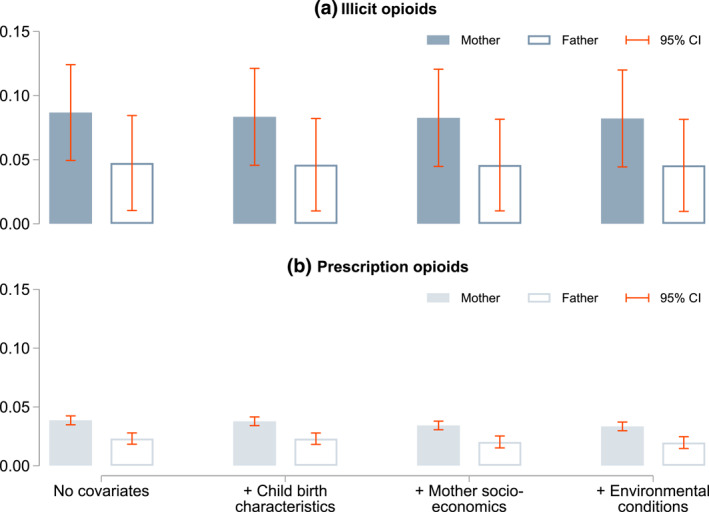
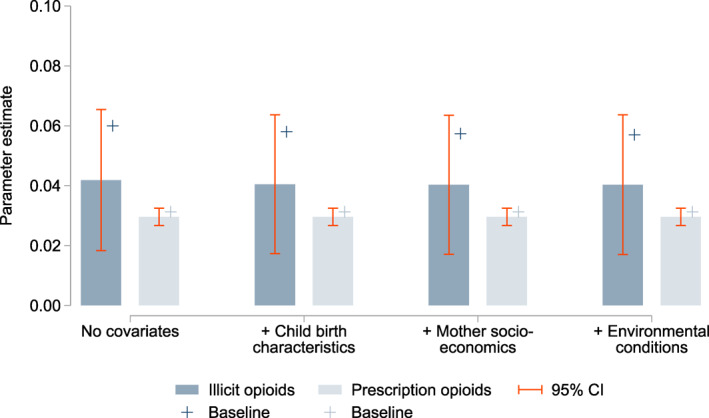
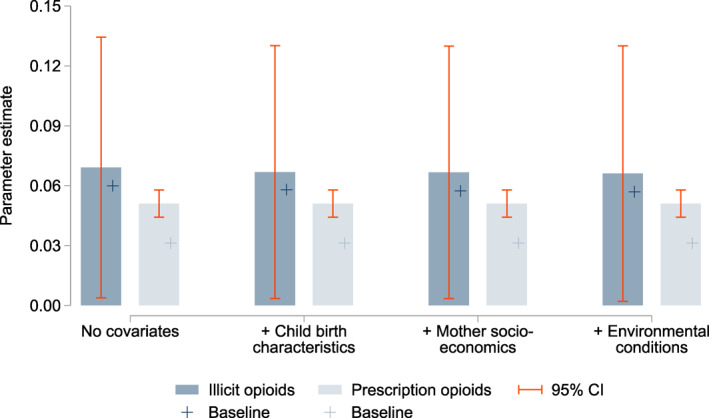
To address the opioid crisis, it is crucial to understand its origins. We provide descriptive evidence for the intergenerational persistence of opioid dependence. Our analysis is based on administrative data covering the universe of Austrian births from 1984 to 1990. We consider prescription opioids and a new proxy for addiction to illicit opioids. We find that, if at least one parent is using illicit opioids, the likelihood of the child using increases from 1% to 7%. For prescription opioids, we observe an increase from 3.6% to 6.7%. Both associations are stable and do not change when controlling for environmental variables.
Keywords: addiction; drug abuse; heroin; illicit opioids; intergenerational correlation; intergenerational transmission; opioids; prescription opioids.
© 2022 The Authors. Health Economics published by John Wiley & Sons Ltd.
Conflict of interest statement
The authors declare no conflict of interest.
Figures

References
-
- Ahammer, A. , Wiesinger, R. , & Zocher, K. (2021). The Austrian Healthcare System: Changes and challenges. In Baltagi B. H. & Moscone F. (Eds.), Contributions to economic analysis (pp. 153–166). Emerald Publishing Limited.
-
- Beckett, K. , Nyrop, K. , & Pfingst, L. (2006). Race, drugs, and policing: Understanding disparities in drug delivery arrests. Criminology, 44(1), 105–137. 10.1111/j.1745-9125.2006.00044.x - DOI
-
- Bhuller, M. , Dahl, G. B. , Loken, K. V. , & Mogstad, M. (2018). Intergenerational effects of incarceration. AEA Papers and Proceedings, 108, 234–240. 10.1257/pandp.20181005 - DOI
Publication types
MeSH terms
Substances
LinkOut - more resources
Full Text Sources
Medical
