


The effectiveness of COVID-19 testing and contact tracing in a US city
- PMID: 35969766
- PMCID: PMC9407477
- DOI: 10.1073/pnas.2200652119
The effectiveness of COVID-19 testing and contact tracing in a US city
Abstract
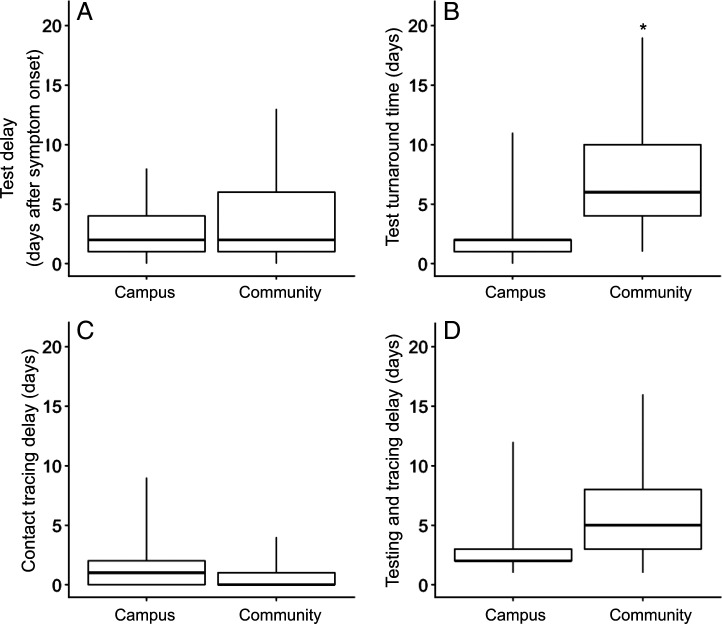
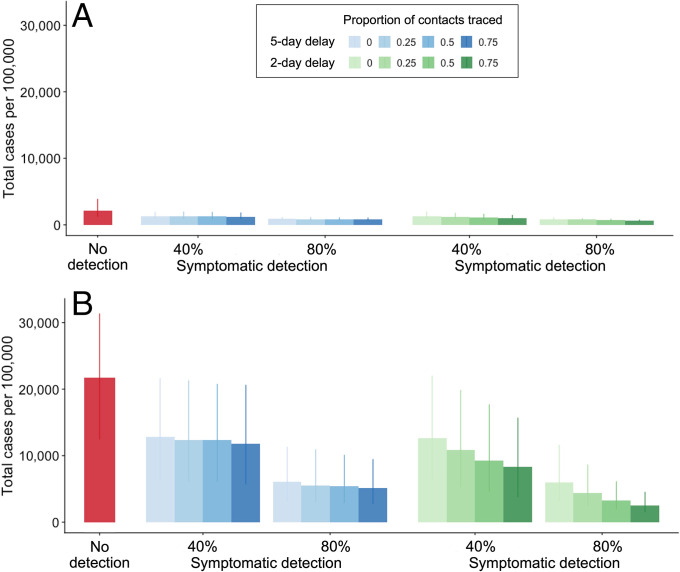
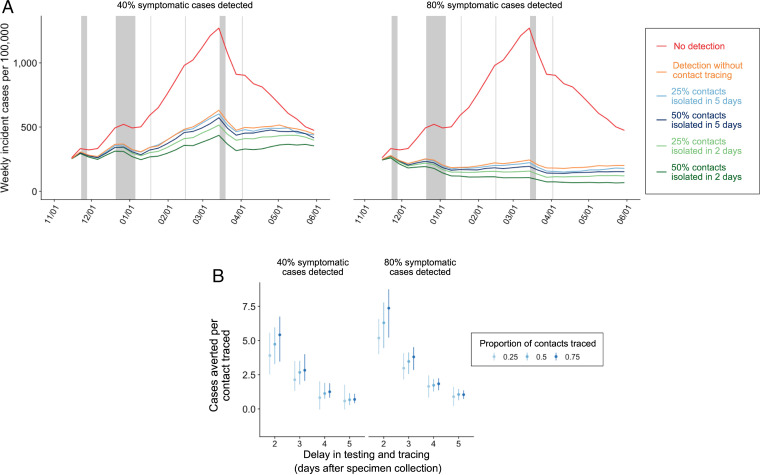
Although testing, contact tracing, and case isolation programs can mitigate COVID-19 transmission and allow the relaxation of social distancing measures, few countries worldwide have succeeded in scaling such efforts to levels that suppress spread. The efficacy of test-trace-isolate likely depends on the speed and extent of follow-up and the prevalence of SARS-CoV-2 in the community. Here, we use a granular model of COVID-19 transmission to estimate the public health impacts of test-trace-isolate programs across a range of programmatic and epidemiological scenarios, based on testing and contact tracing data collected on a university campus and surrounding community in Austin, TX, between October 1, 2020, and January 1, 2021. The median time between specimen collection from a symptomatic case and quarantine of a traced contact was 2 days (interquartile range [IQR]: 2 to 3) on campus and 5 days (IQR: 3 to 8) in the community. Assuming a reproduction number of 1.2, we found that detection of 40% of all symptomatic cases followed by isolation is expected to avert 39% (IQR: 30% to 45%) of COVID-19 cases. Contact tracing is expected to increase the cases averted to 53% (IQR: 42% to 58%) or 40% (32% to 47%), assuming the 2- and 5-day delays estimated on campus and in the community, respectively. In a tracing-accelerated scenario, in which 75% of contacts are notified the day after specimen collection, cases averted increase to 68% (IQR: 55% to 72%). An accelerated contact tracing program leveraging rapid testing and electronic reporting of test results can significantly curtail local COVID-19 transmission.
Keywords: COVID-19; COVID-19 testing; contact tracing; mathematical model; pandemic.
Conflict of interest statement
The authors declare no competing interest.
Figures
References
-
- Wan W., WHO declares a pandemic of coronavirus disease covid-19. The Washington Post, 11 March 2020. https://www.washingtonpost.com/health/2020/03/11/who-declares-pandemic-c.... Accessed 25 March 2020.
-
- World Health Organization, WHO Coronavirus (COVID-19) Dashboard. https://covid19.who.int/. Accessed 30 August 2021.
-
- MITRE Corporation, COVID-19 Healthcare Coalition. https://c19hcc.org/. Accessed 9 December 2020.
-
- Galea S., Merchant R. M., Lurie N., The mental health consequences of COVID-19 and physical distancing: The need for prevention and early intervention. JAMA Intern. Med. 180, 817–818 (2020). - PubMed
Publication types
MeSH terms
Grants and funding
LinkOut - more resources
Full Text Sources
Medical
Miscellaneous
