


The accuracy of pulse oximetry in measuring oxygen saturation by levels of skin pigmentation: a systematic review and meta-analysis
- PMID: 35971142
- PMCID: PMC9377806
- DOI: 10.1186/s12916-022-02452-8
The accuracy of pulse oximetry in measuring oxygen saturation by levels of skin pigmentation: a systematic review and meta-analysis
Abstract
Background: During the COVID-19 pandemic, there have been concerns regarding potential bias in pulse oximetry measurements for people with high levels of skin pigmentation. We systematically reviewed the effects of skin pigmentation on the accuracy of oxygen saturation measurement by pulse oximetry (SpO2) compared with the gold standard SaO2 measured by CO-oximetry.
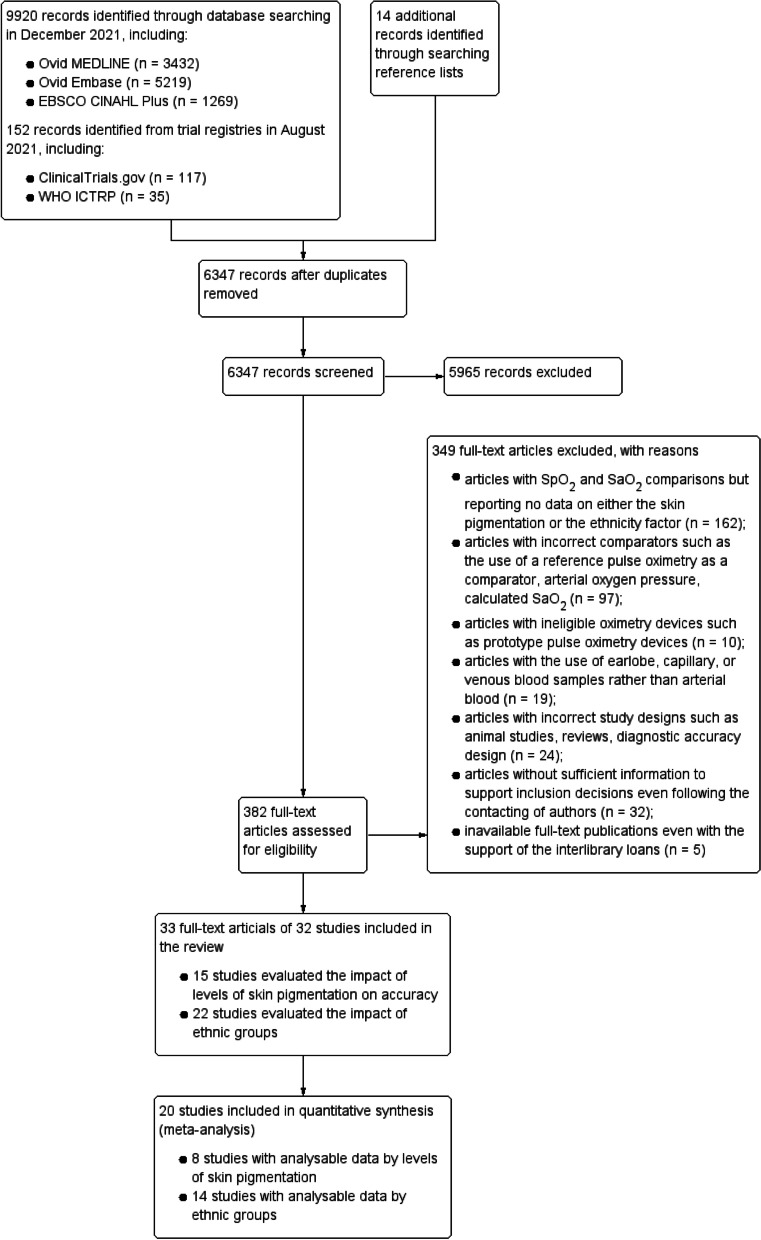
Methods: We searched Ovid MEDLINE, Ovid Embase, EBSCO CINAHL, ClinicalTrials.gov, and WHO International Clinical Trials Registry Platform (up to December 2021) for studies with SpO2-SaO2 comparisons and measuring the impact of skin pigmentation or ethnicity on pulse oximetry accuracy. We performed meta-analyses for mean bias (the primary outcome in this review) and its standard deviations (SDs) across studies included for each subgroup of skin pigmentation and ethnicity and used these pooled mean biases and SDs to calculate accuracy root-mean-square (Arms) and 95% limits of agreement. The review was registered with the Open Science Framework ( https://osf.io/gm7ty ).
Results: We included 32 studies (6505 participants): 15 measured skin pigmentation and 22 referred to ethnicity. Compared with standard SaO2 measurement, pulse oximetry probably overestimates oxygen saturation in people with the high level of skin pigmentation (pooled mean bias 1.11%; 95% confidence interval 0.29 to 1.93%) and people described as Black/African American (1.52%; 0.95 to 2.09%) (moderate- and low-certainty evidence). The bias of pulse oximetry measurements for people with other levels of skin pigmentation or those from other ethnic groups is either more uncertain or suggests no overestimation. Whilst the extent of mean bias is small or negligible for all subgroups evaluated, the associated imprecision is unacceptably large (pooled SDs > 1%). When the extent of measurement bias and precision is considered jointly, pulse oximetry measurements for all the subgroups appear acceptably accurate (with Arms < 4%).
Conclusions: Pulse oximetry may overestimate oxygen saturation in people with high levels of skin pigmentation and people whose ethnicity is reported as Black/African American, compared with SaO2. The extent of overestimation may be small in hospital settings but unknown in community settings. REVIEW PROTOCOL REGISTRATION: https://osf.io/gm7ty.
Keywords: Arterial blood oxygen saturation; Ethnicity; Measurement bias; Pulse oximetry; Skin pigmentation; Systematic review.
© 2022. The Author(s).
Conflict of interest statement
NC reports research grants from the National Institute for Health Research and the Accelerated Access Collaborative at NHS England and NHS Improvement and payments were made to the University of Manchester. PD is the National Deputy Medical Director, NIHR Clinical Research Network Coordinating Centre, UK, developing and delivering clinical research in the subject area and contributing to developing and implementing NIHR’s Equality, Diversity and Inclusion strategy. All other authors have declared that no competing interests exist.
Figures

References
-
- NHS England. COVID Oximetry@home. 2022. https://www.england.nhs.uk/nhs-at-home/covid-oximetry-at-home/. Accessed 21 Apr 2022.
-
- World Health Organization (WHO). COVID-19 clinical management: living guideline (updated 25.1.21). 2021. https://apps.who.int/iris/handle/10665/338882. Accessed 21 Apr 2022.
-
- The Royal Australian College of General Practitioners . Managing COVID-19 at home with assistance from your general practice: a guide, action plan and symptom diary for patients. East Melbourne: RACGP; 2021.
Publication types
MeSH terms
Substances
Grants and funding
LinkOut - more resources
Full Text Sources
Medical
