The EICAT+ framework enables classification of positive impacts of alien taxa on native biodiversity
- PMID: 35972940
- PMCID: PMC9380921
- DOI: 10.1371/journal.pbio.3001729
The EICAT+ framework enables classification of positive impacts of alien taxa on native biodiversity
Abstract
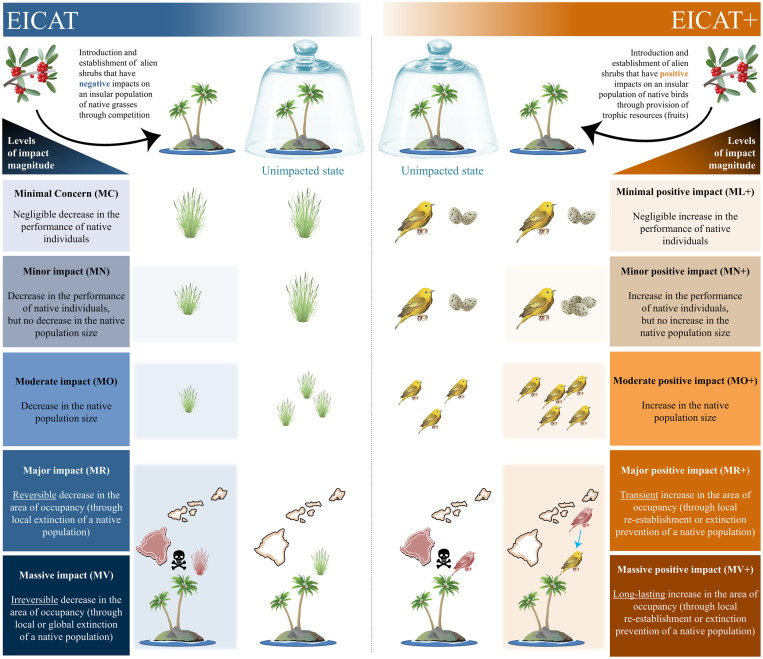
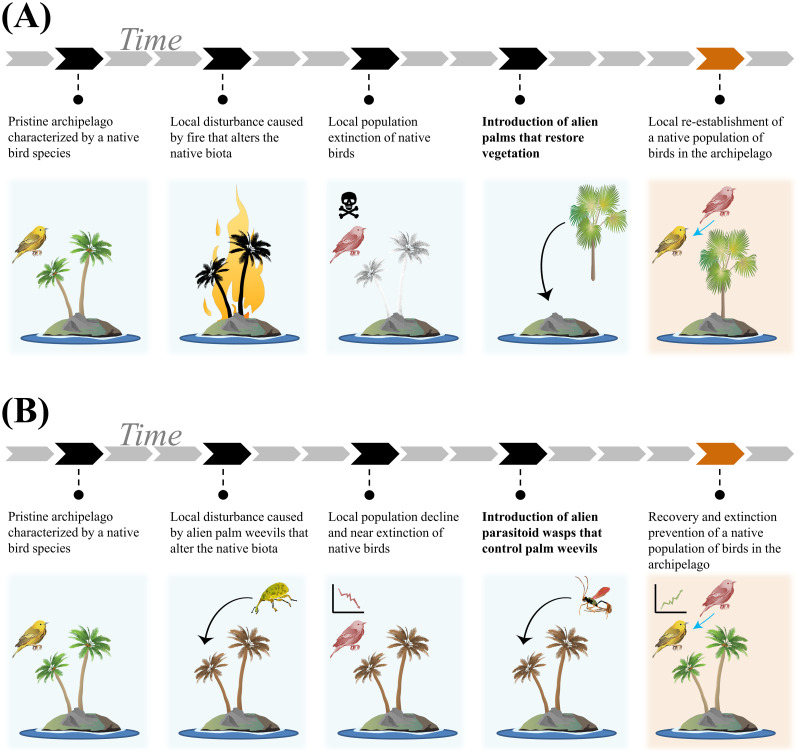
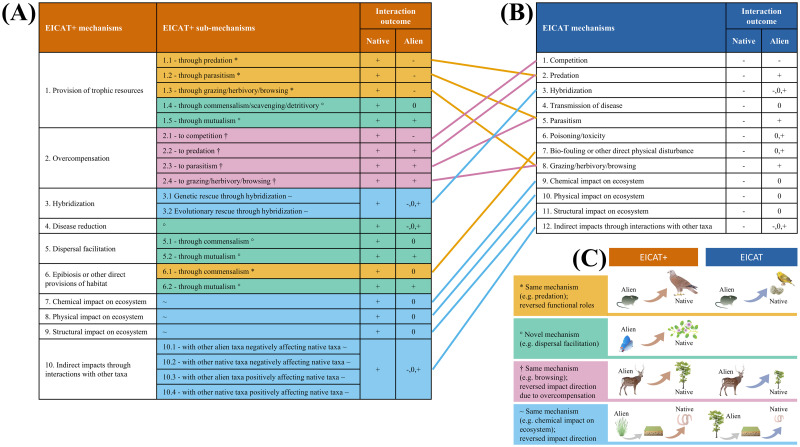
Species introduced through human-related activities beyond their native range, termed alien species, have various impacts worldwide. The IUCN Environmental Impact Classification for Alien Taxa (EICAT) is a global standard to assess negative impacts of alien species on native biodiversity. Alien species can also positively affect biodiversity (for instance, through food and habitat provisioning or dispersal facilitation) but there is currently no standardized and evidence-based system to classify positive impacts. We fill this gap by proposing EICAT+, which uses 5 semiquantitative scenarios to categorize the magnitude of positive impacts, and describes underlying mechanisms. EICAT+ can be applied to all alien taxa at different spatial and organizational scales. The application of EICAT+ expands our understanding of the consequences of biological invasions and can inform conservation decisions.
Conflict of interest statement
The authors have declared that no competing interests exist.
Figures
References
-
- Vitousek PM, Mooney HA, Lubchenco J, Melillo JM. Human Domination of Earth’s Ecosystems. Science. 1997;277:494–499. doi: 10.1126/science.277.5325.494 - DOI
-
- Ricciardi A, Hoopes MF, Marchetti MP, Lockwood JL. Progress toward understanding the ecological impacts of nonnative species. Ecol Monogr. 2013;83:263–282. doi: 10.1890/13-0183.1 - DOI
-
- Katsanevakis S, Wallentinus I, Zenetos A, Leppäkoski E, Çinar ME, Oztürk B, et al. Impacts of invasive alien marine species on ecosystem services and biodiversity: A pan-European review. Aquat Invasions. 2014;9:391–423. doi: 10.3391/ai.2014.9.4.01 - DOI
Publication types
MeSH terms
Grants and funding
LinkOut - more resources
Full Text Sources
Miscellaneous