. 2022 Aug 16;20(8):e3001729.
doi: 10.1371/journal.pbio.3001729. eCollection 2022 Aug.

The EICAT+ framework enables classification of positive impacts of alien taxa on native biodiversity

Affiliations

The EICAT+ framework enables classification of positive impacts of alien taxa on native biodiversity

Giovanni Vimercati et al. PLoS Biol. .

Abstract

Species introduced through human-related activities beyond their native range, termed alien species, have various impacts worldwide. The IUCN Environmental Impact Classification for Alien Taxa (EICAT) is a global standard to assess negative impacts of alien species on native biodiversity. Alien species can also positively affect biodiversity (for instance, through food and habitat provisioning or dispersal facilitation) but there is currently no standardized and evidence-based system to classify positive impacts. We fill this gap by proposing EICAT+, which uses 5 semiquantitative scenarios to categorize the magnitude of positive impacts, and describes underlying mechanisms. EICAT+ can be applied to all alien taxa at different spatial and organizational scales. The application of EICAT+ expands our understanding of the consequences of biological invasions and can inform conservation decisions.


Conflict of interest statement

The authors have declared that no competing interests exist.

Figures
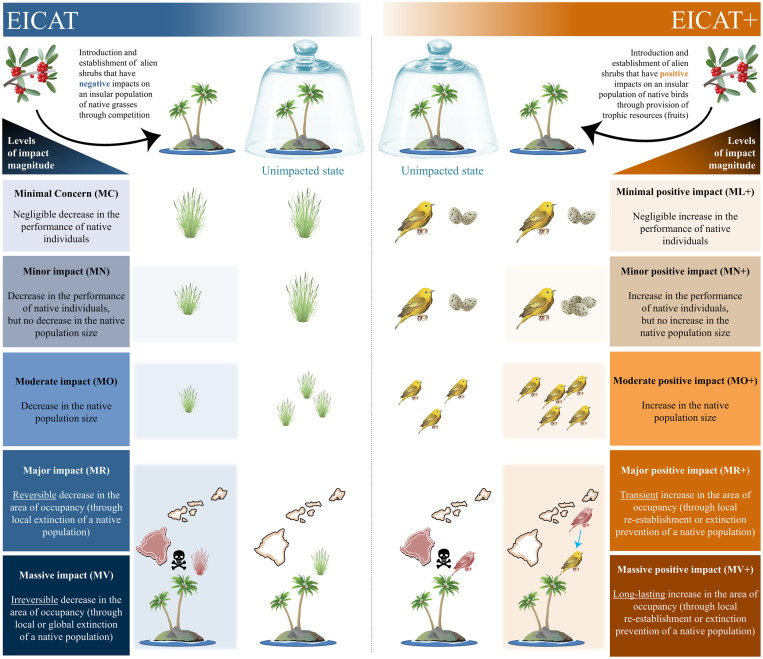
Fig 1
Fig 1. Illustration of EICAT and EICAT+ scenarios.
Conceptual scheme for the 5 semiquantitative scenarios used in EICAT and EICAT+ to assess negative impacts (on the left) and positive impacts (on the right) caused by a focal alien taxon (here, a shrub species) on native taxa of interest (a grass species and a bird species). Black arrows indicate the introduction and establishment of the alien taxon into a recipient ecosystem. The blue arrow indicates the reestablishment or extinction prevention of a native taxon due to an alien taxon (see also Fig 2). Shaded red figures indicate locations unoccupied by the native taxon (e.g., because of local extinctions in EICAT). Symbols were courtesy of the Integration and Application Network, University of Maryland Center for Environmental Science (ian.umces.edu/media-library).
Fig 2
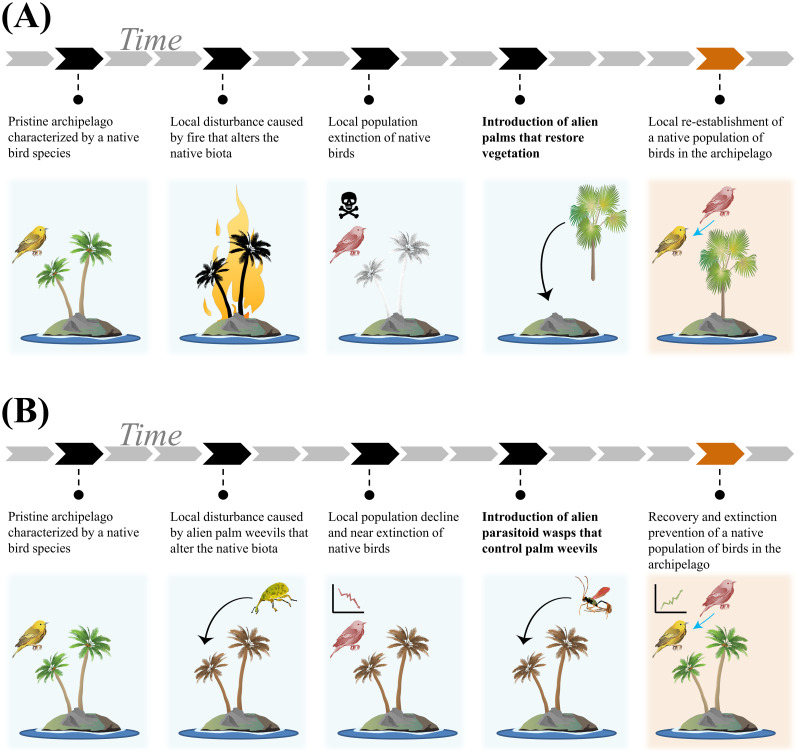
Fig 2. Examples of Major positive impacts under EICAT+.
Hypothetical examples of Major positive impacts (MR+) caused by an alien palm (A) and an alien parasitoid wasp (B) on a local population of a native bird species (taxon of interest) on an archipelago. (A) The alien palm causes the local reestablishment of the native bird species, e.g., via natural dispersal of birds across the archipelago. (B) The alien parasitoid wasp acts as a classical biocontrol agent against alien palm weevils and prevents the extinction of the bird population. Note that under EICAT+, the impact is classified as Major regardless of whether the palm weevil is alien or native (see also submechanisms 10.1 and 10.2 in Fig 3), as the indirect positive impact is caused by an alien taxon (the parasitoid wasp). Since it can be assumed that the newly established population (A) or the recovered population (B) would not persist if the alien taxon causing the positive impact was no longer present on the island, the impacts should not be classified as Massive (MV+), i.e., the alien palm or wasp must continue to be present on the island for the native bird species to survive. Black arrows indicate introduction and establishment of alien taxa into a recipient ecosystem. Blue arrows indicate the reestablishment (A) and extinction prevention (B) of a native taxon due to an alien taxon. Symbols were courtesy of the Integration and Application Network, University of Maryland Center for Environmental Science (ian.umces.edu/media-library).
Fig 3
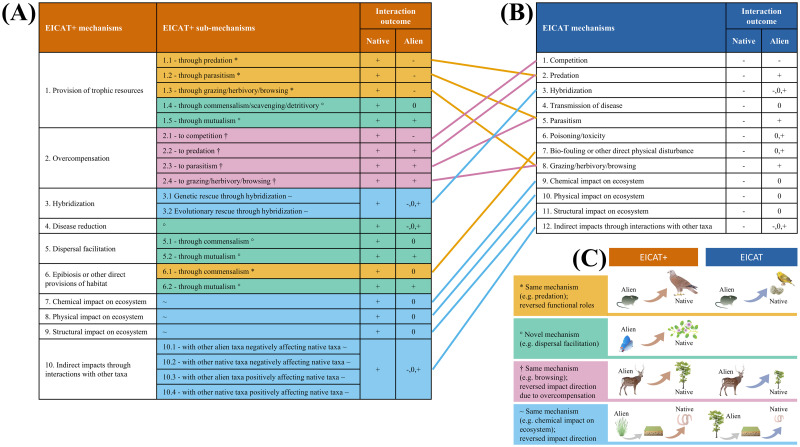
Fig 3. EICAT+ and EICAT mechanisms and submechanisms.
List of EICAT+ mechanisms and submechanisms (A) and EICAT mechanisms (B). EICAT+ and EICAT mechanisms and submechanisms are also compared to each other (C) based on the outcome of the interaction for native and alien taxa. Colors of rows and connecting lines reflect different rationales behind the formulation of the EICAT+ mechanisms and submechanisms, with the different colors and symbols that indicate [yellow and asterisks “*”] mechanisms present in both EICAT+ and EICAT but in which the functional roles of alien and native taxa are reversed (e.g., in EICAT+, the alien taxon is the prey, whereas in EICAT, the alien is the predator); [green and degree signs “°”] mechanisms that are unique to EICAT+ (e.g., dispersal facilitation through pollination); [pink and daggers “†”] mechanisms present in both EICAT+ and EICAT but in which impact direction is reversed because of overcompensation (e.g., in EICAT+, the alien taxon increases growth of the native taxon through browsing-mediated overcompensation, whereas in EICAT, the alien taxon decreases growth of the native taxon through browsing; [blue and tildes “~”] mechanisms present in both EICAT+ and EICAT but in which impact direction is reversed (e.g., in EICAT, the alien taxon decreases a biodiversity attribute by impacting the chemistry of the ecosystem, and in EICAT+, the alien taxon increases a biodiversity attribute by impacting the chemistry of the ecosystem). The symbols +, −, 0 indicate positive, negative, and neutral outcomes of interactions between a native and an alien taxon. In C, arrows indicate impacts of an alien to a native taxon (orange arrow: positive impact; blue arrow: negative impact). Symbols were courtesy of the Integration and Application Network, University of Maryland Center for Environmental Science (ian.umces.edu/media-library).

References

    1. Vitousek PM, Mooney HA, Lubchenco J, Melillo JM. Human Domination of Earth’s Ecosystems. Science. 1997;277:494–499. doi: 10.1126/science.277.5325.494 - DOI
    1. Ricciardi A. Are modern biological invasions an unprecedented form of global change? Conserv Biol. 2007;21:329–336. doi: 10.1111/j.1523-1739.2006.00615.x - DOI - PubMed
    1. Ricciardi A, Hoopes MF, Marchetti MP, Lockwood JL. Progress toward understanding the ecological impacts of nonnative species. Ecol Monogr. 2013;83:263–282. doi: 10.1890/13-0183.1 - DOI
    1. Jeschke JM, Bacher S, Blackburn TM, Dick JTA, Essl F, Evans T, et al. Defining the impact of non-native species. Conserv Biol. 2014;28:1188–1194. doi: 10.1111/cobi.12299 - DOI - PMC - PubMed
    1. Katsanevakis S, Wallentinus I, Zenetos A, Leppäkoski E, Çinar ME, Oztürk B, et al. Impacts of invasive alien marine species on ecosystem services and biodiversity: A pan-European review. Aquat Invasions. 2014;9:391–423. doi: 10.3391/ai.2014.9.4.01 - DOI

Publication types