


doi: 10.1021/acs.jpcb.2c04614.
Epub 2022 Aug 16.
Early Stages of RNA-Mediated Conversion of Human Prions
Affiliations
- PMID: 35973105
- PMCID: PMC9420815
- DOI: 10.1021/acs.jpcb.2c04614
Item in Clipboard
Early Stages of RNA-Mediated Conversion of Human Prions
J Phys Chem B.
.
Abstract
Prion diseases are characterized by the conversion of prion proteins from a PrPC fold into a disease-causing PrPSC form that is self-replicating. A possible agent to trigger this conversion is polyadenosine RNA, but both mechanism and pathways of the conversion are poorly understood. Using coarse-grained molecular dynamic simulations we study the time evolution of PrPC over 600 μs. We find that both the D178N mutation and interacting with polyadenosine RNA reduce the helicity of the protein and encourage formation of segments with strand-like motifs. We conjecture that these transient β-strands nucleate the conversion of the protein to the scrapie conformation PrPSC.
Figures
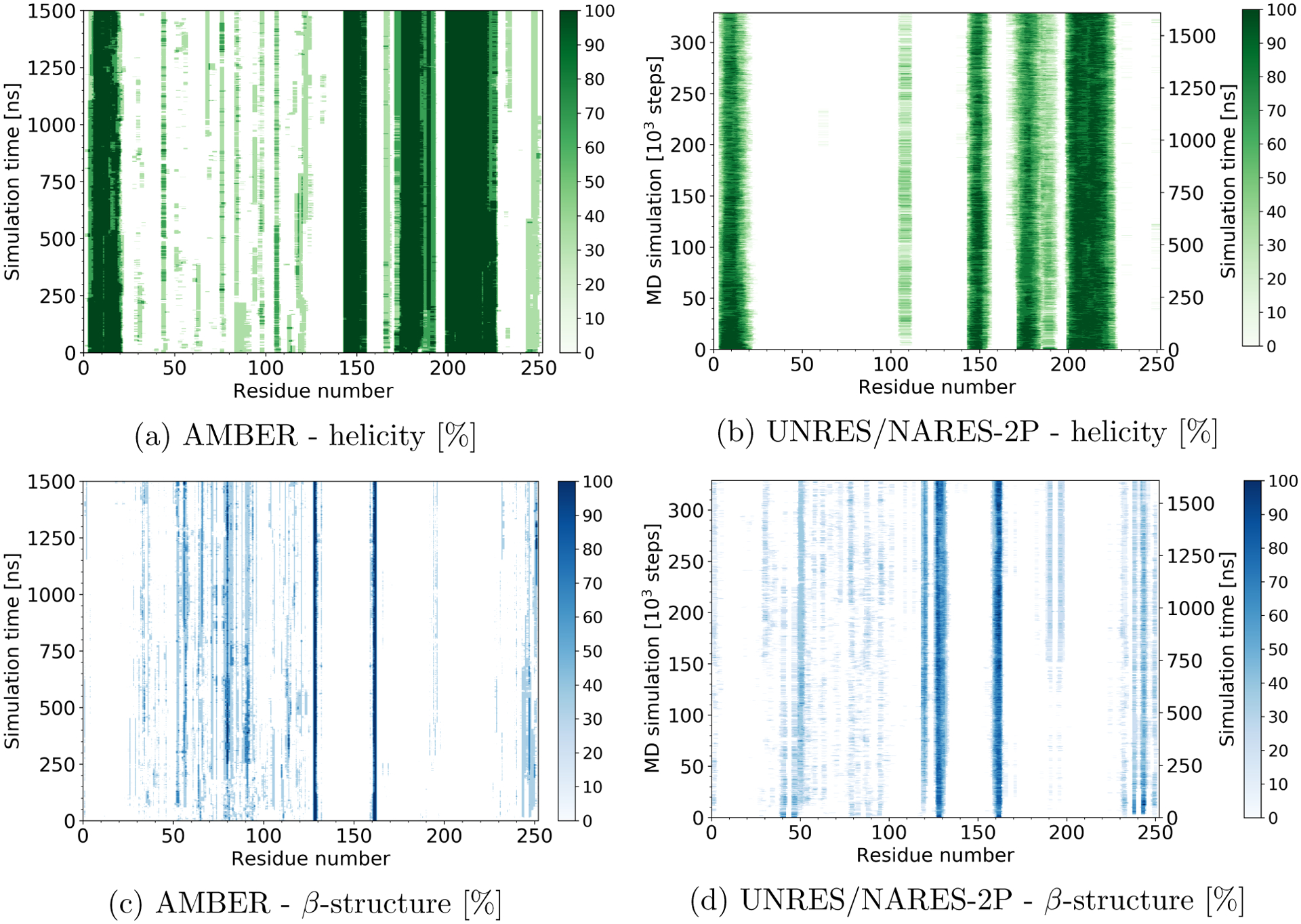
Time evolution of secondary structure as measured for the 129M-178D prion-RNA complex secondary structure in all-atom (AMBER) simulations (a and c), and in coarse-grained (UNRES) (b and d) simulations. The helical fragments are marked in green colors (a and b), and the β-strands in blue (c and d). The colors intensity corresponds to the frequency of occurrence of the secondary structure. All trajectories start with RNA bound to the binding site 3 of the wild type 129M-178D prion.

Average number of contacts between prion and RNA, measured for the last 120 μs of the 600 μs and averaged over all eight trajectories of the corresponding systems. The error bars represent the standard deviation of the average.

Frequency of contacts with the poly-A-RNA fragment for residue of the four prion systems, the two wild type variants : a) 129M-178D and b) 129V-178D; and the two mutants c) 129V-178N and d) 129M-178N. The contact frequency is show as percentage and calculated over the last 120 μs, averaged over all eight trajectories for each system.

The loss of total helicity of the prion in regard to the start configuration, as measured for each system for the last 120 μs and average over eight trajectories. The total helicity is calculated for the C-terminal domain (residues 121 to 253). The error bars represent the standard deviation.

Root-mean-square-fluctuation (RMSF) measured over the last 120 μs and averaged over eight trajectories, for residue of the four prion systems, the two wild type variants: a) 129M-178D and b) 129V-178D; and the two mutants: c) 129V-178N and d) 129M-178N.

The final structure of the 129M-178N prion-RNA complex for trajectory 2. The prion chain is colored from blue to red from the N- to the C-terminus, respectively, except for helix B, which is dark grey. There is a partial unwinding of helix B in its C-terminal part, caused by the interactions with RNA molecule (shown in magnification). The RNA molecule is drawn in brown. The picture was made using Mol*.

RMSF values measured for residues in control simulations of the prion proteins: 129M-178D and 129V-178D wild type variants, and the mutants: 129V-178N and 129M-178N, measured for the last 120 μs, average over all trajectories.
References
-
- Bremer J; Baumann F; Tiberi C; Wessig C; Fischer H; Schwarz P; Steele A; Toyka K; Nave K-A; Weis J et al. Axonal prion protein is required for peripheral myelin maintenance. Nat. Neurosci 2010, 13, 310–318. - PubMed
-
- Sáa P; Harris DA; Cervenakova L Mechanisms of prion-induced neurodegeneration. Expert Rev. Mol. Med 2016, 18, e5. - PubMed
Publication types
MeSH terms
Substances
Grants and funding
LinkOut - more resources
Full Text Sources
Research Materials
