Predictors of increase in chronicity index and of kidney function impairment at repeat biopsy in lupus nephritis
- PMID: 35973744
- PMCID: PMC9386217
- DOI: 10.1136/lupus-2022-000721
Predictors of increase in chronicity index and of kidney function impairment at repeat biopsy in lupus nephritis
Abstract
Objectives: Based on available data, the histological predictors of long-term outcome of lupus nephritis (LN) are not clearly defined. Aims of this retrospective study were: (i) to evaluate the change of chronicity index from the first to second kidney biopsy and to find the predictors of chronicity index increase and (ii) to detect the clinical/histological features at first and at second kidney biopsy associated with long-term kidney function impairment.
Methods: Among 203 biopsy proven LN subjects, 61 repeated kidney biopsy 49 months after the first biopsy. The reasons for repeated biopsy were: nephritic flares in 25 (41%), proteinuric flares in 21 (36%) of patients and protocol biopsy in 14 (23%) of cases.
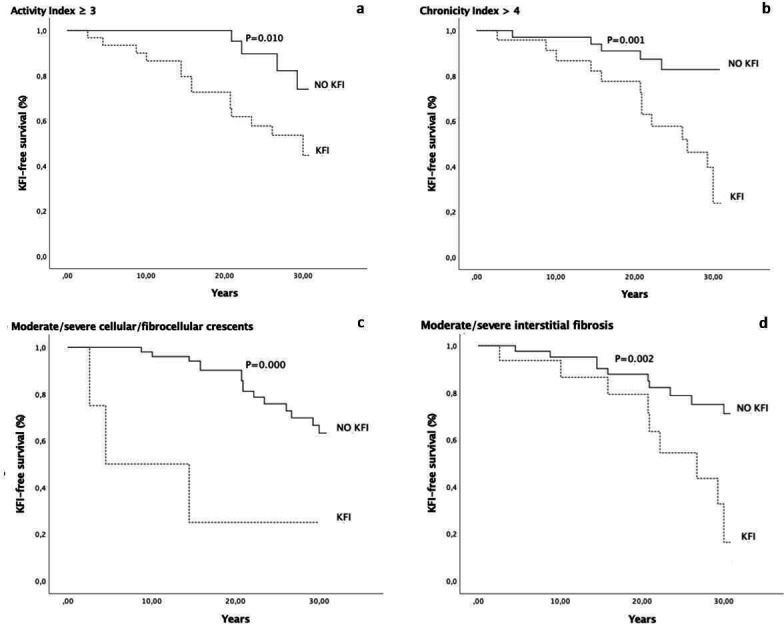
Results: During 23-year follow-up, 25 patients presented a decrease in glomerular filtration rate (eGFR) ≥30%. At repeat biopsy, chronicity index increased in 44 participants (72%) and did not increase in 17 (28%). Nephritic syndrome and serum creatinine >1.6 mg/dL at presentation correlated with chronicity index increase (p=0.031, 0.027, respectively), cyclophosphamide therapy tended to protect against chronicity index increase (p=0.059). Kidney flares occurred in 53.6% of patients with vs 23.5% of those without chronicity index increase (p=0.035). Chronicity index increases of 3.5 points in patients with kidney flares vs 2 in those without flares (p=0.001). At second, but not at first kidney biopsy, two different models predicted eGFR decrease at multivariate analysis. The first included activity index >3 (OR: 3.230; p=0.013) and chronicity index >4 (OR: 2.905; p=0.010), and the second model included moderate/severe cellular/fibrocellular crescents (OR: 4.207; p=0.010) and interstitial fibrosis (OR: 2.525; p=0.025).
Conclusion: At second biopsy, chronicity index increased in 3/4 of participants. Its increase was predicted by kidney dysfunction at presentation and occurrence of LN flares. Kidney function impairment was predicted by both activity and chronicity index and by some of their components at repeated biopsy, but not at first biopsy.
Keywords: Cyclophosphamide; Lupus Erythematosus, Systemic; Lupus Nephritis.
© Author(s) (or their employer(s)) 2022. Re-use permitted under CC BY-NC. No commercial re-use. See rights and permissions. Published by BMJ.
Conflict of interest statement
Competing interests: None declared.
Figures
References
-
- Fanouriakis A, Kostopoulou M, Cheema K, et al. 2019 update of the joint European League against rheumatism and European renal Association–European dialysis and transplant association (EULAR/ERA–EDTA) recommendations for the management of lupus nephritis. Ann Rheum Dis 2020;79:713–23. 10.1136/annrheumdis-2020-216924 - DOI - PubMed
MeSH terms
LinkOut - more resources
Full Text Sources
Medical
Research Materials
Miscellaneous