


Zero- or missed-dose children in Nigeria: Contributing factors and interventions to overcome immunization service delivery challenges
- PMID: 35973864
- PMCID: PMC9485449
- DOI: 10.1016/j.vaccine.2022.07.058
Zero- or missed-dose children in Nigeria: Contributing factors and interventions to overcome immunization service delivery challenges
Abstract
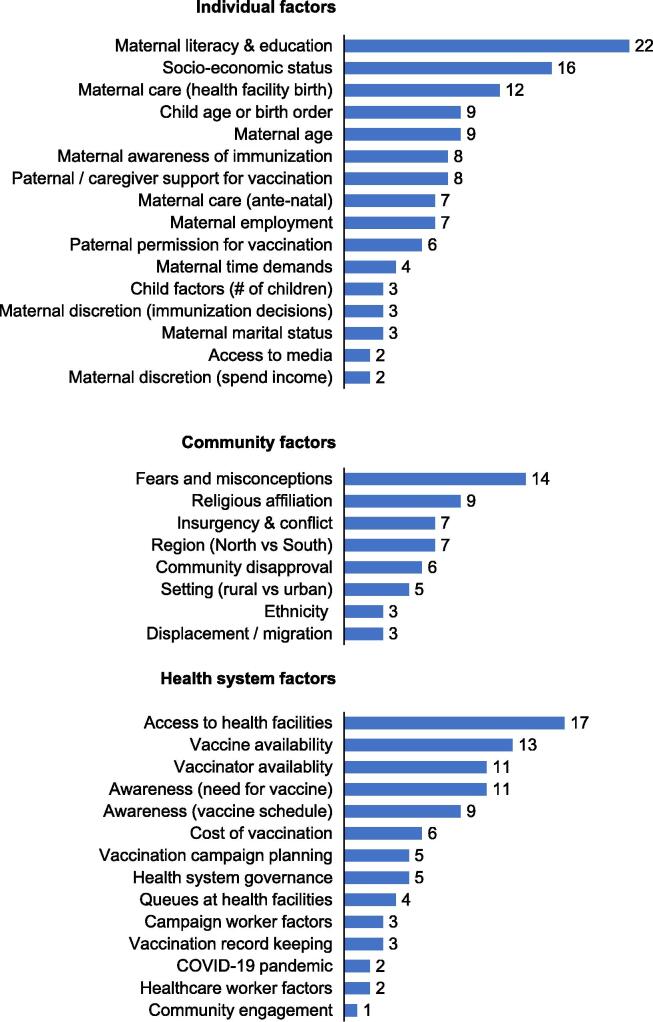
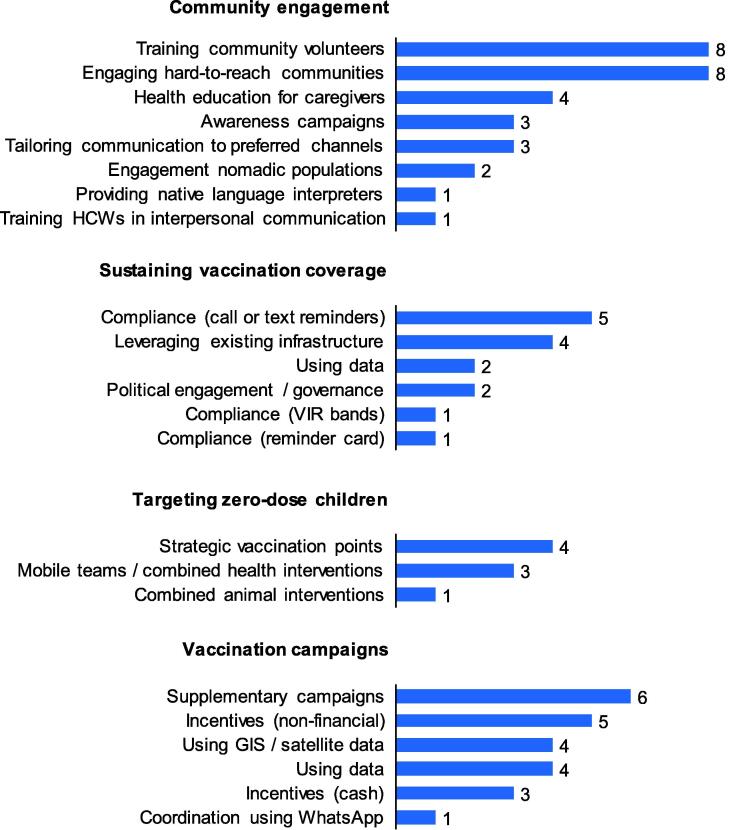
'Zero-dose' refers to a person who does not receive a single dose of any vaccine in the routine national immunization schedule, while 'missed dose' refers to a person who does not complete the schedule. These peopleremain vulnerable to vaccine-preventable diseases, and are often already disadvantaged due to poverty, conflict, and lack of access to basic health services. Globally, more 22.7 million children are estimated to be zero- or missed-dose, of which an estimated 3.1 million (∼14 %) reside in Nigeria.We conducted a scoping review tosynthesize recent literature on risk factors and interventions for zero- and missed-dosechildren in Nigeria. Our search identified 127 papers, including research into risk factors only (n = 66); interventions only (n = 34); both risk factors and interventions (n = 18); and publications that made recommendations only (n = 9). The most frequently reported factors influencing childhood vaccine uptake were maternal factors (n = 77), particularly maternal education (n = 22) and access to ante- and perinatal care (n = 19); heterogeneity between different types of communities - including location, region, wealth, religion, population composition, and other challenges (n = 50); access to vaccination, i.e., proximity of facilities with vaccines and vaccinators (n = 37); and awareness about immunization - including safety, efficacy, importance, and schedules (n = 18).Literature assessing implementation of interventions was more scattered, and heavily skewed towards vaccination campaigns and polio eradication efforts. Major evidence gaps exist in how to deliver effective and sustainable routine childhood immunization. Overall, further work is needed to operationalise the learnings from these studies, e.g. through applying findings to Nigeria's next review of vaccination plans, and using this summary as a basis for further investigation and specific recommendations on effective interventions.
Keywords: Child; Immunization; Intervention; Missed-dose; Nigeria; Risk factor; Unvaccinated; Zero-dose.
Copyright © 2022 This is an open access article under the CC BY-NC-ND IGO license. Published by Elsevier Ltd.. All rights reserved.
Conflict of interest statement
Declaration of Competing Interest The authors declare that they have no known competing financial interests or personal relationships that could have appeared to influence the work reported in this paper.
Figures

References
-
- World Health Organization. Immunization coverage. Key Facts 2020; Available from: https://www.who.int/news-room/fact-sheets/detail/immunization-coverage.
-
- World Health Organization, Global Routine Immunization Strategies and Practices (GRISP): a companion document to the Global.
-
- Vaccine Action Plan (GVAP), WHO, Editor. 2016, WHO: WHO Library Cataloguing-in-Publication Data.
-
- WHO/UNICEF, Progress and Challenges with Sustaining and Advancing Immunization Coverage During the COVID-19 Pandemic, in National Immunization Coverage (WUENIC 2020), WHO/UNICEF, Editor. 2020, WHO/UNICEF: Online.
Publication types
MeSH terms
Substances
Grants and funding
LinkOut - more resources
Full Text Sources
Medical
