Review
. 2022 Nov 23;107(11):2963-2972.
doi: 10.1210/clinem/dgac471.

Targeted Therapies in Pheochromocytoma and Paraganglioma

Affiliations
Review

Targeted Therapies in Pheochromocytoma and Paraganglioma

Katharina Wang et al. J Clin Endocrinol Metab. .

Abstract

Molecular targeted therapy plays an increasingly important role in the treatment of metastatic pheochromocytomas and paragangliomas (PPGLs), which are rare tumors but remain difficult to treat. This mini-review provides an overview of established molecular targeted therapies in present use, and perspectives on those currently under development and evaluation in clinical trials. Recently published research articles, guidelines, and expert views on molecular targeted therapies in PPGLs are systematically reviewed and summarized. Some tyrosine kinase inhibitors (sunitinib, cabozantinib) are already in clinical use with some promising results, but without formal approval for the treatment of PPGLs. Sunitinib is the only therapeutic option which has been investigated in a randomized placebo-controlled clinical trial. It is clinically used as a first-, second-, or third-line therapeutic option for the treatment of progressive metastatic PPGLs. Some other promising molecular targeted therapies (hypoxia-inducible factor 2 alpha [HIF2α] inhibitors, tumor vaccination together with checkpoint inhibitors, antiangiogenic therapies, kinase signaling inhibitors) are under evaluation in clinical trials. The HIF2α inhibitor belzutifan may prove to be particularly interesting for cluster 1B-/VHL/EPAS1-related PPGLs, whereas antiangiogenic therapies seem to be primarily effective in cluster 1A-/SDHx-related PPGLs. Some combination therapies currently being evaluated in clinical trials, such as temozolomide/olaparib, temozolomide/talazoparib, or cabozantinib/atezolizumab, will provide data for novel therapy for metastatic PPGLs. It is likely that advances in such molecular targeted therapies will play an essential role in the future treatment of these tumors, with more personalized therapy options paving the way towards improved therapeutic outcomes.

Keywords: metastatic; molecular targeted therapy; paraganglioma; pheochromocytoma.


Figures

Figure 1.
Figure 1.
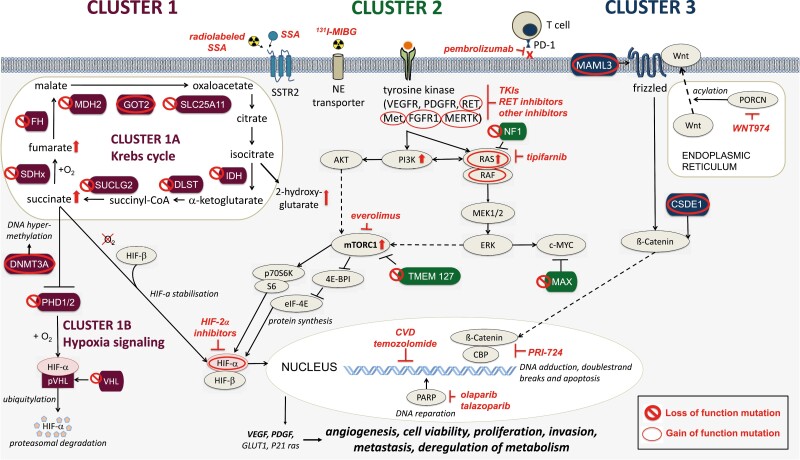
The 3 main molecular clusters of PPGLs and their associated gain (○) or loss (○) of function mutations. Cluster 1 mutations (crimson) include mutations in cluster 1A/Krebs cycle-related genes (SDHx, FH, MDH2, GOT2, SLC25A11, IDH, DLST, SUCLG2) and cluster 1B/hypoxia signaling-related genes (PHD1/2, VHL, HIF2A/EPAS1). These mutations lead to an accumulation of oncometabolites, increased DNS hypermethylation, decreased HIF-α degradation and HIF-α stabilization. Cluster 2 mutations (green) disrupt the kinase signaling pathway and lead to their overactivation (RET, MET, FGFR1, MERTK, NGFR, NF1, HRAS, BRAF, TMEM127, MAX). Cluster 3 mutations (blue) affect the Wnt signaling pathway (MAML3, CSDE1). All mutations may lead to increased angiogenesis, cell proliferation, invasion, metastasis, and deregulation of metabolism. Potential therapies are shown in red. ⇧ protein activation or upregulation; ⊥ protein inhibition.
Figure 2.
Figure 2.
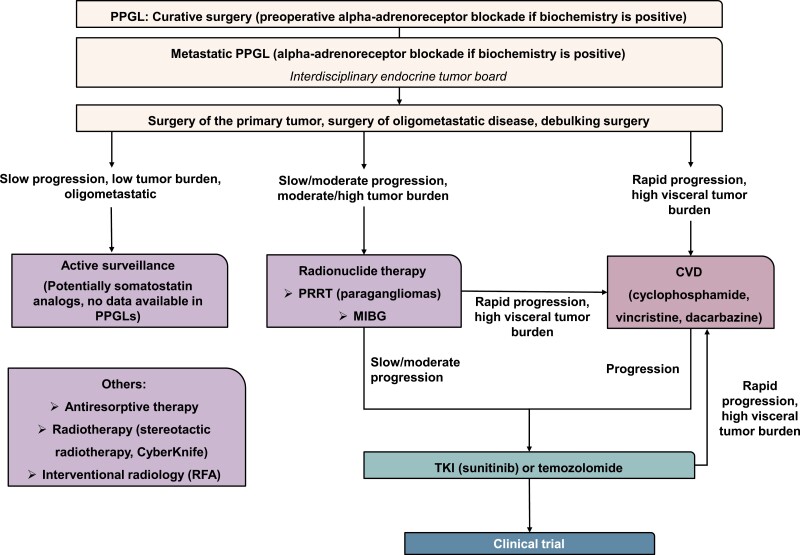
Simplified flow chart of the practical therapy standards in metastatic PPGLs (12). Each metastatic PPGL patient should be discussed in an interdisciplinary endocrine tumor board. Surgery of the primary tumor, of oligometastatic disease or debulking surgery, should always be considered. In the case of slow progression, low tumor burden and oligometastatic disease, active surveillance may be considered. In patients with slow-to-moderate progression, moderate-to-high tumor burden and positivity on SSTR2 or MIBG imaging, radionuclide therapy using either PRRT or MIBG (depending on avidity on molecular imaging) may be applied. For slowly/moderately progressing tumors that are not eligible for PRRT or MIBG, TKIs or temozolomide may be considered as first-line therapies. In the case of rapid progression or high visceral tumor burden, CVD chemotherapy may be applied. In the case of slow-to-moderate progression following radionuclide therapy, TKIs or temozolomide may be considered. In the case of rapid progression and high visceral tumor burden following other systemic therapies, CVD should be considered. Following progression to CVD, TKIs, or temozolomide may be considered. In case of further progression, inclusion in clinical trials may be considered. MIBG, meta-[131I] iodobenzylguanidine; PRRT, somatostatin receptor-based radionuclide therapy; RFA, radiofrequency ablation; TKI, tyrosine kinase inhibitor.

References

    1. Jhawar S, Arakawa Y, Kumar S, et al. New insights on the genetics of pheochromocytoma and paraganglioma and its clinical implications. Cancers 2022;14(3). doi 10.3390/cancers14030594 [published Online First: Epub Date]| - DOI - PMC - PubMed
    1. Crona J, Lamarca A, Ghosal S, Welin S, Skogseid B, Pacak K. Genotype-phenotype correlations in pheochromocytoma and paraganglioma: a systematic review and individual patient meta-analysis. Endocr Relat Cancer. 2019;26(5):539–550. - PMC - PubMed
    1. Fishbein L, Leshchiner I, Walter V, et al. Comprehensive molecular characterization of pheochromocytoma and paraganglioma. Cancer Cell 2017;31(2):181–193. - PMC - PubMed
    1. Luchetti A, Walsh D, Rodger F, et al. Profiling of somatic mutations in phaeochromocytoma and paraganglioma by targeted next generation sequencing analysis. Int J Endocrinol 2015;2015:138573. doi: 10.1155/2015/138573 [published Online First: Epub Date]| - DOI - PMC - PubMed
    1. Gieldon L, William D, Hackmann K, et al. Optimizing genetic workup in pheochromocytoma and paraganglioma by integrating diagnostic and research approaches. Cancers 2019;11(6). doi 10.3390/cancers11060809 [published Online First: Epub Date]| - DOI - PMC - PubMed

Publication types

MeSH terms