


Cardiovascular health in the menopause transition: a longitudinal study of up to 3892 women with up to four repeated measures of risk factors
- PMID: 35974322
- PMCID: PMC9382827
- DOI: 10.1186/s12916-022-02454-6
Cardiovascular health in the menopause transition: a longitudinal study of up to 3892 women with up to four repeated measures of risk factors
Abstract
Background: Women experience adverse changes in cardiovascular health in mid-life; whether the menopausal transition influences these remains strongly debated. The aim of this study was to examine associations of reproductive age (time since final menstrual period (FMP)) with change in carotid intima media thickness (CIMT) and cardiovascular risk factors and determine the role of chronological and reproductive age.
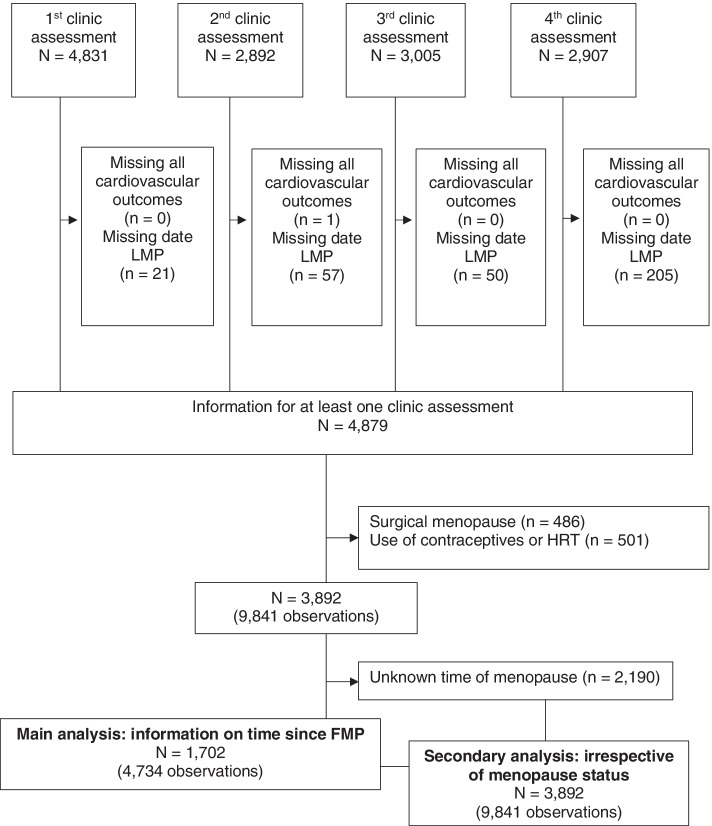
Methods: We used data from 1702 women from a pregnancy-based UK cohort who had up to four repeat cardiovascular health measures between mean age 51 (SD = 4.0) and 56 (SD = 3.6) years and experienced a natural menopause. Multilevel models were used to assess the relationship between cardiovascular measures and time since FMP (reproductive age), whilst adjusting for the underlying effects of chronological age and confounders (socioeconomic factors, body mass index, smoking, alcohol, parity, age at menarche). In addition, we looked at the relationship between cardiovascular measures by chronological age according to menopausal stages (pre-menopause, peri-menopause and post-menopause) using information from women who had and had not experienced menopause (N = 3892).
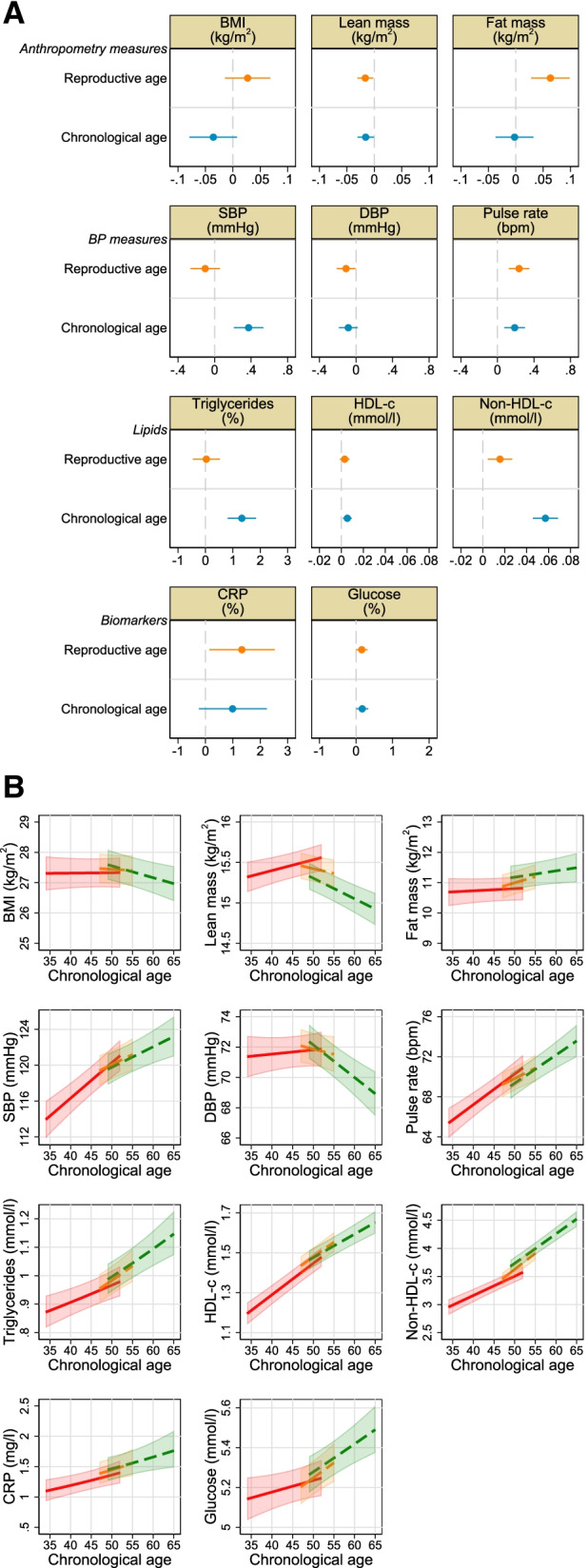
Results: There was no strong evidence that reproductive age was associated with CIMT (difference in mean 0.8 μm/year, 95% CI - 0.4, 2.1), whereas there was a strong positive association of chronological age (7.6 μm/year, 95% CI 6.3, 8.9). Consistent with this, we found weaker linear associations of reproductive compared with chronological age for atherosclerotic risk factors, such as with systolic blood pressure (- 0.1 mmHg/year, 95% CI - 0.3, 0.1, and 0.4 mmHg/year, 95% CI 0.2, 0.5, respectively) and non-HDL-cholesterol (0.02 mmol/l/year, 95% CI 0.005, 0.03, and 0.06, 95% CI 0.04, 0.07, respectively). In contrast, associations with fat mass (0.06 kg/m2/year, 95% CI 0.03, 0.10, and 0 kg/m2/year, 95% CI - 0.04, 0.04, respectively) and C-reactive protein (0.01, 95% CI 0.001, 0.02, and 0.01, 95% CI - 0.001, 0.02 natural logged mg/l/year, respectively) were stronger for reproductive compared with chronological age. Both reproductive and chronological age were (weakly) positively associated with glucose (0.002, 95% CI 0.0001, 0.003, and 0.002, 95% CI 0.0001, 0.003 natural logged mmol/l/year, respectively).
Conclusions: Our results suggest that going through the menopausal transition does not further increase women's risk of atherosclerosis (measured by CIMT) beyond effects of ageing. Menopausal transition may, in additional to ageing, modestly increase adiposity and glucose levels and therefore a possible associated diabetes risk.
Keywords: ALSPAC; CIMT; Cardiovascular; Menopausal transition; Menopause; Reproductive age; Time to final menstrual period.
© 2022. The Author(s).
Conflict of interest statement
AF and KT report funding from UK Medical Research Council, for work unrelated to that presented here. DAL reports receiving support from several national and international government and charity research funders, and grants from Medtronic Ltd for work unrelated to that presented here. SMN has received speaker’s fees and participated in medical advisory boards for Roche. GLC, ALGS, FK, PIW, and NS declare that they have no competing interests.
Figures

References
Publication types
MeSH terms
Substances
Grants and funding
LinkOut - more resources
Full Text Sources
Medical
Research Materials
