


Increasing numbers and improved overall survival of patients on kidney replacement therapy over the last decade in Europe: an ERA Registry study
- PMID: 35974693
- PMCID: PMC10064979
- DOI: 10.1093/ndt/gfac165
Increasing numbers and improved overall survival of patients on kidney replacement therapy over the last decade in Europe: an ERA Registry study
Abstract
Background: The aim of this study was to describe the trends in the incidence, prevalence and survival of patients on kidney replacement therapy (KRT) for end-stage kidney disease (ESKD) across Europe from 2008 to 2017.
Methods: Data from renal registries in 9 countries and 16 regions that provided individual patient data to the ERA Registry from 2008 to 2017 were included. These registries cover 34% of the general population in Europe. Crude and standardized incidence and prevalence per million population (pmp) were determined. Trends over time were studied using Joinpoint regression. Survival probabilities were estimated using Kaplan-Meier analysis and hazard ratios (HRs) using Cox regression analysis.
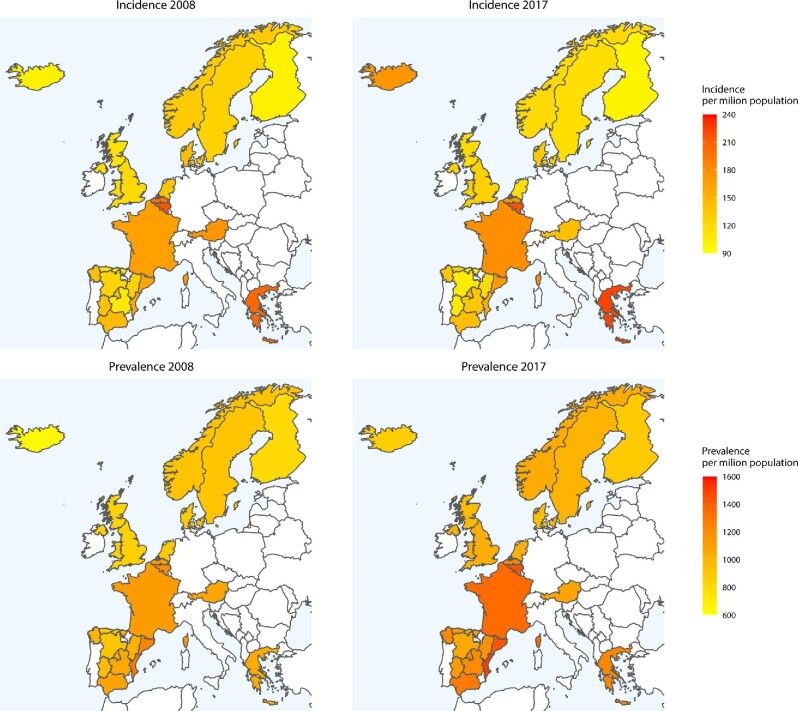
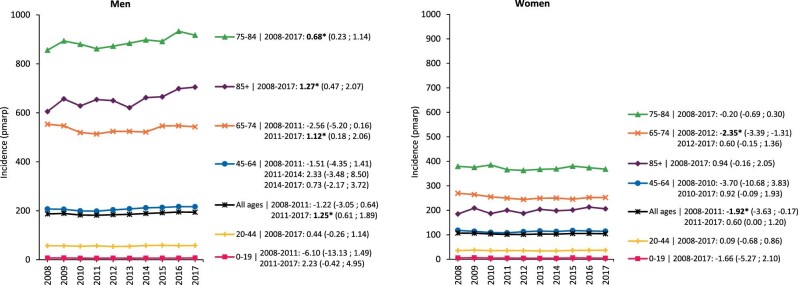
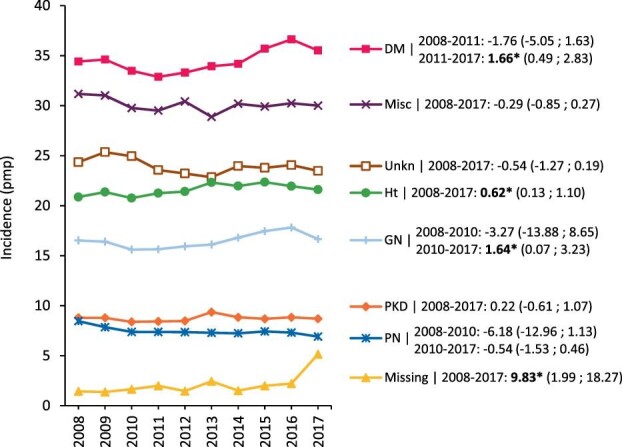
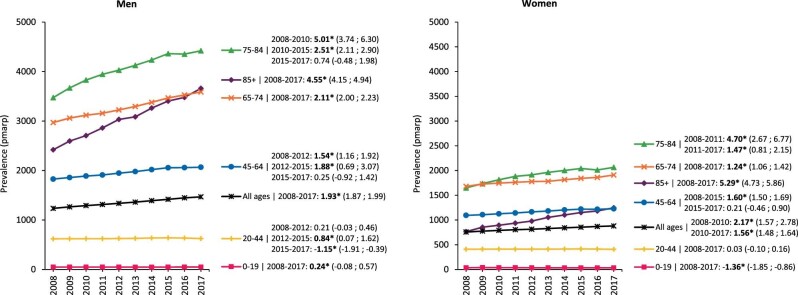
Results: The standardized incidence of KRT was stable [annual percentage change (APC): -1.48 (-3.15; 0.21)] from 2008 (146.0 pmp) to 2011 (141.6 pmp), followed by a slight increase [APC: 1.01 (0.43; 1.60)] to 148.0 pmp in 2017, although trends in incidence varied across countries. This increase was primarily due to a rise in the incidence of KRT in men older than 65 years. Moreover, as a cause of kidney failure, diabetes mellitus is increasing. The standardized prevalence increased from 2008 (990.0 pmp) to 2017 (1166.8 pmp) [APC: 1.82 (1.75; 1.89)]. Patient survival on KRT improved in the time period 2011-13 compared with 2008-[adjusted HR: 0.94 (0.93; 0.95)].
Conclusion: This study showed an overall increase in the incidence and prevalence of KRT for ESKD as well as an increase in the KRT patient survival over the last decade in Europe.
Keywords: dialysis; incidence; kidney transplantation; prevalence; survival.
© The Author(s) 2022. Published by Oxford University Press on behalf of the ERA.
Conflict of interest statement
K.J.J. reports grants from the European Renal Association (ERA). All other authors declare no competing interests. The results presented in this paper have not been published previously in whole or part.
Figures
Comment in
-
Trends in the incidence of kidney replacement therapy: comparisons of ERA, USRDS and Japan registries.Nephrol Dial Transplant. 2023 Mar 31;38(4):797-799. doi: 10.1093/ndt/gfac312. Nephrol Dial Transplant. 2023. PMID: 36441018 No abstract available.
References
-
- Jager KJ, Kovesdy C, Langham Ret al. A single number for advocacy and communication-worldwide more than 850 million individuals have kidney diseases. Nephrol Dial Transplant 2019; 34: 1803–1805 - PubMed
-
- Liyanage T, Ninomiya T, Jha Vet al. Worldwide access to treatment for end-stage kidney disease: a systematic review. Lancet 2015; 385: 1975–1982 - PubMed
-
- Nitta K, Masakane I, Hanafusa Net al. Annual dialysis data report for 2017, JSDT Renal Data Registry: survey methods, facility data, incidence, prevalence, and mortality. Ren Replace Ther 2020; 6: 41
-
- Pippias M, Jager KJ, Kramer Aet al. The changing trends and outcomes in renal replacement therapy: data from the ERA-EDTA registry. Nephrol Dial Transplant 2016; 31: 831–841 - PubMed
-
- Kramer A, Stel V, Zoccali Cet al. An update on renal replacement therapy in Europe: ERA-EDTA registry data from 1997 to 2006. Nephrol Dial Transplant 2009; 24: 3557–3566 - PubMed
Publication types
MeSH terms
LinkOut - more resources
Full Text Sources
Medical
Research Materials
