


Microbial Journey: Mount Everest to Mars
- PMID: 35974919
- PMCID: PMC9375815
- DOI: 10.1007/s12088-022-01029-6
Microbial Journey: Mount Everest to Mars
Abstract
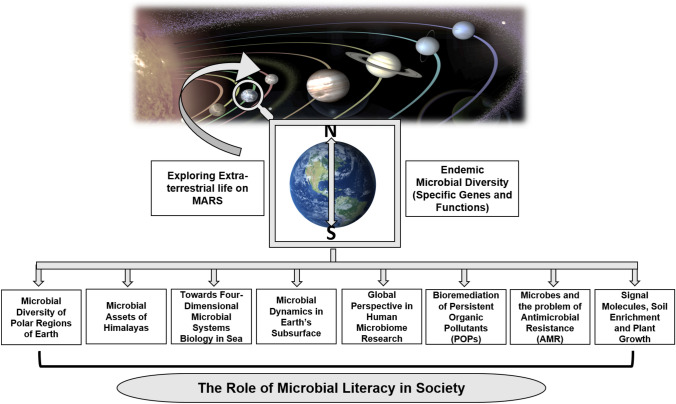
A rigorous exploration of microbial diversity has revealed its presence on Earth, deep oceans, and vast space. The presence of microbial life in diverse environmental conditions, ranging from moderate to extreme temperature, pH, salinity, oxygen, radiations, and altitudes, has provided the necessary impetus to search for them by extending the limits of their habitats. Microbiology started as a distinct science in the mid-nineteenth century and has provided inputs for the betterment of mankind during the last 150 years. As beneficial microbes are assets and pathogens are detrimental, studying both have its own merits. Scientists are nowadays working on illustrating the microbial dynamics in Earth's subsurface, deep sea, and polar regions. In addition to studying the role of microbes in the environment, the microbe-host interactions in humans, animals and plants are also unearthing newer insights that can help us to improve the health of the host by modulating the microbiota. Microbes have the potential to remediate persistent organic pollutants. Antimicrobial resistance which is a serious concern can also be tackled only after monitoring the spread of resistant microbes using disciplines of genomics and metagenomics The cognizance of microbiology has reached the top of the world. Space Missions are now looking for signs of life on the planets (specifically Mars), the Moon and beyond them. Among the most potent pieces of evidence to support the existence of life is to look for microbial, plant, and animal fossils. There is also an urgent need to deliberate and communicate these findings to layman and policymakers that would help them to take an adequate decision for better health and the environment around us. Here, we present a glimpse of recent advancements by scientists from around the world, exploring and exploiting microbial diversity.
Keywords: AMR; Mars; Microbial diversity; Microbial literacy; Microbiome; Quorum sensing; Subsurface.
© Association of Microbiologists of India 2022.
Figures
References
-
- McBurney MI, Davis C, Fraser CM, Schneeman BO, Huttenhower C, Verbeke K, Walter J, Latulippe ME. Establishing what constitutes a healthy human gut microbiome: state of the science, regulatory considerations, and future Directions. J Nutr. 2019;149:1882–1895. doi: 10.1093/jn/nxz154. - DOI - PMC - PubMed
Publication types
LinkOut - more resources
Full Text Sources
Research Materials
Miscellaneous