


Stability and inactivation of SARS-CoV-2 on food contact surfaces
- PMID: 35975280
- PMCID: PMC9374322
- DOI: 10.1016/j.foodcont.2022.109306
Stability and inactivation of SARS-CoV-2 on food contact surfaces
Abstract
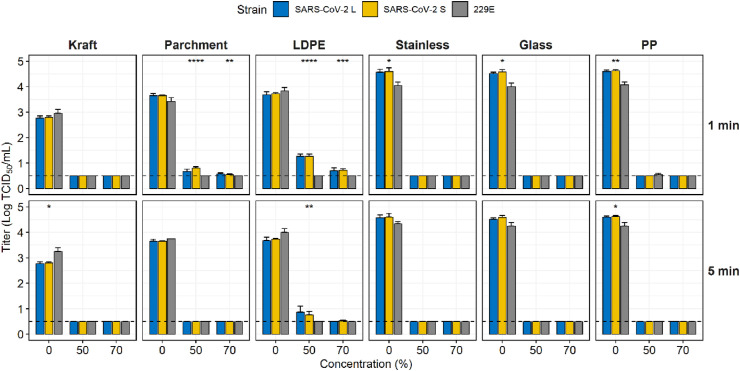
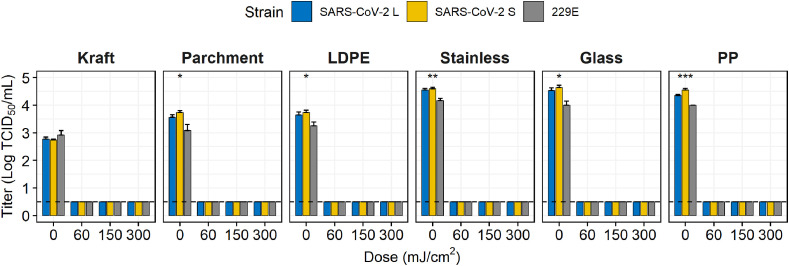
Severe acute respiratory syndrome coronavirus 2 (SARS-CoV-2) has infected more than 269 million people and killed more than 5.3 million people worldwide. Although fomite transmission of SARS-CoV-2 has been continuously reported, few studies have been conducted on food contact surfaces. Therefore, this study aimed to investigate the viability of coronaviruses on food contact surfaces and to remove SARS-CoV-2 contaminated on food contact surfaces with disinfectants. At 20 °C, SARS-CoV-2 was inactivated within 48 h on all food contact surfaces. At 4 °C, it was inactivated at 48 h on kraft paper and 96 h on parchment paper, but it was viable up to 5 days in low-density polyethylene (LDPE). At -20 °C, SARS-CoV-2 did not decrease by even 1 log on all food contact surfaces until 5 days. Treatment with 70% ethanol or 1000 ppm sodium hypochlorite for 5 min was sufficient to completely remove SARS-CoV-2 from 6 food contact surfaces. Similarly, UV-C irradiation at 60 mJ/cm2 eliminated SARS-CoV-2 contaminated on food contact surfaces. Also, the wiping test showed that even wiping an area contaminated with SARS-CoV-2 with a cloth moistened with 70% ethanol or 1000 ppm sodium hypochlorite, it took 5 min to inactivate the virus. Our findings suggested that SARS-CoV-2 contaminated on food contact surfaces in local retail may be viable enough to be transported home. However, if the type and method of use of the disinfectant suggested in this study are followed, it is possible to sufficiently control the fomite transmission of SARS-CoV-2 through food contact surfaces at home.
Keywords: COVID-19; Food contact surface; Quantitative carrier test; Viability; Wiping test.
© 2022 Elsevier Ltd. All rights reserved.
Conflict of interest statement
The authors declare that they have no known competing financial interests or personal relationships that could have appeared to influence the work reported in this paper.
Figures




References
-
- Achilias D., Roupakias C., Megalokonomos P., Lappas A., Antonakou Ε. Chemical recycling of plastic wastes made from polyethylene (LDPE and HDPE) and polypropylene (PP) Journal of Hazardous Materials. 2007;149(3):536–542. - PubMed
-
- Birhane M., Bressler S., Chang G., Clark T., Dorough L., Fischer M., Watkins L., Goldstein J.M., Kugeler K., Langley G., Lecy K., Martin S., Medalla F., Mitruka K., Nolen L., Sadigh K., Spratling R., Thompson G., Trujillo A. Update: COVID-19 among workers in meat and poultry processing facilities―United States, April–may 2020. Morbidity and Mortality Weekly Report. 2020;69(27):887. - PMC - PubMed
-
- Birhane M., Bressler S., Chang G., Clark T., Dorough L., Fischer M., Watkins L.F., Goldstein J.M.K.K., Langley G., Lecy K., Martin S., Medalla F., Mitruka K., Nolen L., Sadigh K., Spratling R., Thompson G., Trujillo A. COVID-19 vaccine breakthrough infections reported to CDC—United States, January 1–April 30, 2021. Morbidity and Mortality Weekly Report. 2021;70(21):792. - PMC - PubMed
-
- Callaway E. Fast-spreading COVID variant can elude immune responses. Nature. 2021:500–501. - PubMed
LinkOut - more resources
Full Text Sources
Miscellaneous