


Kidney outcomes in early adolescence following perinatal asphyxia and hypothermia-treated hypoxic-ischaemic encephalopathy
- PMID: 35976440
- PMCID: PMC9925534
- DOI: 10.1007/s00467-022-05705-z
Kidney outcomes in early adolescence following perinatal asphyxia and hypothermia-treated hypoxic-ischaemic encephalopathy
Abstract
Background: Acute kidney injury (AKI) remains common among infants with hypothermia-treated hypoxic-ischaemic encephalopathy (HIE). Little is known about long-term kidney outcomes following hypothermia treatment. We recently reported that 21% of survivors of hypothermia-treated HIE had decreased estimated glomerular filtration rate (eGFR) based on plasma creatinine in early adolescence. Here, we assessed kidney functions more comprehensively in our population-based cohort of children born in Stockholm 2007-2009 with a history of hypothermia-treated HIE.
Methods: At 10-12 years of age, we measured cystatin C (cyst C) to estimate GFR. Children with decreased cyst C eGFR also underwent iohexol clearance examination. We measured urine-albumin/creatinine ratio, blood pressure (BP) and kidney volume on magnetic resonance imaging. Fibroblast growth factor 23 (FGF 23) levels in plasma were assessed by enzyme-linked immunosorbent assay (ELISA). Outcomes were compared between children with and without a history of neonatal AKI.
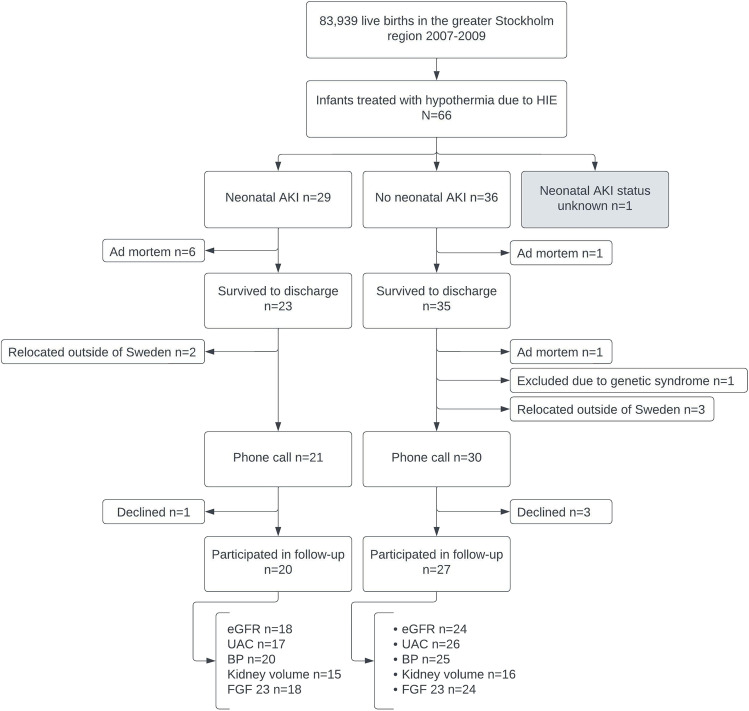
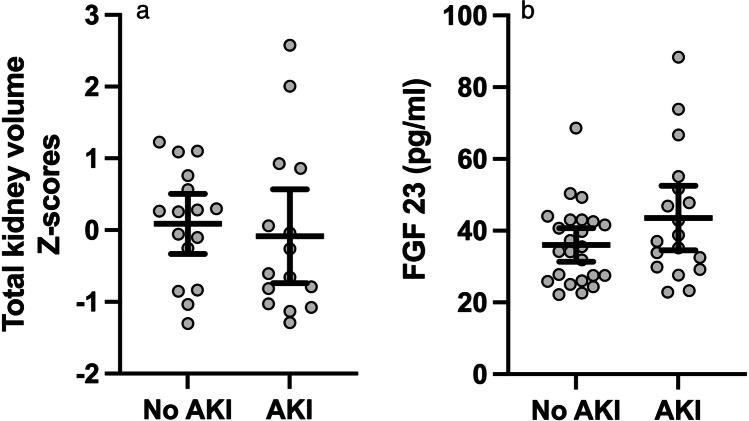
Results: Forty-seven children participated in the assessment. Two children (2/42) had decreased cyst C eGFR, for one of whom iohexol clearance confirmed mildly decreased GFR. One child (1/43) had Kidney Disease Improving Global Outcomes (KDIGO) category A2 albuminuria, and three (3/45) had elevated office BP. Subsequent ambulatory 24-h BP measurement confirmed high normal BP in one case only. No child had hypertension. Kidney volume and FGF 23 levels were normal in all children. There was no difference in any of the parameters between children with and without a history of neonatal AKI.
Conclusion: Renal sequelae were rare in early adolescence following hypothermia-treated HIE regardless of presence or absence of neonatal AKI. A higher resolution version of the Graphical abstract is available as Supplementary information.
Keywords: Acute kidney injury; Chronic kidney disease; Hypothermia treatment; Hypoxic-ischaemic encephalopathy; Long-term outcome; Perinatal asphyxia.
© 2022. The Author(s).
Conflict of interest statement
The authors declare no competing interests.
Figures

References
Publication types
MeSH terms
Substances
LinkOut - more resources
Full Text Sources
Medical
Research Materials
Miscellaneous
