Association Between COVID-19 Relief Funds and Hospital Characteristics in the US
- PMID: 35977159
- PMCID: PMC8727033
- DOI: 10.1001/jamahealthforum.2021.3325
Association Between COVID-19 Relief Funds and Hospital Characteristics in the US
Erratum in
-
Erratum: Errors in Introduction and Discussion.JAMA Health Forum. 2021 Nov 19;2(11):e214096. doi: 10.1001/jamahealthforum.2021.4096. eCollection 2021 Nov. JAMA Health Forum. 2021. PMID: 35981212 Free PMC article.
Abstract
Importance: In response to financial stress created by the reduction in care during the COVID-19 pandemic, hospitals received financial assistance through the Coronavirus Aid, Relief, and Economic Security (CARES) Act program. To date, the allocation of CARES Act funding is not well understood.
Objective: To examine the disbursement of the High-Impact Distribution CARES Act funds and the association between financial assistance and hospital-level financial resources prior to the COVID-19 pandemic.
Design setting and participants: This cross-sectional analysis of US-based hospitals and health systems assesses the hospital characteristics associated with CARES Act funding with linear regression models using linked hospital and health system-level information on CARES Act funding with hospital characteristics from Hospital Cost Report data.
Exposures: Hospital and health system CARES Act financial assistance.
Main outcomes and measures: Hospital and health system affiliation, status, and financial health prior to the COVID-19 pandemic. Data analysis took place from December 2020 through June 2021.
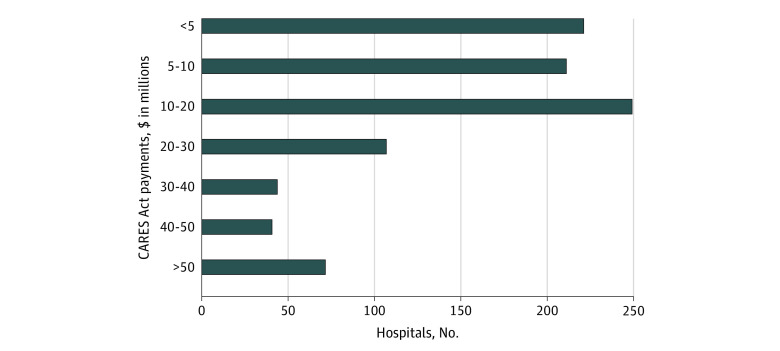
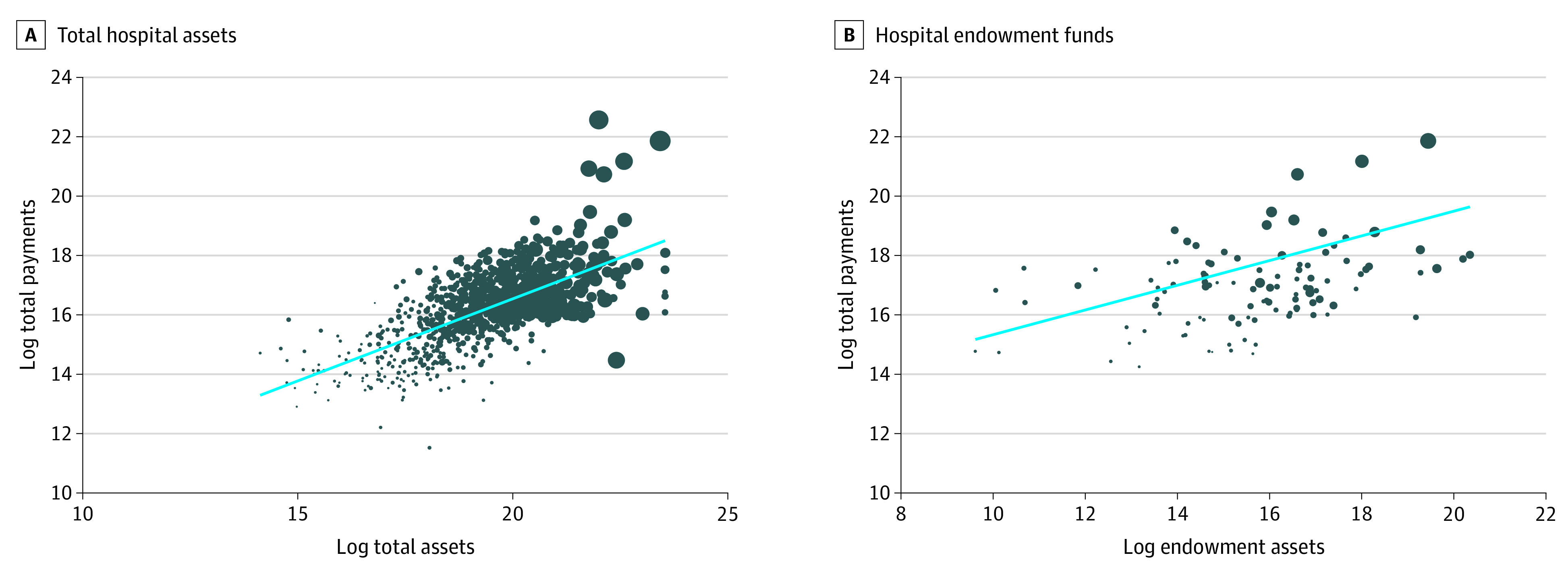
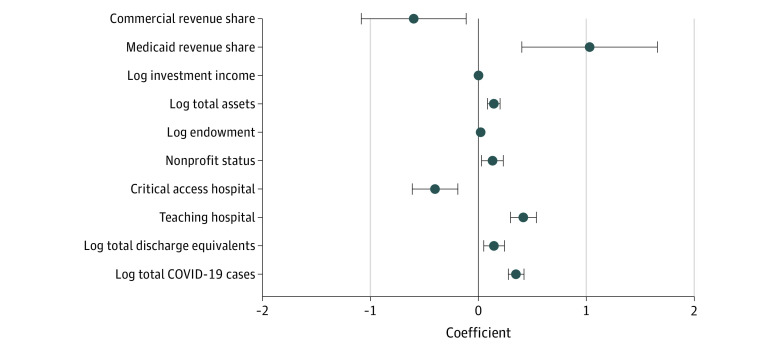
Results: The analysis included 952 hospital-level entities with an average payment of $33.6 million, most of which was received during the first payment round. Wide ranges existed in CARES Act funding, with 24% of matched hospitals receiving less than $5 million in funding and 8% receiving more than $50 million. Academic-affiliated hospitals, hospitals with higher pre-COVID-19 assets and hospitals with higher COVID-19 cases received higher levels of funding, while critical access hospitals received lower levels of financial assistance. A 10% increase in hospital assets, endowment size, and COVID-19 cases was associated with 1.4% (95% CI, 0.8% to 2.0%; P = .003), 0.2% (95% CI, 0.1% to 0.3%; P < .001), and 3.5% (95% CI, 2.8% to 4.2%; P < .001) increases in CARES Act funding, respectively.
Conclusions and relevance: In this cross-sectional study of US hospitals and health systems, findings suggest that High-Impact Distribution CARES Act funds may have disproportionately gone to hospitals that were in a stronger financial situation prior to the pandemic compared with those that were not, but funds also went disproportionately to those that eventually had the most cases.
Copyright 2021 Cantor J et al. JAMA Health Forum.
Conflict of interest statement
Conflict of Interest Disclosures: Drs Cantor and Whaley and Messrs Briscombe, Chapman, and Qureshi reported receiving grants from Arnold Ventures during the conduct of the study. Dr Whaley also acknowledges support from National Institute on Aging (grant No. 1K01AG061274). The content is solely the responsibility of the authors and does not necessarily represent the official views of the study funders.
Figures
References
-
- COVID-19 US state policy database (CUSP). Accessed August 1, 2020. https://docs.google.com/spreadsheets/d/1zu9qEWI8PsOI_i8nI_S29HDGHlIp2lfV...
-
- Chernew ME, Fendrick AM, Armbrester K, Brantes Fde. COVID-19 effects on care volumes: what they might mean and how we might respond. Health Affairs Blog. Published July 6, 2020. https://www.healthaffairs.org/do/10.1377/hblog20200702.788062/full/ - DOI
Publication types
MeSH terms
LinkOut - more resources
Full Text Sources
Medical