Assessment of Simulated Surveillance Testing and Quarantine in a SARS-CoV-2-Vaccinated Population of Students on a University Campus
- PMID: 35977169
- PMCID: PMC8727034
- DOI: 10.1001/jamahealthforum.2021.3035
Assessment of Simulated Surveillance Testing and Quarantine in a SARS-CoV-2-Vaccinated Population of Students on a University Campus
Abstract
Importance: The importance of surveillance testing and quarantine on university campuses to limit SARS-CoV-2 transmission needs to be reevaluated in the context of a complex and rapidly changing environment that includes vaccines, variants, and waning immunity. Also, recent US Centers for Disease Control and Prevention guidelines suggest that vaccinated students do not need to participate in surveillance testing.
Objective: To evaluate the use of surveillance testing and quarantine in a fully vaccinated student population for whom vaccine effectiveness may be affected by the type of vaccination, presence of variants, and loss of vaccine-induced or natural immunity over time.
Design setting and participants: In this simulation study, an agent-based Susceptible, Exposed, Infected, Recovered model was developed with some parameters estimated using data from the 2020 to 2021 academic year at Duke University (Durham, North Carolina) that described a simulated population of 5000 undergraduate students residing on campus in residential dormitories. This study assumed that 100% of residential undergraduates are vaccinated. Under varying levels of vaccine effectiveness (90%, 75%, and 50%), the reductions in the numbers of positive cases under various mitigation strategies that involved surveillance testing and quarantine were estimated.
Main outcomes and measures: The percentage of students infected with SARS-CoV-2 each day for the course of the semester (100 days) and the total number of isolated or quarantined students were estimated.
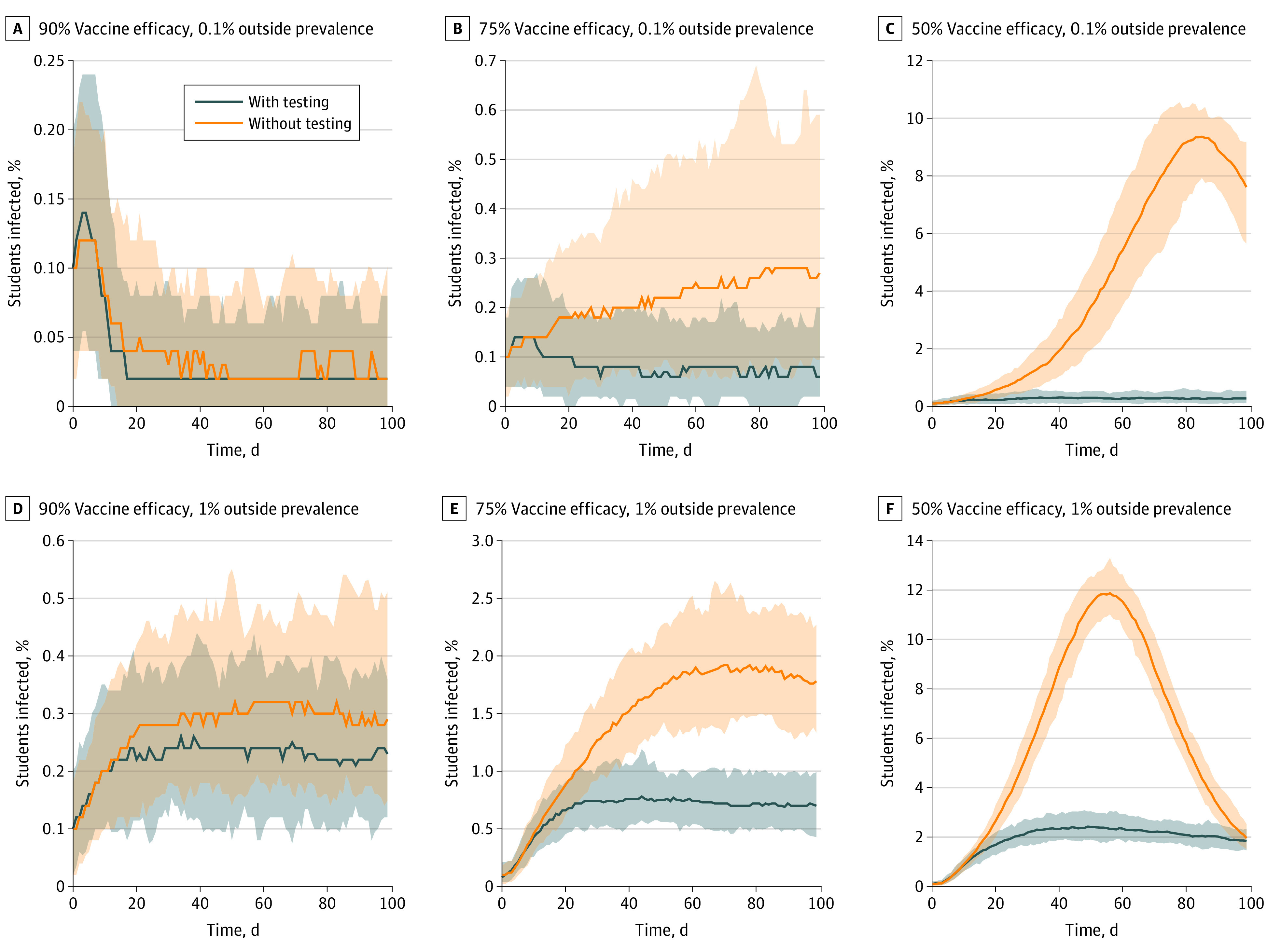
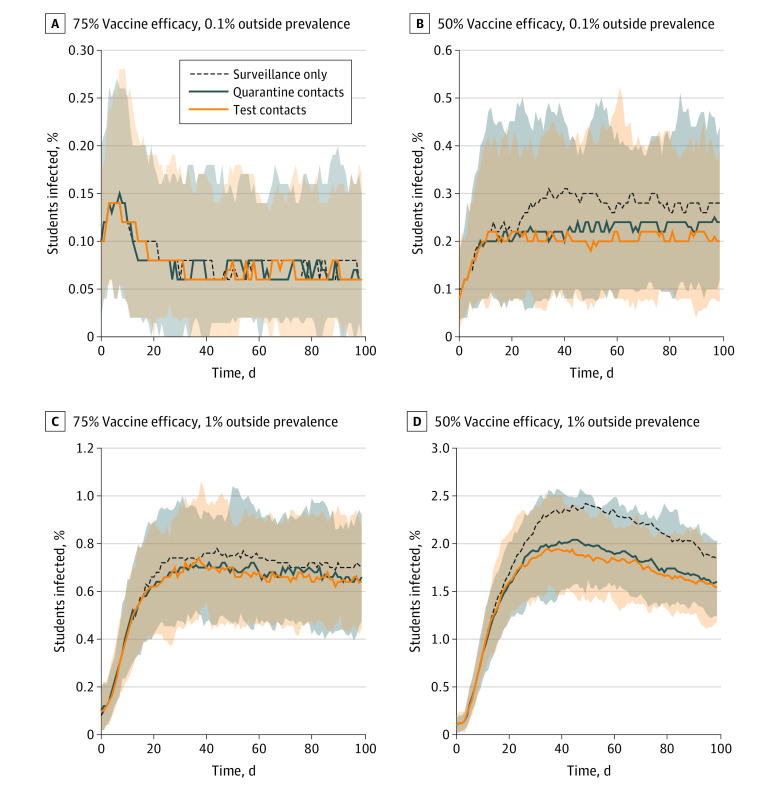
Results: A total of 5000 undergraduates were simulated in the study. In simulations with 90% vaccine effectiveness, weekly surveillance testing was associated with only marginally reduced viral transmission. At 50% to 75% effectiveness, surveillance testing was estimated to reduce the number of infections by as much as 93.6%. A 10-day quarantine protocol for exposures was associated with only modest reduction in infections until vaccine effectiveness dropped to 50%. Increased testing of reported contacts was estimated to be at least as effective as quarantine at limiting infections.
Conclusions and relevance: In this simulated modeling study of infection dynamics on a college campus where 100% of the student body is vaccinated, weekly surveillance testing was associated with a substantial reduction of campus infections with even a modest loss of vaccine effectiveness. Model simulations also suggested that an increased testing cadence can be as effective as a 10-day quarantine period at limiting infections. Together, these findings provide a potential foundation for universities to design appropriate mitigation protocols for the 2021 to 2022 academic year.
Copyright 2021 Motta FC et al. JAMA Health Forum.
Conflict of interest statement
Conflict of Interest Disclosures: Dr McGoff reported grants from National Science Foundation (NSF) during the conduct of the study. Dr Deckard reported employment with Geometric Data Analytics and research support from the US Defense Advanced Research Project Agency, Synergistic Discovery and Design (313-0743), NSF, and SBIR (award number 2029153) outside of the submitted work. Dr Moody reported personal fees from GlaxoSmithKline and Abcam and being a cofounder and co-owner of Grid Therapeutics outside the submitted work. No other disclosures were reported.
Figures
References
-
- Denny TN, Andrews L, Bonsignori M, et al. Implementation of a pooled surveillance testing program for asymptomatic SARS-CoV-2 infections on a college campus—Duke University, Durham, North Carolina, August 2-October 11, 2020. MMWR Morb Mortal Wkly Rep. 2020;69(46):1743-1747. doi: 10.15585/mmwr.mm6946e1 - DOI - PMC - PubMed
-
- Thompson MG, Burgess JL, Naleway AL, et al. Interim estimates of vaccine effectiveness of BNT162b2 and mRNA-1273 COVID-19 vaccines in preventing SARS-CoV-2 infection among health care personnel, first responders, and other essential and frontline workers—eight U.S. locations, December 2020-March 2021. MMWR Morb Mortal Wkly Rep. 2021;70(13):495-500. doi: 10.15585/mmwr.mm7013e3 - DOI - PMC - PubMed
Publication types
MeSH terms
LinkOut - more resources
Full Text Sources
Medical
Miscellaneous