US Trends in COVID-19-Associated Hospitalization and Mortality Rates Before and After Reopening Economies
- PMID: 35977172
- PMCID: PMC8796994
- DOI: 10.1001/jamahealthforum.2021.1262
US Trends in COVID-19-Associated Hospitalization and Mortality Rates Before and After Reopening Economies
Abstract
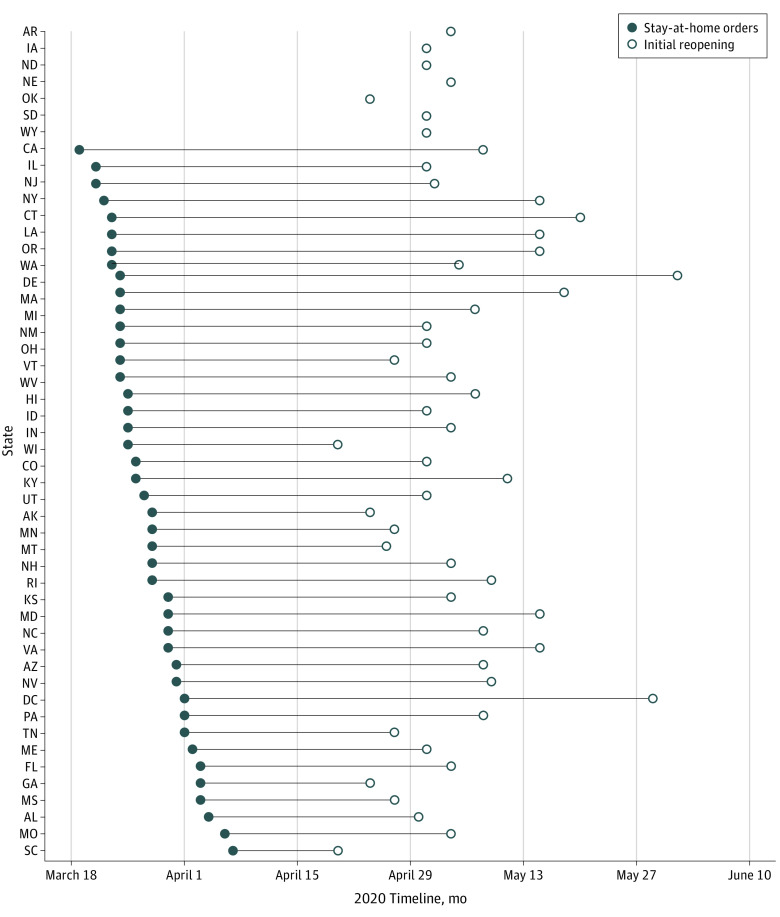
Importance: After abrupt closures of businesses and public gatherings in the US in late spring 2020 due to the COVID-19 pandemic, by mid-May 2020, most states reopened their economies. Owing in part to a lack of earlier data, there was little evidence on whether state reopening policies influenced important pandemic outcomes-COVID-19-related hospitalizations and mortality-to guide future decision-making in the remainder of this and future pandemics.
Objective: To investigate changes in COVID-19-related hospitalizations and mortality trends after reopening of US state economies.
Design setting and participants: Using an interrupted time series approach, this cross-sectional study examined trends in per-capita COVID-19-related hospitalizations and deaths before and after state reopenings between April 16 and July 31, 2020. Daily state-level data from the University of Minnesota COVID-19 Hospitalization Tracking Project on COVID-19-related hospitalizations and deaths across 47 states were used in the analysis.
Exposures: Dates that states reopened their economies.
Main outcomes and measures: State-day observations of COVID-19-related hospitalizations and COVID-19-related new deaths per 100 000 people.
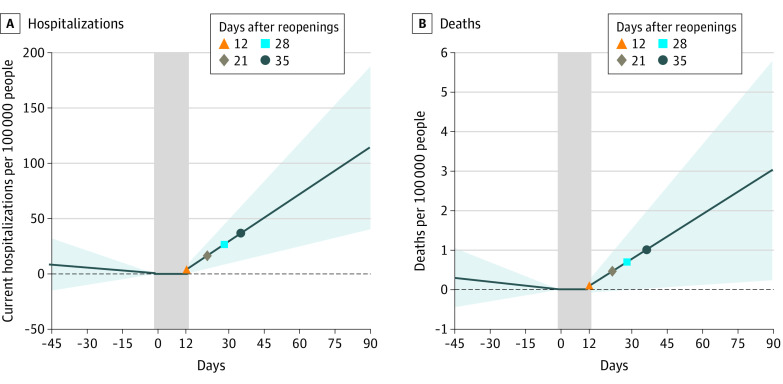
Results: The study included 3686 state-day observations of hospitalizations and 3945 state-day observations of deaths. On the day of reopening, the mean number of hospitalizations per 100 000 people was 17.69 (95% CI, 12.54-22.84) and the mean number of daily new deaths per 100 000 people was 0.395 (95% CI, 0.255-0.536). Both outcomes displayed flat trends before reopening, but they started trending upward thereafter. Relative to the hospitalizations trend in the period before state reopenings, the postperiod trend was higher by 1.607 per 100 000 people (95% CI, 0.203-3.011; P = .03). This estimate implied that nationwide reopenings were associated with 5319 additional people hospitalized for COVID-19 each day. The trend in new deaths after reopening was also positive (0.0376 per 100 000 people; 95% CI, 0.0038-0.0715; P = .03), but the change in mortality trend was not significant (0.0443; 95% CI, -0.0048 to 0.0933; P = .08).
Conclusions and relevance: In this cross-sectional study conducted over a 3.5-month period across 47 US states, data on the association of hospitalizations and mortality with state reopening policies may provide input to state projections of the pandemic as policy makers continue to balance public health protections with sustaining economic activity.
Copyright 2021 Gupta S et al. JAMA Health Forum.
Conflict of interest statement
Conflict of Interest Disclosures: Dr Karaca-Mandic reported receiving grants from the University of Minnesota Office of Academic Clinical Affairs funds to support data collection, which is made publicly available, and grants from United Health Foundation funds to support data collection, which is made publicly available during the conduct of the study; personal fees from Tactile Medical consulting for unrelated work, personal fees from Precision Health Economics consulting for unrelated work, personal fees from Sempre Health consulting for unrelated work, grants from Agency for Healthcare Research and Quality for unrelated research, grants from the American Cancer Society for unrelated research, grants from the National Institute for Health Care Management for unrelated research, and grants from the National Institutes of Health for unrelated research outside the submitted work. No other disclosures were reported.
Figures
Comment in
References
-
- Gupta S, Nguyen TD, Lozano Rojas F, et al. Tracking public and private responses to the COVID-19 epidemic: evidence from state and local government actions. NBER Working Paper Series, No. w27027. National Bureau of Economic Research; 2020.
-
- Lee SY, Park M, Shin Y. Hit Harder, Recover Slower? Unequal Employment Effects of the Covid-19 Shock. National Bureau of Economic Research; 2021. doi: 10.3386/w28354 - DOI
Publication types
MeSH terms
LinkOut - more resources
Full Text Sources
Medical
Miscellaneous