Risk Factors for Prolonged Mechanical Ventilation and Weaning Failure: A Systematic Review
- PMID: 35977525
- PMCID: PMC9677859
- DOI: 10.1159/000525604
Risk Factors for Prolonged Mechanical Ventilation and Weaning Failure: A Systematic Review
Abstract
Introduction: Prolonged mechanical ventilation (PMV) and weaning failure are factors associated with prolonged hospital length of stay and increased morbidity and mortality. In addition to the burden these places on patients and their families, it also imposes high costs on the public health system. The aim of this systematic review was to identify risk factors for PMV and weaning failure.
Methods: The study was conducted according to PRISMA guidelines. After a comprehensive search of the COCHRANE Library, CINHAL, Web of Science, MEDLINE, and the LILACS Database a PubMed request was made on June 8, 2020. Studies that examined risk factors for PMV, defined as mechanical ventilation ≥96 h, weaning failure, and prolonged weaning in German and English were considered eligible; reviews, meta-analyses, and studies in very specific patient populations whose results are not necessarily applicable to the majority of ICU patients as well as pediatric studies were excluded from the analysis. This systematic review was registered in the PROSPERO register under the number CRD42021271038.
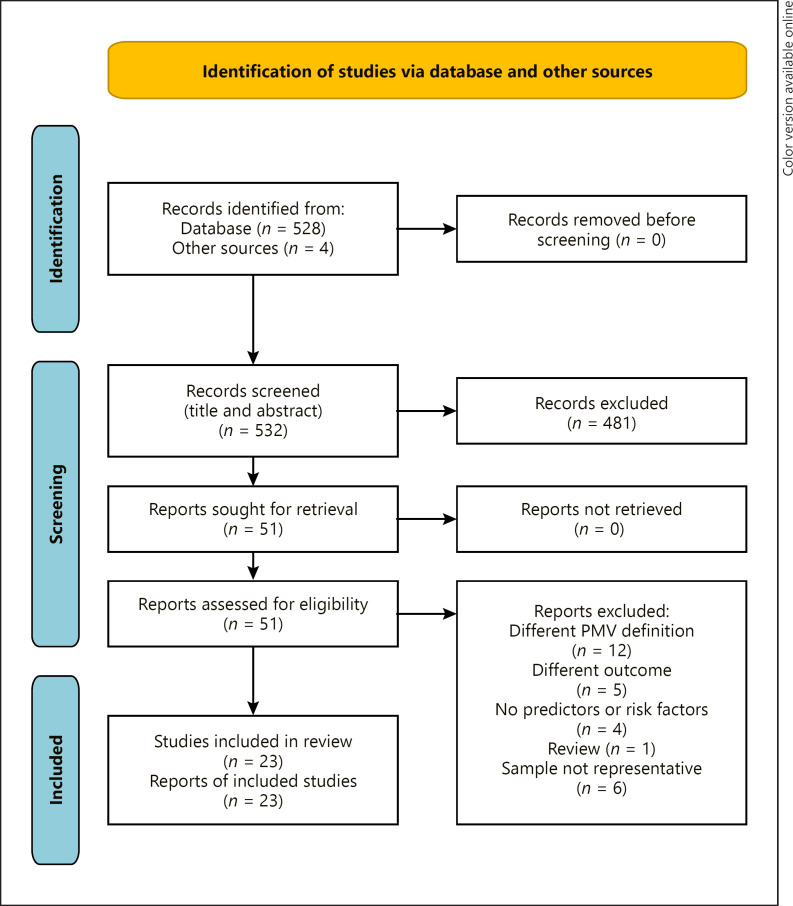
Results: Of 532 articles identified, 23 studies with a total of 23,418 patients met the inclusion criteria. Fourteen studies investigated risk factors of PMV including prolonged weaning, 9 studies analyzed risk factors of weaning failure. The concrete definitions of these outcomes varied considerably between studies. For PMV, a variety of risk factors were identified, including comorbidities, site of intubation, various laboratory or blood gas parameters, ventilator settings, functional parameters, and critical care scoring systems. The risk of weaning failure was mainly related to age, previous home mechanical ventilation (HMV), cause of ventilation, and preexisting underlying diseases. Elevated PaCO2 values during spontaneous breathing trials were indicative of prolonged weaning and weaning failure.
Conclusion: A direct comparison of risk factors was not possible because of the heterogeneity of the studies. The large number of different definitions and relevant parameters reflects the heterogeneity of patients undergoing PMV and those discharged to HMV after unsuccessful weaning. Multidimensional scores are more likely to reflect the full spectrum of patients ventilated in different ICUs than single risk factors.
Keywords: Home mechanical ventilation; Mechanical ventilation; Prolonged mechanical ventilation; Weaning.
© 2022 The Author(s). Published by S. Karger AG, Basel.
Conflict of interest statement
Felix J.F. Herth is Editor-in-Chief of “Respiration.” The other authors have no conflicts of interest to declare.
Figures
References
-
- Beduneau G, Pham T, Schortgen F, Piquilloud L, Zogheib E, Jonas M, et al. Epidemiology of weaning outcome according to a new definition. The WIND Study. Am J Respir Crit Care Med. 2017 Mar 15;195((6)):772–783. - PubMed
-
- Kohler D. Tremendous increase of home care in ventilated and tracheostomized patients: reasons, consequences, solutions. Dtsch Med Wochenschr. 2019 Feb;144((4)):282–285. - PubMed
-
- MacIntyre NR, Epstein SK, Carson S, Scheinhorn D, Christopher K, Muldoon S, et al. Management of patients requiring prolonged mechanical ventilation: report of a NAMDRC consensus conference. Chest. 2005 Dec;128((6)):3937–3954. - PubMed
-
- Boles JM, Bion J, Connors A, Herridge M, Marsh B, Melot C, et al. Weaning from mechanical ventilation. Eur Respir J. 2007 May;29((5)):1033–1056. - PubMed
-
- Schonhofer B, Geiseler J, Dellweg D, Fuchs H, Moerer O, Weber-Carstens S, et al. Prolonged weaning: S2k guideline published by the German Respiratory Society. Respiration. 2020 Dec;99((11)):982–1084. - PubMed
Publication types
MeSH terms
LinkOut - more resources
Full Text Sources
Medical
Miscellaneous