


Explaining behavioral health differences in urban and rural sexual minority adolescents: A longitudinal investigation of minority stress in a diverse national sample of sexual minority adolescents: A longitudinal investigation of minority stress in a diverse national sample of sexual minority adolescents
- PMID: 35977886
- PMCID: PMC9771913
- DOI: 10.1111/jrh.12706
Explaining behavioral health differences in urban and rural sexual minority adolescents: A longitudinal investigation of minority stress in a diverse national sample of sexual minority adolescents: A longitudinal investigation of minority stress in a diverse national sample of sexual minority adolescents
Abstract
Purpose: Experiences of sexuality-based discrimination (ie, minority stressors) against youth who identify as nonheterosexual (ie, sexual minority) have been associated with increased symptoms of anxiety, depression, and post-traumatic stress disorder (PTSD) for sexual minority adolescents (SMA; ages 14-17). However, little is known about the experiences of SMA living in rural communities across the United States. Thus, the present study sought to examine differences in mental health patterns between urban and rural dwelling SMA, and to see whether these differences are, at least in part, explained by experiences of lifetime minority stress.
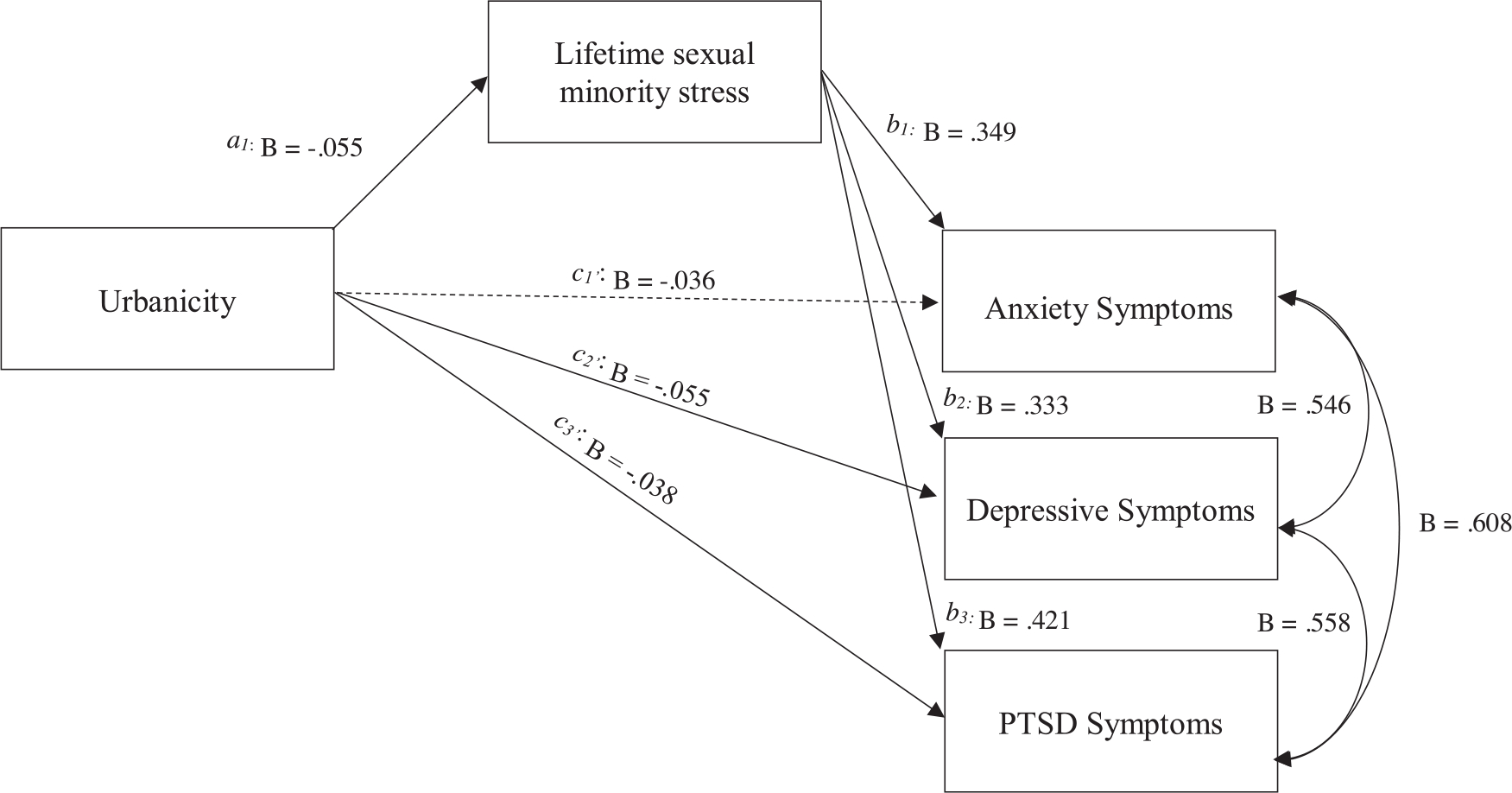
Methods: A nationwide sample of SMA residing in the United States (N = 2,558; aged 14-17, M = 15.90 years, SD = 0.98) was recruited through purposive social media and respondent-driven sampling methods to complete a cross-sectional survey online. Measures included those of minority stress, urbanicity, and symptoms of anxiety, depression, and PTSD. Parallel multiple mediation (PMM) analysis was employed to test whether urbanicity was associated with anxiety, depressive, and PTSD symptoms through reported lifetime minority stress.
Findings: On average, SMA living in rural areas significantly reported more lifetime minority stress, depressive, and PTSD symptoms than SMA living in urban settings. Results from our PMM analysis indicated that heightened experiences of lifetime minority stress indirectly linked the effects of living in rural areas on anxiety (b = -0.288, 95% CI = [-0.491, -0.085]), depressive (b = -0.158, 95% CI = [-0.270, -0.047), and PTSD symptoms PTSD (b = -0.349, 95% CI = [-0.596, -0.105]). The model accounted for 16.8%, 18%, and 24.1% of the variability in anxiety symptoms, depressive symptoms, and PTSD symptoms, respectively.
Conclusions: SMA in our study who reside in rural areas reported elevated minority stress, depressive, and PTSD symptoms as compared to their urban dwelling peers. Our study found that lifetime experiences of minority stress fully mediated the relationship between urbanicity and both depressive and PTSD symptoms, and partially mediated the relationship between urbanicity and anxiety. These findings highlight the need to increase support for rural youth who are growing into adulthood and may find continuing challenges in their family, peer, and community relationships.
Keywords: LGBT; adolescent; behavioral health; urbanicity.
© 2022 National Rural Health Association.
Conflict of interest statement
CONFLICTS OF INTEREST
The authors report no conflicts of interest.
Figures
References
-
- Berghe WV, Dewaele A, Cox N, Vincke J. Minority-specific determinants of mental well-being among lesbian, gay, and bisexual youth. J Appl Soc Psychol. 2010;40(1):153–166.
-
- Goldbach JT, Schrager SM, Dunlap SL, Holloway IW. The application of minority stress theory to marijuana use among sexual minority adolescents. Subst Use Misuse. 2015;50(3):366–375. - PubMed
-
- Hendricks M, Testa RJ. Model for understanding risk and resiliency in transgender and gender-nonconforming individuals. Prof Psychol Res Pract. 2012;43(5):460–467.
-
- Whitbeck LB, Chen X, Hoyt DR, Tyler KA, Johnson KD. Mental disorder, subsistence strategies, and victimization among gay, lesbian, and bisexual homeless and runaway adolescents. J Sex Res. 2004;41(4):329–342. - PubMed
