Review
. 2022 Aug 17;10(1):115.
doi: 10.1186/s40478-022-01420-w.

Chromosomal instability in adult-type diffuse gliomas

Affiliations
Review

Chromosomal instability in adult-type diffuse gliomas

Timothy E Richardson et al. Acta Neuropathol Commun. .

Abstract

Chromosomal instability (CIN) is a fundamental property of cancer and a key underlying mechanism of tumorigenesis and malignant progression, and has been documented in a wide variety of cancers, including colorectal carcinoma with mutations in genes such as APC. Recent reports have demonstrated that CIN, driven in part by mutations in genes maintaining overall genomic stability, is found in subsets of adult-type diffusely infiltrating gliomas of all histologic and molecular grades, with resulting elevated overall copy number burden, chromothripsis, and poor clinical outcome. Still, relatively few studies have examined the effect of this process, due in part to the difficulty of routinely measuring CIN clinically. Herein, we review the underlying mechanisms of CIN, the relationship between chromosomal instability and malignancy, the prognostic significance and treatment potential in various cancers, systemic disease, and more specifically, in diffusely infiltrating glioma subtypes. While still in the early stages of discovery compared to other solid tumor types in which CIN is a known driver of malignancy, the presence of CIN as an early factor in gliomas may in part explain the ability of these tumors to develop resistance to standard therapy, while also providing a potential molecular target for future therapies.

Keywords: Astrocytoma; CIN; Chromosomal instability; Chromothripsis; Copy number burden; Copy number variation; Glioblastoma; Glioma; Oligodendroglioma.


Conflict of interest statement

The results presented in this paper have not been published previously in whole or part. The authors declare that they have no competing interests.

Figures
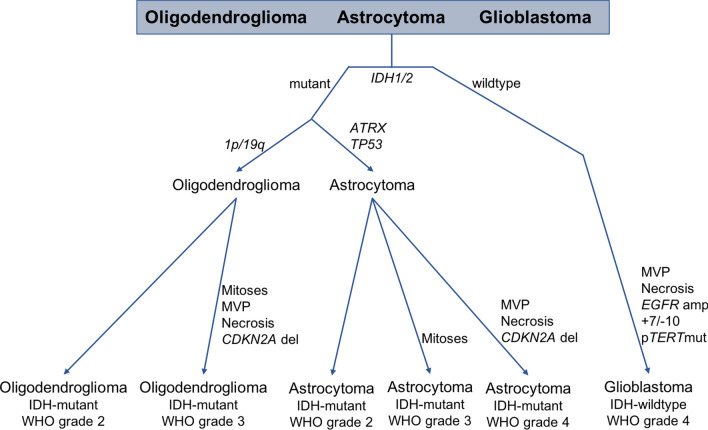
Fig. 1
Fig. 1
Diagnostic algorithm for integrating histologic and molecular features into a combined diffuse glioma diagnosis. Adapted from Louis et al. 2016 [64] and Louis et al. 2021 [65]
Fig. 2
Fig. 2
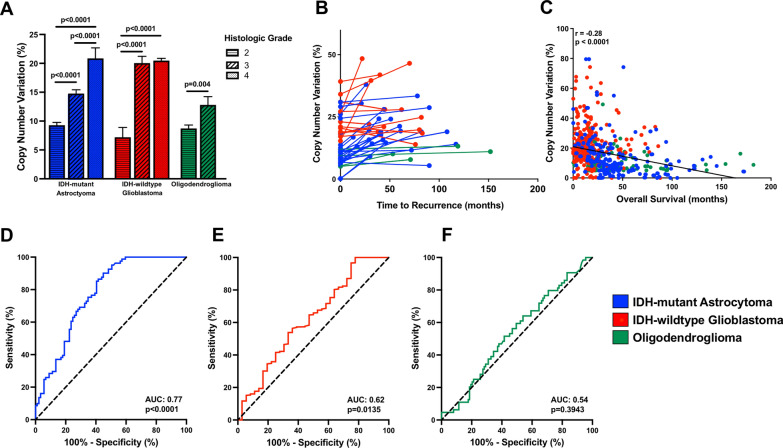
A Copy number variation (CNV) levels (expressed here as a percentage of the total genome) demonstrating a significant difference between overall CNV in all grades of IDH-mutant astrocytoma (p < 0.0001), between IDH-wildtype tumors histologically consistent with grade 2 and their histologic grade 3 and 4 counterparts (p < 0.0001), and between grade 2 and 3 oligodendroglioma (p = 0.0036), B copy number burden plot demonstrating a significant increase in the mean CNV in IDH-mutant astrocytoma (mean increase of 7.9 ± 1.1% in initial biopsy/resection versus recurrence; n = 22; p = 0.0012), and trend toward increased mean CNV percentage in IDH-wildtype glioblastoma (mean increase of 6.4 ± 1.1% in initial biopsy/resection versus recurrence; n = 13; p = 0.0795), C copy number burden plot demonstrating an inverse relationship between CNV in initial diffuse glioma biopsy and overall patient survival (r = -0.2507, p < 0.0001), and receiver operating characteristic (ROC) curves demonstrating the relative value of CNV in predicting outcome in D IDH-mutant astrocytoma (Area Under Curve (AUC) = 0.77; p < 0.0001), E IDH-wildtype glioblastoma (AUC = 0.62; p = 0.0135), and F oligodendroglioma (AUC = 0.54; p = 0.3943). All data are derived from Richardson et al. 2021 [97] and Liu et al. 2022 [62]
Fig. 3
Fig. 3
Representative copy number profiles of A a WHO grade 2 IDH-mutant astrocytoma case with late recurrence and overall patient survival of greater than 9 years (conventional clinical course), B a WHO grade 2 IDH-mutant astrocytoma with rapid progression to WHO grade 4 and short patient survival, C a WHO grade 4 IDH-mutant astrocytoma, and D a WHO grade 4 IDH-wildtype glioblastoma, for comparison. “Gain” or “loss” in the copy number profiles was defined as copy number change log2 ≥ 0.3. All cases represent the initial biopsy/resection specimen before any radiation or chemotherapy was given to the patient. Copy number plots for the IDH-mutant cases are reproduced from Richardson, et al. 2017 [98] (https://www.springer.com/journal/11060) and Richardson, et al. 2019 [94] (https://academic.oup.com/jnen) and are all used here with permission
Fig. 4
Fig. 4
Examples of modern indirect and direct detection methods of chromosomal instability in cohorts of IDH-mutant astrocytoma. A, B Copy number profiles and copy number variation (CNV) quantification in otherwise low-grade tumors with chromosomal instability (CIN) versus relatively chromosomally stable tumors (CS), derived from Illumina Infinium DNA methylation 450 k and EPIC (850 k) arrays C mRNA expression profiling (CIN70 panel), D, E methylation profile-based clustering, derived from Illumina Infinium DNA methylation 450 k arrays, and F single nucleus RNA sequencing (InferCNV). Panels A and C are adapted from Richardson, et al. 2018 [96] and Richardson et al. 2021 [97], respectively (https://academic.oup.com/jnen), and Panels D-E are adapted from Liu et al. 2022 [62] (https://actaneurocomms.biomedcentral.com/), and are all used here with permission

References

    1. Al-Rawi DH, Bakhoum SF. Chromosomal instability as a source of genomic plasticity. Curr Opin Genet Dev. 2022;74:101913. doi: 10.1016/j.gde.2022.101913. - DOI - PMC - PubMed
    1. Anderson KJ, Tan AC, Parkinson J, Back M, Kastelan M, Newey A, Brewer J, Wheeler H, Hudson AL, Amin SB, et al. Molecular and clonal evolution in recurrent metastatic gliosarcoma. Cold Spring Harb Mol Case Stud. 2020 doi: 10.1101/mcs.a004671. - DOI - PMC - PubMed
    1. Aoki K, Nakamura H, Suzuki H, Matsuo K, Kataoka K, Shimamura T, Motomura K, Ohka F, Shiina S, Yamamoto T, et al. Prognostic relevance of genetic alterations in diffuse lower-grade gliomas. Neuro Oncol. 2018;20:66–77. doi: 10.1093/neuonc/nox132. - DOI - PMC - PubMed
    1. Bakhoum SF, Compton DA. Chromosomal instability and cancer: a complex relationship with therapeutic potential. J Clin Invest. 2012;122:1138–1143. doi: 10.1172/JCI59954. - DOI - PMC - PubMed
    1. Bakhoum SF, Danilova OV, Kaur P, Levy NB, Compton DA. Chromosomal instability substantiates poor prognosis in patients with diffuse large B-cell lymphoma. Clin Cancer Res. 2011;17:7704–7711. doi: 10.1158/1078-0432.CCR-11-2049. - DOI - PMC - PubMed

Publication types