. 2022 Jul 21;13(8):1370-1377.
doi: 10.1021/acsmedchemlett.2c00270. eCollection 2022 Aug 11.

Novel CA(1-7)M(2-9) Analogs: Synthesis, Characterization, and Antibacterial Evaluation

Affiliations

Novel CA(1-7)M(2-9) Analogs: Synthesis, Characterization, and Antibacterial Evaluation

Talia Chetty et al. ACS Med Chem Lett. .

Abstract

Hybrid peptides from cecropin A and melittin have attracted the interest of the research community for decades. Here we synthesized several new analogs of the pentadecapeptide CA(1-7)M(2-9) and studied their antibacterial and hemolytic activity and tryptic stability. Single substitution of the Lys residues by Arg did not have a significant impact on the antibacterial activity of these analogs, but the substitution of the five Lys residues by Arg resulted in an increment in hemolytic activity. In contrast, the substitution of Lys residues by Orn conserved the antibacterial activity, with even lower hemolysis, and improved the enzymatic stability. The disulfide cyclic version of CA(1-7)M(2-9) was obtained by adding a Cys residue to each end of the peptide and carrying out a chemoselective thiol-disulfide interchange using sec-isoamylmecaptan as protecting group of one of these residues. This cyclic peptide showed good antibacterial activity with low hemolysis and improved enzymatic stability.


Conflict of interest statement

The authors declare no competing financial interest.

Figures

Figure 1
Figure 1
Linear precursors of the head-to-tail cyclic CAM.
Figure 2
Figure 2
(A) Cyclization reaction facilitated by SIT. (B) HPLC of the crude linear peptide. (C) HPLC and MS of cyclic CAM.
Figure 3
Figure 3
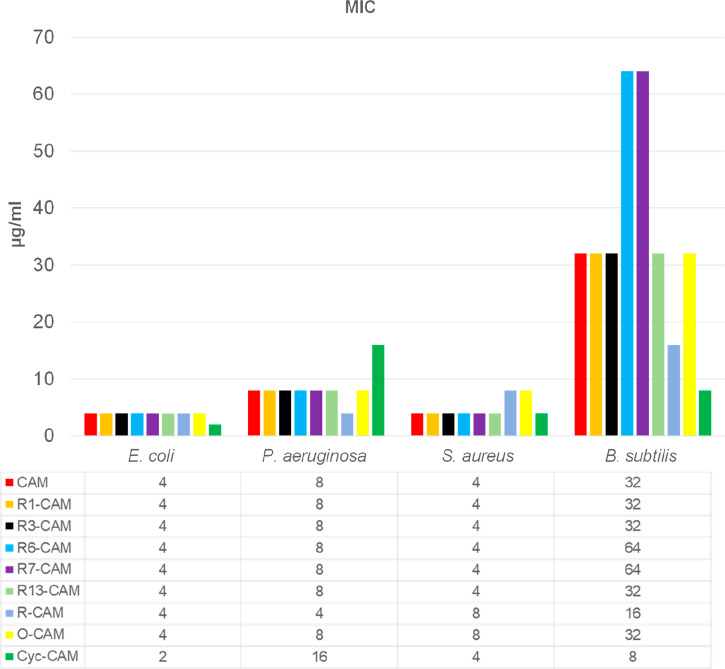
MIC of peptides tested against E. coli (ATCC 25922), P. aeruginosa (ATCC 27853), S. aureus (ATCC 29213), and B. subtilis (ATCC 6051).
Figure 4
Figure 4
Hemolytic activity of the peptides tested in SRBCs.
Figure 5
Figure 5
Time course of trypsin digestion of (A) CAM, (B) Cyc-CAM, and (C) O-CAM.

References

    1. Erdem Büyükkiraz M.; Kesmen Z. Antimicrobial peptides (AMPs): A promising class of antimicrobial compounds. J. Appl. Microbiol. 2022, 132, 1573–1596. 10.1111/jam.15314. - DOI - PubMed
    1. Matsuzaki K. Control of cell selectivity of antimicrobial peptides. Biochim. Biophys. Acta - Biomembr. 2009, 1788, 1687–1692. 10.1016/j.bbamem.2008.09.013. - DOI - PubMed
    1. Yu G.; Baeder D. Y.; Regoes R. R.; Rolff J. Combination Effects of Antimicrobial Peptides. Antimicrob. Agents Chemother. 2016, 60, 1717–1724. 10.1128/AAC.02434-15. - DOI - PMC - PubMed
    1. Boman H. G.; Wade D.; Boman I. A.; Wåhlin B.; Merrifield R. B. Antibacterial and antimalarial properties of peptides that are cecropin-melittin hybrids. FEBS Lett. 1989, 259, 103–106. 10.1016/0014-5793(89)81505-4. - DOI - PubMed
    1. Steiner H.; Hultmark D.; Engström Å.; Bennich H.; Boman H. G. Sequence and specificity of two antibacterial proteins involved in insect immunity. Nature 1981, 292, 246–248. 10.1038/292246a0. - DOI - PubMed