


Role of high mobility group box protein 1 in depression: A mechanistic and therapeutic perspective
- PMID: 35978968
- PMCID: PMC9258272
- DOI: 10.5498/wjp.v12.i6.779
Role of high mobility group box protein 1 in depression: A mechanistic and therapeutic perspective
Abstract
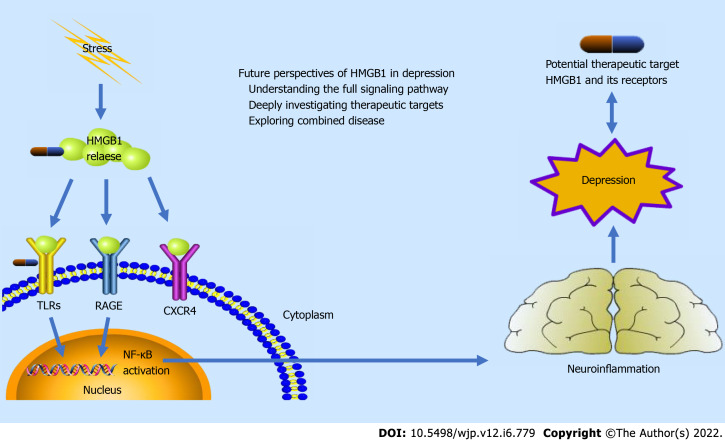
As a common and serious psychiatric disorder, depression significantly affects psychosocial functioning and quality of life. However, the mechanism of depression is still enigmatic and perplexing, which limits its precise and effective therapeutic methods. Recent studies demonstrated that neuroinflammation activation plays an important role in the pathophysiology of depression. In this respect, high mobility group box 1 (HMGB1) may be a possible signaling inducer of neuroinflammation and can be a potential mechanistic and therapeutic target for depression. Herein, we review recent studies on the mechanistic and therapeutic targets of HMGB1 in depression and propose potential perspectives on this topic.
Keywords: Depression; High mobility group box 1; Mechanism; Neuroinflammation; Perspective; Review.
©The Author(s) 2022. Published by Baishideng Publishing Group Inc. All rights reserved.
Conflict of interest statement
Conflict-of-interest statement: The authors declare that they have no conflicts of interest.
Figures
References
-
- Tran BX, Ha GH, Nguyen DN, Nguyen TP, Do HT, Latkin CA, Ho CSH, Ho RCM. Global mapping of interventions to improve quality of life of patients with depression during 1990-2018. Qual Life Res. 2020;29:2333–2343. - PubMed
-
- GBD 2017 Disease and Injury Incidence and Prevalence Collaborators. Global, regional, and national incidence, prevalence, and years lived with disability for 354 diseases and injuries for 195 countries and territories, 1990-2017: a systematic analysis for the Global Burden of Disease Study 2017. Lancet. 2018;392:1789–1858. - PMC - PubMed
-
- Liu Q, He H, Yang J, Feng X, Zhao F, Lyu J. Changes in the global burden of depression from 1990 to 2017: Findings from the Global Burden of Disease study. J Psychiatr Res. 2020;126:134–140. - PubMed
Publication types
LinkOut - more resources
Full Text Sources
Research Materials
