


Adherence to weekly anal self-examination among men who have sex with men for detection of anal syphilis
- PMID: 35979212
- PMCID: PMC9376231
- DOI: 10.3389/fmed.2022.941041
Adherence to weekly anal self-examination among men who have sex with men for detection of anal syphilis
Abstract
Background: Men who have sex with men (MSM) practicing exclusively receptive anal sex are more likely to present with secondary than primary syphilis, implying primary anorectal lesions may be missed. If men could detect anorectal lesions by regular anal self-examination, the duration of infectiousness could be reduced. This study aimed to examine adherence to weekly anal self-examination.
Method: We conducted a longitudinal feasibility study examining the adherence to weekly anal self-examinations among MSM attending a sexual health clinic in Melbourne, Australia between December 2020 and June 2021. Adherence to weekly anal self-examinations over 12 weeks was assessed from a logbook and 4-weekly surveys. Participants who identified abnormalities in their anus were recommended to seek medical review.
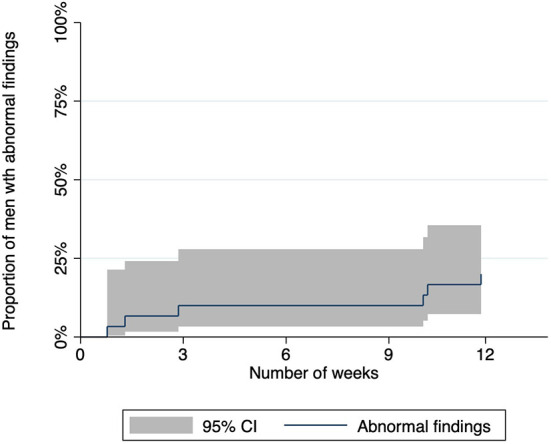
Results: Of the 30 men who completed the study, anal self-examination was performed at least weekly for 308 of 360 person-weeks (86% of the weeks, 95% CI: 82-89). The mean adherence was 3.6 (95% CI: 3.3-3.9) examinations per 4-weeks per person in Weeks 1-4, 3.5 (95% CI: 3.1-3.8) in Weeks 5-8 and 3.3 (95% CI: 2.9-3.7) in Weeks 9-12 (P trend = 0.06). Six men (20%, 6/30) were seen for medical review after they identified abnormalities, whilst eight men (27%, 8/30) reported abnormalities, but did not seek medical review. No participants were diagnosed with syphilis during the study period.
Conclusion: We conclude that men adhered well to weekly anal self-examination. Therefore, it is feasible to trial this as a routine practice among MSM. Future studies should investigate possible reductions in adherence over time and ways to increase medical review for abnormalities that men find.
Keywords: adherence; anal self-examination; anal syphilis; feasibility; men who have sex with men (MSM); syphilis; weekly exam.
Copyright © 2022 Aung, Fairley, Ong, Phillips, Tran, Chen, Maddaford and Chow.
Conflict of interest statement
EC was supported by an Australian NHMRC Emerging Leadership Investigator Grant (GNT1172873). CF was supported by an Australian NHMRC Leadership Investigator Grant (GNT1172900). JO was supported by an Australian NHMRC Emerging Leadership Investigator Grant (GNT1193955). EA was supported by Australian Government Research Training Program (RTP) scholarship from Monash University and Research Entry Scholarship from the Chapter of Sexual Health Medicine, Royal Australasian College of Physician. JT was supported by Australian Government Research Training Program (RTP) Scholarship from Monash University. The remaining authors declare that the research was conducted in the absence of any commercial or financial relationships that could be construed as a potential conflict of interest.
Figures
References
-
- Kirby Institute. HIV, Viral Hepatitis and Sexually Transmissible Infections in Australia Annual Surveillance Report 2018. Sydney: Kirby Institute UNSW; (2018).
-
- STIs in Gay Men Action Group (STIGMA) . Australian Sexually Transmitted Infection And HIV Testing Guidelines 2019 for Asymptomatic Men Who Have Sex With Men. Sydney: NSW Sexually Transmissible Infections Unit; (2019).
LinkOut - more resources
Full Text Sources
