


Review of clinical characteristics, immune responses and regulatory mechanisms of hepatitis E-associated liver failure
- PMID: 35979284
- PMCID: PMC9294909
- DOI: 10.12998/wjcc.v10.i19.6341
Review of clinical characteristics, immune responses and regulatory mechanisms of hepatitis E-associated liver failure
Abstract
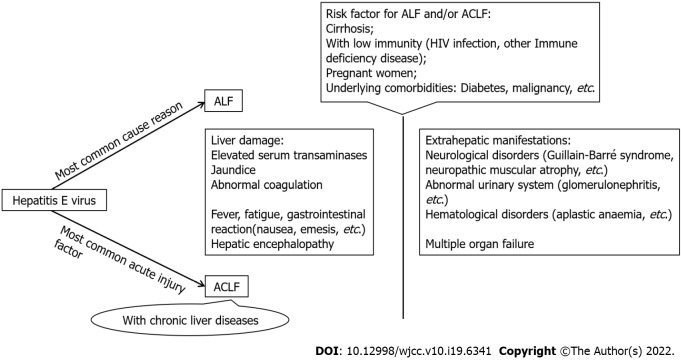
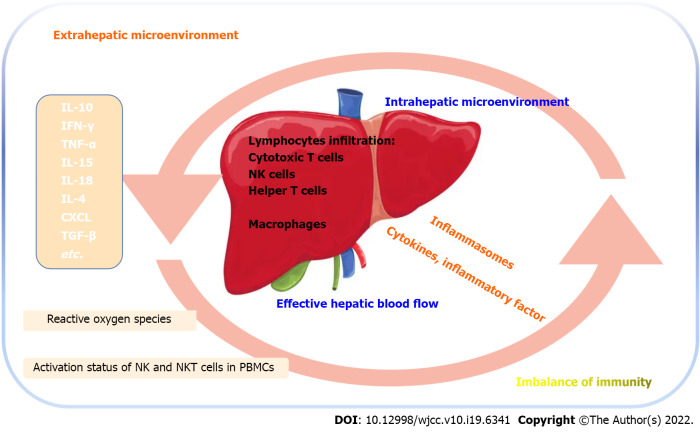
Hepatitis E virus (HEV) is the most common cause of acute liver failure (LF) and one of the most common factors causing acute injury in acute-on-chronic LF (ACLF). When HEV-related LF occurs, a series of changes take place in both the intrahepatic environment and extrahepatic microenvironment. The changed types and distribution of immune cells (infiltrating macrophages and increased lymphocytes) in liver tissue, as well the increased proinflammatory cytokines and chemokines in the blood, indicate that the occurrence and progression of HEV-related LF are closely related to immune imbalance. The clinical features and immune reaction in the body during HEV-related acute LF (ALF) and ACLF are complicated. This review highlights recent progress in elucidating the clinical manifestations of HEV-associated ALF and ACLF and discusses the corresponding systemic immune changes and possible regulatory mechanisms.
Keywords: Acute liver failure; Acute-on-chronic liver failure; Cytokines; Hepatitis E virus; Immune cells; Mechanism.
©The Author(s) 2022. Published by Baishideng Publishing Group Inc. All rights reserved.
Conflict of interest statement
Conflict-of-interest statement: All the authors declare no conflict of interest related to the manuscript.
Figures
References
-
- Zhang S, Chen C, Peng J, Li X, Zhang D, Yan J, Zhang Y, Lu C, Xun J, Li W, Ling Y, Huang Y, Chen L. Investigation of underlying comorbidities as risk factors for symptomatic human hepatitis E virus infection. Aliment Pharmacol Ther. 2017;45:701–713. - PubMed
Publication types
LinkOut - more resources
Full Text Sources
