


Actively incorporating lifestyle modifications into daily life: The key to adherence in a lifestyle intervention programme for metabolic syndrome
- PMID: 35979455
- PMCID: PMC9376606
- DOI: 10.3389/fpubh.2022.929043
Actively incorporating lifestyle modifications into daily life: The key to adherence in a lifestyle intervention programme for metabolic syndrome
Abstract
Introduction: Lifestyle modifications are the first-line interventions for metabolic syndrome (MetS) management. The effectiveness of lifestyle interventions depends mostly on participants' adherence to the interventions. The current study was to explore the experiences of MetS patients in attending lifestyle intervention program (LIP) and the factors that influenced their adherence to the interventions.
Methods: A descriptive qualitative study was designed following the COREQ guideline. Face-to-face semi-structured individual interviews were conducted with a purposive sample from the participants who attended the LIP using the data saturation principle. Content analysis of transcripts was conducted following the methods proposed by Graneheim and Lundman.
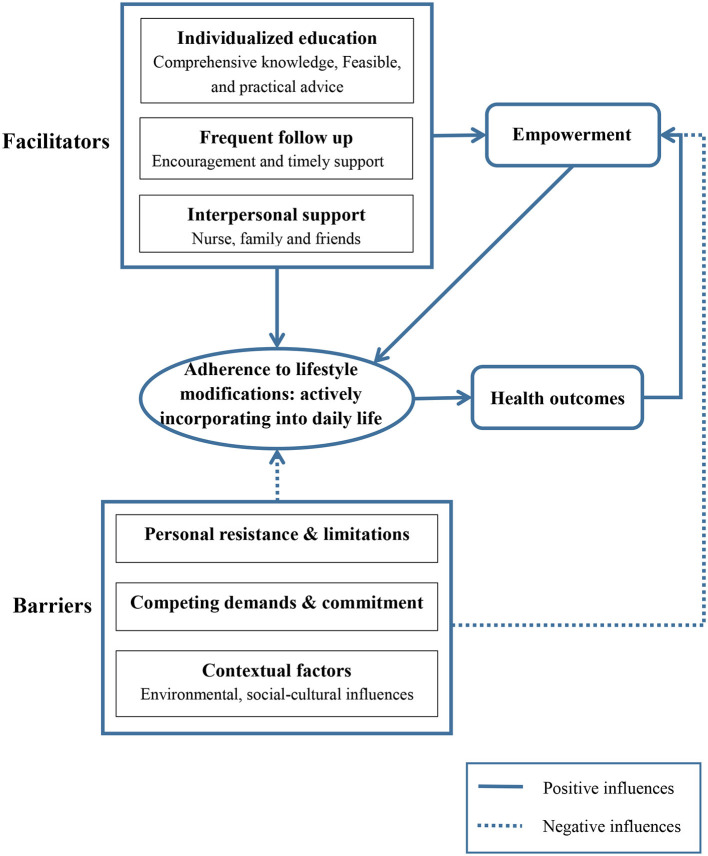
Results: The study recruited 27 participants, including 13 males and 14 females. Four themes were identified: (i) the positive and beneficial experiences of attending the LIP, including incorporating lifestyle modifications into daily life, improved physical and psychological health, and empowerment; (ii) facilitators of adherence, including individualized lifestyle education, regular follow-ups, and adequate interpersonal support; (iii) barriers to adherence, including personal resistance, competing demands, and contextual factors; (iv) suggestions for future interventions: with multidisciplinary team, longer term intervention, and more efficient approaches. The findings also indicated that young-to-middle aged patients faced more conflicts with role-related commitments, and were open for e-approaches in lifestyle interventions.
Conclusion: The LIP provided positive and beneficial experiences for the participants. Actively incorporating lifestyle modifications into daily life is the key to maintain participants' adherence to the LIP. Culturally appropriate and psycho-behavioral strategies should be adopted to overcome personal and contextual barriers. Special attentions should be paid for the young-to-middle aged population in MetS management.
Keywords: adherence; experiences; lifestyle intervention; metabolic syndrome; qualitative research.
Copyright © 2022 Wang, Chair, Wong and Qiu.
Conflict of interest statement
The authors declare that the research was conducted in the absence of any commercial or financial relationships that could be construed as a potential conflict of interest.
Figures
References
-
- International Diabetes Federation . The IDF Consensus Worldwide Definition of the Metabolic Syndrome. Belgium: IDF; (2006).
-
- Huang JJ, Huang JL, Withers M, Chien KL, Trihandini I, Elcarte E, et al. . Prevalence of metabolic syndrome in Chinese women and men: a systematic review and meta-analysis of data from 734,511 individuals. Lancet. (2018) 392:S14. 10.1016/S0140-6736(18)32643-6 - DOI
-
- Alberti KG, Eckel RH, Grundy SM, Zimmet PZ, Cleeman JI, Donato KA, et al. . Harmonizing the metabolic syndrome: a joint interim statement of the International Diabetes Federation Task Force on Epidemiology and Prevention; National Heart, Lung, and Blood Institute; American Heart Association; World Heart Federation; International Atherosclerosis Society; and International Association for the Study of Obesity. Circulation. (2009) 120:1640–5. 10.1161/CIRCULATIONAHA.109.192644 - DOI - PubMed
Publication types
MeSH terms
LinkOut - more resources
Full Text Sources
Medical
