


Evaluating the concordance of functional MRI-based language lateralization and Wada testing in epilepsy patients: A single-center analysis
- PMID: 35979608
- PMCID: PMC10549711
- DOI: 10.1177/15910199221121384
Evaluating the concordance of functional MRI-based language lateralization and Wada testing in epilepsy patients: A single-center analysis
Abstract
Background: For patients with drug-resistant epilepsy, surgery may be effective in controlling their disease. Surgical evaluation may involve localization of the language areas using functional magnetic resonance imaging (fMRI) or Wada testing. We evaluated the accuracy of task-based fMRI versus Wada-based language lateralization in a cohort of our epilepsy patients.
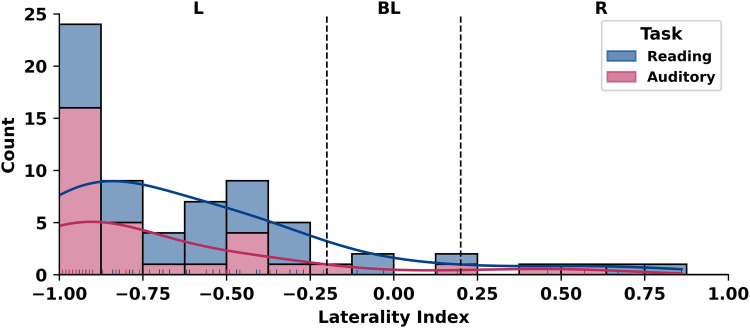
Methods: In a single-center, retrospective analysis, we identified patients with medically intractable epilepsy who participated in presurgical language mapping (n = 35) with fMRI and Wada testing. Demographic variables and imaging metrics were obtained. We calculated the laterality index (LI) from task-evoked fMRI activation maps across language areas during auditory and reading tasks to determine lateralization. Possible scores for LI range from -1 (strongly left-hemisphere dominant) to 1 (strongly right-hemisphere dominant). Concordance between fMRI and Wada was estimated using Cohen's Kappa coefficient. Association between the LI scores from the auditory and reading tasks was tested using Spearman's rank correlation coefficient.
Results: The fMRI-based laterality indices were concordant with results from Wada testing in 91.4% of patients during the reading task (κ = .55) and 96.9% of patients during the auditory task (κ = .79). The mean LIs for the reading and auditory tasks were -0.52 ± 0.43 and -0.68 ± 0.42, respectively. The LI scores for the language and reading tasks were strongly correlated, r(30) = 0.57 (p = 0.001).
Conclusion: Our findings suggest that fMRI is generally an accurate, low-risk alternative to Wada testing for language lateralization. However, when fMRI indicates atypical language lateralization (e.g., bilateral dominance), patients may benefit from subsequent Wada testing or intraoperative language mapping.
Keywords: Epilepsy; Wada test; fMRI; language; lateralization.
Conflict of interest statement
Declaration of conflicting interestsThe author(s) declared no potential conflicts of interest with respect to the research, authorship, and/or publication of this article.
Figures
References
-
- Beghi E. The epidemiology of epilepsy. Neuroepidemiology 2020; 54: 185–191. - PubMed
-
- Kwan P, Brodie MJ. Early identification of refractory epilepsy. New Engl J Med 2000; 342: 314–319. - PubMed
-
- French JA. Refractory epilepsy: clinical overview. Epilepsia 2007; 48: 3–7. - PubMed
-
- Kwan P, Arzimanoglou A, Berg AT, et al. Definition of drug resistant epilepsy: consensus proposal by the ad hoc task force of the ILAE commission on therapeutic strategies. Epilepsia 2010; 51: 1069–1077. - PubMed
-
- Spencer S, Huh L. Outcomes of epilepsy surgery in adults and children. Lancet Neurol 2008; 7: 525–537. - PubMed
MeSH terms
Grants and funding
LinkOut - more resources
Full Text Sources
Medical
