


Implementing a Novel Statewide Network to Support Emergency Department-initiated Buprenorphine Treatment
- PMID: 35980408
- PMCID: PMC9391018
- DOI: 10.5811/westjem.2022.3.54680
Implementing a Novel Statewide Network to Support Emergency Department-initiated Buprenorphine Treatment
Abstract
Introduction: Medications for opioid use disorder (MOUD), including buprenorphine, represent an evidence-based treatment that supports long-term recovery and reduces risk of overdose death. Patients in crisis from opioid use disorder (OUD) often seek care from emergency departments (ED). The New York Medication for Addiction Treatment and Electronic Referrals (MATTERS) network is designed to support ED-initiated buprenorphine and urgent referrals to long-term care for patients suffering from OUD.
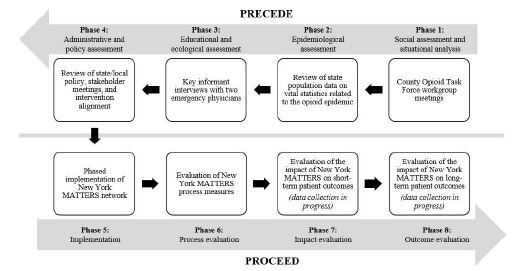
Methods: Using the PRECEDE-PROCEED implementation science framework, we provide an overview of the creation of the MATTERS network in Western New York. We also include an explanation of how the network was designed and launched as a response to the opioid epidemic. Finally, we analyzed the program's outputs and outcomes, thus far, as it continues to grow across the state.
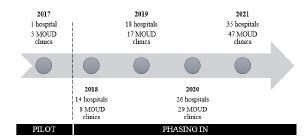
Results: The New York MATTERS network was created and implemented in 2019 with a single hospital referring patients with OUD to three local clinics. In the social assessment and situational analysis phase, we describe the opioid epidemic and available resources in the region at the outset of the program. In the epidemiological assessment phase, we quantify the epidemic on the state and regional levels. In the educational and ecological assessment, we review local ED practices and resources. In the administrative and policy assessment and intervention alignment phase, the program's unique framework is reviewed. In the piloting phase, we describe the initial deployment of New York MATTERS. Finally, in the process evaluation phase, we depict the early lessons we learned. By the beginning of 2021, the New York MATTERS network included 35 hospitals that refer to 47 clinics throughout New York State.
Conclusion: The New York MATTERS network provides a structured approach to reduce barriers to ED-initiated buprenorphine and urgent referral to long-term care. An implementation framework provides a structured means of evaluating this best practice model.
Conflict of interest statement
Figures
Similar articles
-
Implementation facilitation to promote emergency department-initiated buprenorphine for opioid use disorder: protocol for a hybrid type III effectiveness-implementation study (Project ED HEALTH).Implement Sci. 2019 May 7;14(1):48. doi: 10.1186/s13012-019-0891-5. Implement Sci. 2019. PMID: 31064390 Free PMC article.
-
Implementation of emergency department-initiated buprenorphine for opioid use disorder in a rural southern state.J Subst Abuse Treat. 2020 Mar;112S:73-78. doi: 10.1016/j.jsat.2020.02.007. J Subst Abuse Treat. 2020. PMID: 32220414 Free PMC article. Clinical Trial.
-
Implementation of a rural emergency department-initiated buprenorphine program in the mountain west: a study protocol.Addict Sci Clin Pract. 2024 Sep 3;19(1):63. doi: 10.1186/s13722-024-00496-0. Addict Sci Clin Pract. 2024. PMID: 39228007 Free PMC article.
-
A practical review of buprenorphine utilization for the emergency physician in the era of decreased prescribing restrictions.Am J Emerg Med. 2021 Oct;48:316-322. doi: 10.1016/j.ajem.2021.06.065. Epub 2021 Jul 5. Am J Emerg Med. 2021. PMID: 34274576 Review.
-
Approach to buprenorphine use for opioid withdrawal treatment in the emergency setting.Am J Emerg Med. 2019 Jan;37(1):143-150. doi: 10.1016/j.ajem.2018.10.013. Epub 2018 Oct 11. Am J Emerg Med. 2019. PMID: 30355476 Review.
Cited by
-
National Institute on Drug Abuse Clinical Trials Network Meeting Report: Advancing Emergency Department Initiation of Buprenorphine for Opioid Use Disorder.Ann Emerg Med. 2023 Sep;82(3):326-335. doi: 10.1016/j.annemergmed.2023.03.025. Epub 2023 May 12. Ann Emerg Med. 2023. PMID: 37178101 Free PMC article.
-
Antecedents of fatal overdose in an adult cohort identified through administrative record linkage in Indiana, 2015-2022.Drug Alcohol Depend. 2023 Jun 1;247:109891. doi: 10.1016/j.drugalcdep.2023.109891. Epub 2023 Apr 22. Drug Alcohol Depend. 2023. PMID: 37120921 Free PMC article.
-
Perspectives of Clinicians and Staff at Community-Based Opioid Use Disorder Treatment Settings on Linkages With Emergency Department-Initiated Buprenorphine Programs.JAMA Netw Open. 2023 May 1;6(5):e2312718. doi: 10.1001/jamanetworkopen.2023.12718. JAMA Netw Open. 2023. PMID: 37163263 Free PMC article.
-
Using RE-AIM to evaluate the implementation of a social marketing and free product distribution project for fentanyl and xylazine test strips in New York State.Harm Reduct J. 2025 Jun 12;22(1):105. doi: 10.1186/s12954-025-01259-z. Harm Reduct J. 2025. PMID: 40506707 Free PMC article.
References
-
- Hasegawa K, Espinola JA, Brown DF, et al. Trends in U.S. emergency department visits for opioid overdose, 1993–2010. Pain Med. 2014;15(10):1765–70. - PubMed
-
- Manchikanti L, Kaye AM, Knezevic NN, et al. Responsible, safe, and effective prescription of opioids for chronic non-cancer pain: American Society of Interventional Pain Physicians (ASIPP) Guidelines. Pain Physician. 2017;20(2S):S3–S92. - PubMed