


Delirium, changes in cognitive function, and risk of diagnosed dementia after kidney transplantation
- PMID: 35980673
- PMCID: PMC10138281
- DOI: 10.1111/ajt.17176
Delirium, changes in cognitive function, and risk of diagnosed dementia after kidney transplantation
Abstract
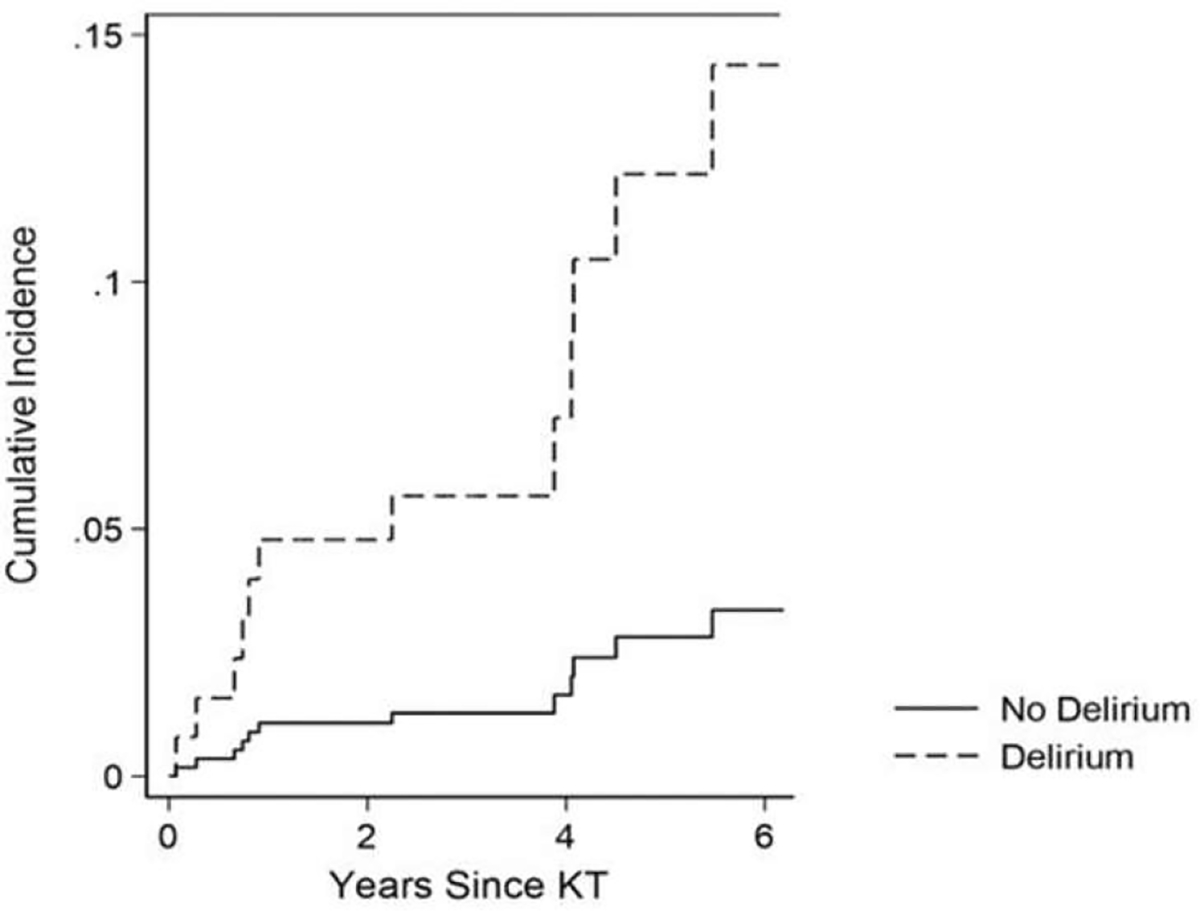
Kidney transplant (KT) recipients with delirium, a preventable surgical complication, are likely to reap cognitive benefits from restored kidney function, but may be more vulnerable to longer-term neurotoxic stressors post-KT (i.e., aging, immunosuppression). In this prospective cohort study, we measured delirium (chart-based), global cognitive function (3MS), and executive function (Trail Making Test Part B minus Part A) in 894 recipients (2009-2021) at KT, 1/3/6-months, 1-year, and annually post-KT. Dementia was ascertained using linked Medicare claims. We described repeated measures of cognitive performance (mixed effects model) and quantified dementia risk (Fine & Gray competing risk) by post-KT delirium. Of 894 recipients, 43(4.8%) had post-KT delirium. Delirium was not associated with global cognitive function at KT (difference = -3.2 points, 95%CI: -6.7, 0.4) or trajectories post-KT (0.03 points/month, 95%CI: -0.27, 0.33). Delirium was associated with worse executive function at KT (55.1 s, 95%CI: 25.6, 84.5), greater improvements in executive function <2 years post-KT (-2.73 s/month, 95%CI: -4.46,-0.99), and greater decline in executive function >2 years post-KT (1.72 s/month, 95%CI: 0.22, 3.21). Post-KT delirium was associated with over 7-fold greater risk of dementia post-KT (adjusted subdistribution hazard ratio = 7.84, 95%CI: 1.22, 50.40). Transplant centers should be aware of cognitive risks associated with post-KT delirium and implement available preventative interventions to reduce delirium risk.
Keywords: clinical research/practice; cognitive function; delirium; epidemiology; health services and outcomes research; kidney disease; kidney transplant; kidney transplantation/nephrology; mental health; neurology.
© 2022 The American Society of Transplantation and the American Society of Transplant Surgeons.
Conflict of interest statement
DISCLOSURE
The authors of this manuscript have no conflicts of interest to disclose as described by the
Figures

Similar articles
-
Association of Postoperative Delirium With Incident Dementia and Graft Outcomes Among Kidney Transplant Recipients.Transplantation. 2024 Feb 1;108(2):530-538. doi: 10.1097/TP.0000000000004779. Epub 2023 Aug 29. Transplantation. 2024. PMID: 37643030 Free PMC article.
-
Incidence, Risk Factors, and Sequelae of Post-kidney Transplant Delirium.J Am Soc Nephrol. 2018 Jun;29(6):1752-1759. doi: 10.1681/ASN.2018010064. Epub 2018 Apr 23. J Am Soc Nephrol. 2018. PMID: 29685884 Free PMC article.
-
Long-Term Trajectories of Frailty and Its Components After Kidney Transplantation.J Gerontol A Biol Sci Med Sci. 2022 Dec 29;77(12):2474-2481. doi: 10.1093/gerona/glac051. J Gerontol A Biol Sci Med Sci. 2022. PMID: 35184167 Free PMC article.
-
Association of postoperative delirium with cognitive outcomes: A meta-analysis.J Clin Anesth. 2021 Dec;75:110496. doi: 10.1016/j.jclinane.2021.110496. Epub 2021 Sep 2. J Clin Anesth. 2021. PMID: 34482263 Review.
-
An overview of frailty in kidney transplantation: measurement, management and future considerations.Nephrol Dial Transplant. 2020 Jul 1;35(7):1099-1112. doi: 10.1093/ndt/gfaa016. Nephrol Dial Transplant. 2020. PMID: 32191296 Free PMC article. Review.
Cited by
-
Age Is Just a Number for Older Kidney Transplant Patients.Transplantation. 2025 Jan 1;109(1):133-141. doi: 10.1097/TP.0000000000005073. Epub 2024 May 21. Transplantation. 2025. PMID: 38771060 Review.
-
Association of Postoperative Delirium With Incident Dementia and Graft Outcomes Among Kidney Transplant Recipients.Transplantation. 2024 Feb 1;108(2):530-538. doi: 10.1097/TP.0000000000004779. Epub 2023 Aug 29. Transplantation. 2024. PMID: 37643030 Free PMC article.
-
The Relationship between Delirium and Dementia.Semin Neurol. 2024 Dec;44(6):732-751. doi: 10.1055/s-0044-1791543. Epub 2024 Oct 11. Semin Neurol. 2024. PMID: 39393800 Review.
-
Comprehensive Geriatric Assessment (CGA) and Optimisation Services in Older Kidney Patients: Results from the First UK-Wide Transplant Centre and Renal Unit Survey Study.J Clin Med. 2025 Apr 29;14(9):3070. doi: 10.3390/jcm14093070. J Clin Med. 2025. PMID: 40364102 Free PMC article.
-
Intradialytic Cognitive and Aerobic Exercise Training to Preserve Cognitive Function: IMPCT, a Multi-Dialysis Center 2 × 2 Factorial Block-Randomized Controlled Trial.Am J Nephrol. 2025 May 10:1-13. doi: 10.1159/000546296. Online ahead of print. Am J Nephrol. 2025. PMID: 40349685 Free PMC article.
References
Publication types
MeSH terms
Grants and funding
LinkOut - more resources
Full Text Sources
Medical
