. 2022 Oct 10;61(41):e202211304.
doi: 10.1002/anie.202211304. Epub 2022 Sep 6.

Closed Aromatic Tubes-Capsularenes

Affiliations

Closed Aromatic Tubes-Capsularenes

Radoslav Z Pavlović et al. Angew Chem Int Ed Engl. .

Abstract

In this study, we describe a synthetic method for incorporating arenes into closed tubes that we name capsularenes. First, we prepared vase-shaped molecular baskets 4-7. The baskets comprise a benzene base fused to three bicycle[2.2.1]heptane rings that extend into phthalimide (4), naphthalimide (6), and anthraceneimide sides (7), each carrying a dimethoxyethane acetal group. In the presence of catalytic trifluoroacetic acid (TFA), the acetals at top of 4, 6 and 7 change into aliphatic aldehydes followed by their intramolecular cyclization into 1,3,5-trioxane (1 H NMR spectroscopy). Such ring closure is nearly a quantitative process that furnishes differently sized capsularenes 1 (0.7×0.9 nm), 8 (0.7×1.1 nm;) and 9 (0.7×1.4 nm;) characterized by X-Ray crystallography, microcrystal electron diffraction, UV/Vis, fluorescence, cyclic voltammetry, and thermogravimetry. With exceptional rigidity, unique topology, great thermal stability, and perhaps tuneable optoelectronic characteristics, capsularenes hold promise for the construction of novel organic electronic devices.

Keywords: Acenes; Aromatic Compounds; Molecular Electronics; Supramolecular Catalysis; Trioxanes.


Conflict of interest statement

The authors declare no conflict of interest.

Figures
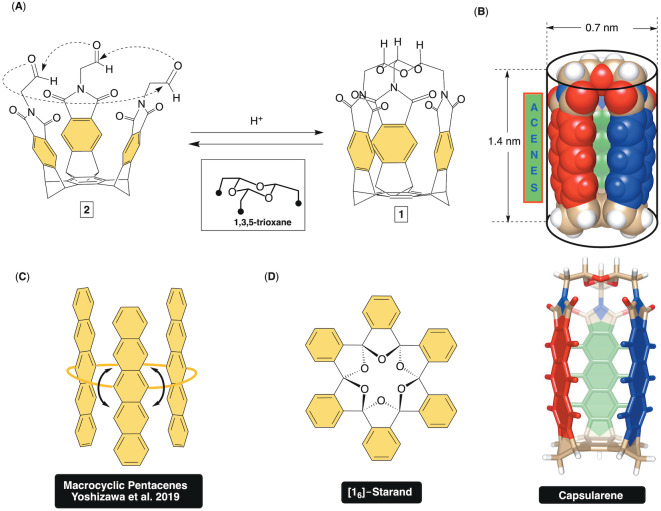
Figure 1
Figure 1
A) Acid promoted conversion of basket 2 into capsularene 1. B) Van der Waals and stick representations of energy minimized capsularene (PM3) with anthraceneimide sides. C) A cyclotrimer of pentacene was used for studying singlet fission. D) Chemical structure of [1 6]‐starand.
Figure 2
Figure 2
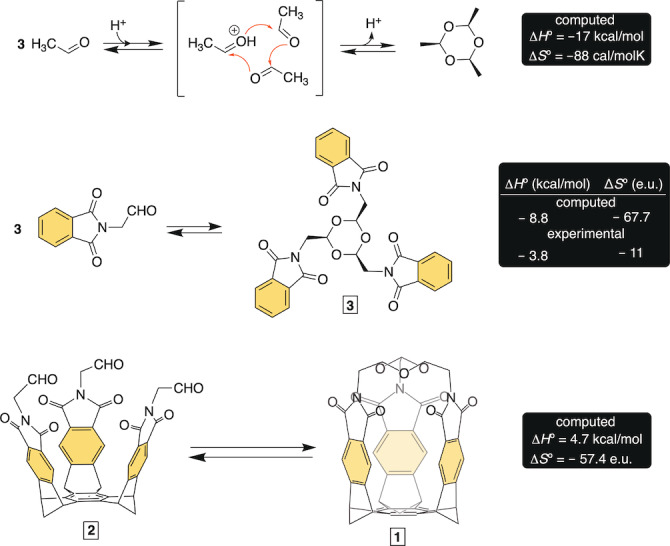
Computed (DFT/B3LYP:6‐31+G*) and experimental (NMR) data pertaining the conversion of acetaldehyde (top), phthalimidoacetaldehyde (middle) and basket 2 (bottom) into corresponding 1,3,5‐trioxanes.
Figure 3
Figure 3
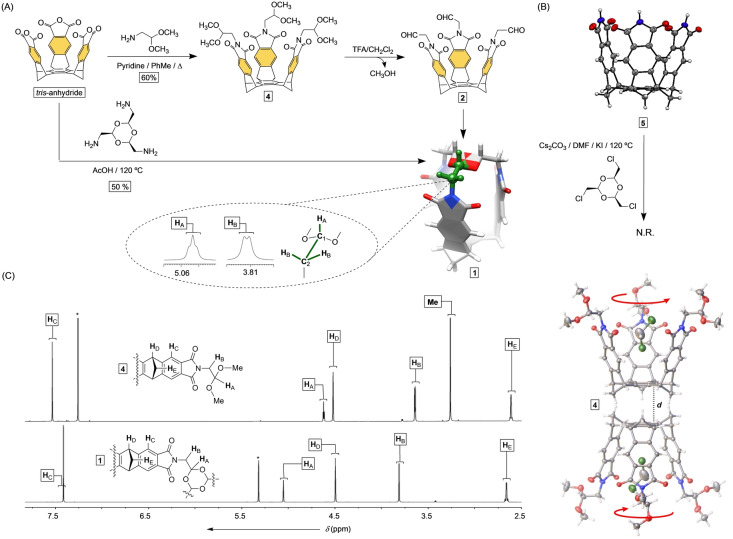
A) Synthesis of tris‐acetal 4 and its TFA catalyzed conversion into capsularene 1, with basket 2 forming as an intermediate. The condensation of tris‐anhydride and tris(methylamine)‐trioxane gave capsule 1 in 50 % yield. B) The coupling of tris‐imide 5 with tris(chloromethyl)‐trioxane gave no desired products. ORTEP plots (50 % probability) of X‐ray structures of tris‐imide basket 5 (top) and tris‐acetal basket 4 (bottom). C) 1H NMR spectra (850 MHz, 298 K) of tris‐acetal basket 4 (CDCl3) and capsularene 1 (CD2Cl2).
Figure 4
Figure 4
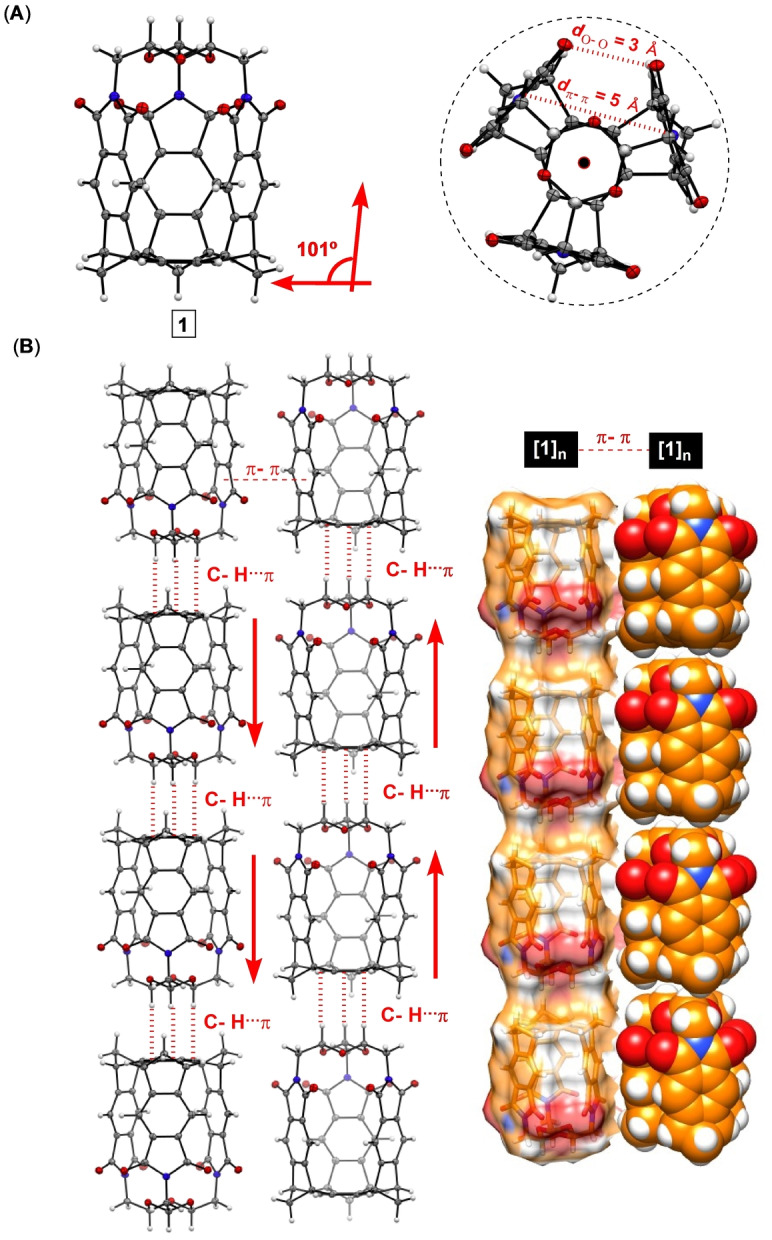
A) ORTEP (50 % probability) plots of capsularene 1 with B) these molecules packing into 1D arrays along the crystallographic a axis.
Figure 5
Figure 5
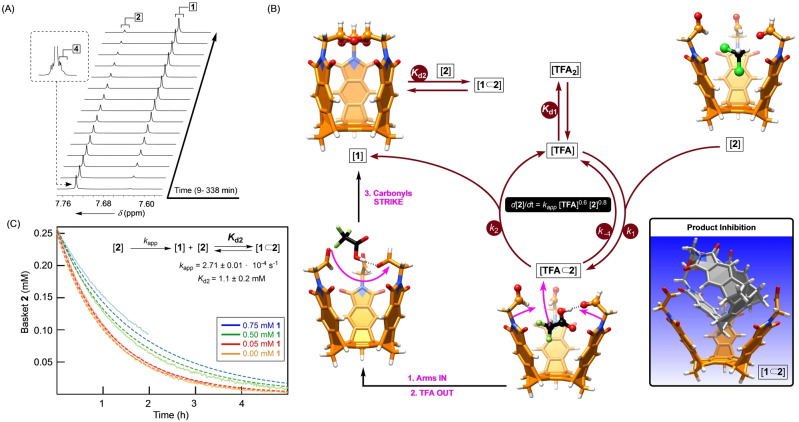
A) The conversion of 1.92 mM tris‐acetal basket 4 in CD2Cl2, containing 3.27 M TFA, into 1 was monitored with 1H NMR spectroscopy (850 MHz, 298 K). A segment of recorded spectra for a period of 338 min is shown. B) The proposed catalytic cycle for the formation of capsularene 1 from tris‐aldehyde basket 2 with the corresponding kinetic parameters and energy minimized structures (OPLS3) of the participating molecules. C) Changes in the concentration of 0.25 mM basket 2, measured for varying initial concentrations of basket 1, were fitted as a function of time to a model of product inhibition to determine the rate coefficient k app and the dissociation constant K d2.
Figure 6
Figure 6
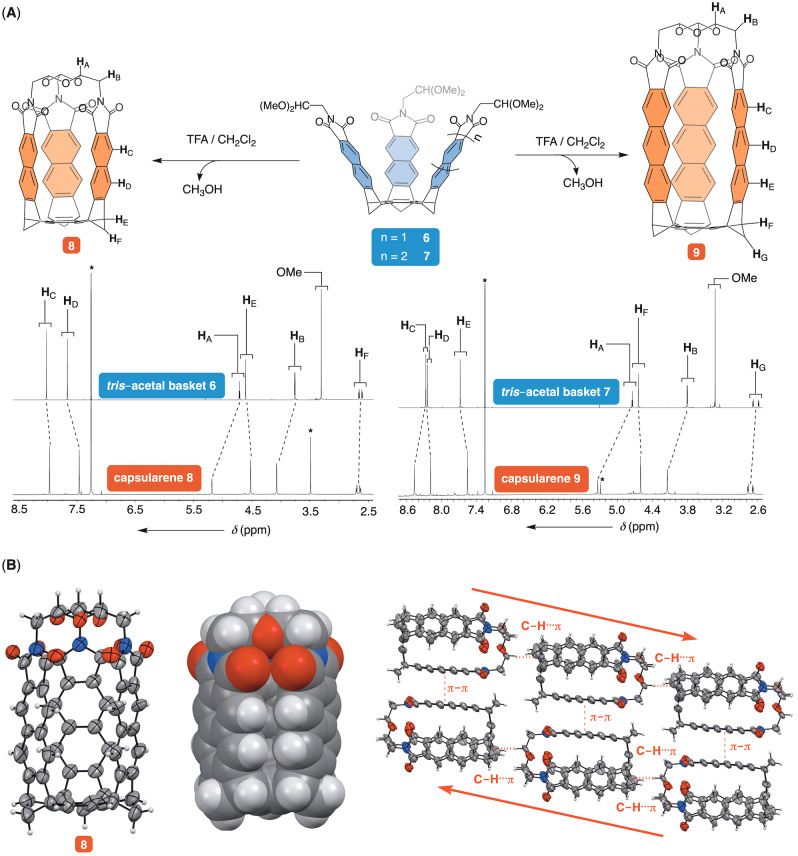
A) Capsularenes 8 and 9 were obtained from tris‐acetal baskets 6 and 7, respectively. 1H NMR spectra (850 MHz, 298 K) of 69 in CDCl3 are shown at the bottom; note that CDCl3 solution of capsularenes 9 contains TFA (for improving its solubility). B) ORTEP plot (50 % probability) and CPK representation of capsularene 8 obtained from MicroED analysis. (Right) Capsularenes 8 form 1D arrays along crystallographic b axis.
Figure 7
Figure 7
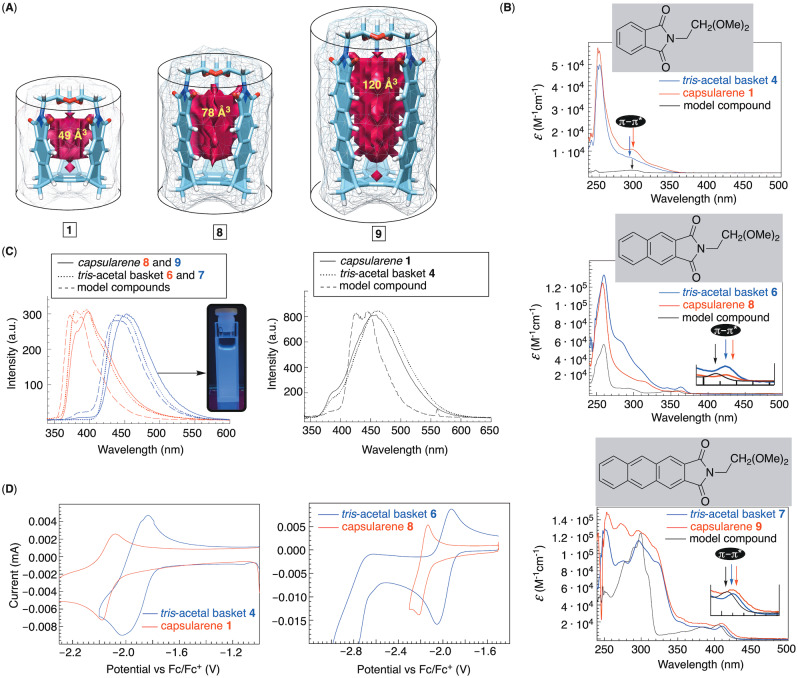
A) Energy‐minimized structures (DFT:B3LYP/6‐31+G*) of capsularenes 1, 8 and 9 with their inner volumes. B) UV/Vis spectra of model compounds tris‐acetal baskets 4,6 and 7 and capsularenes 1, 8 and 9 in CH2Cl2 at 298 K. C) Emission spectra (λ exc=280 nm) of model compounds, tris‐acetal baskets 4, 6 and 7 and capsularenes 1, 8 and 9 in CH2Cl2. D) Cyclic voltammograms of tris‐acetal basket 4, tris‐acetal basket 6, capsularene 1 and capsularene 8 in DMF containing TBAPF6.

References

    1. None
    1. Guo Q.-H., Qiu Y., Wang M.-X., Stoddart J. F., Nat. Chem. 2021, 13, 402; - PubMed
    1. Li Y., Kono H., Maekawa T., Segawa Y., Yagi A., Itami K., Acc. Mater. Res. 2021, 2, 681;
    1. Ball M., Zhong Y., Wu Y., Schenck C., Ng F., Steigerwald M., Xiao S., Nuckolls C., Acc. Chem. Res. 2015, 48, 267; - PubMed
    1. Zhang B., Hernandez Sanchez R., Zhong Y., Ball M., Terban M. W., Paley D., Billinge S. J. L., Ng F., Steigerwald M. L., Nuckolls C., Nat. Commun. 2018, 9, 1957. - PMC - PubMed

LinkOut - more resources