


Breast cancer metastasis: Is it a matter of OMICS and proper ex-vivo models?
- PMID: 35983233
- PMCID: PMC9355905
- DOI: 10.1016/j.csbj.2022.07.044
Breast cancer metastasis: Is it a matter of OMICS and proper ex-vivo models?
Abstract
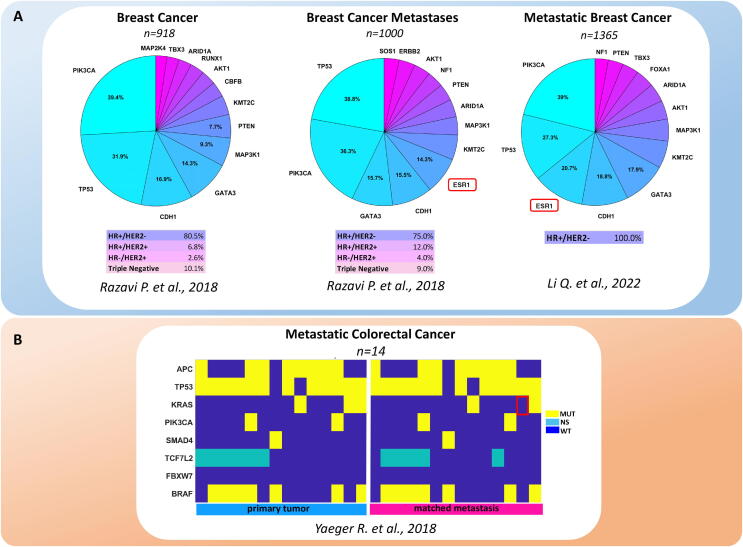
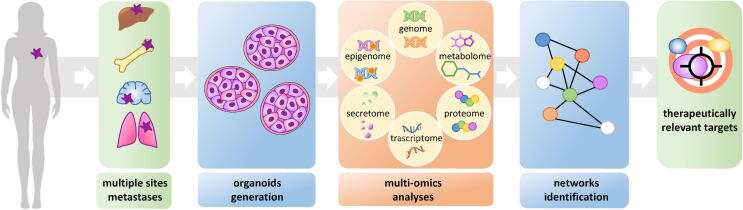
Genomics has greatly increased the understanding of the study of breast cancer (BC) and has shaped the concept of intra-tumor heterogeneity, currently recognized as a propelling force for cancer progression. In this context, knowledge and understanding of metastatic breast cancer (mBC) has somehow lagged behind that of primary breast cancer. This may be explained by the relative scarcity of matched mBC samples, however it is possible that the mutation spectrum obtained from primary BC does not capture the full complexity of the metastatic disease. Here, we provide a few examples supporting this possibility, from public databases. We evoke the need to perform an integrated multi-OMICS characterization of mBC, to obtain a broad understanding of this complex disease, whose evolution cannot be explained solely by genomics. Pertinent to this, we suggest that rather an infrequent use of Patient-Derived -Tumor-Organoids (PDTOs) may be influenced by assuming that the metastatic conditions of PDTOs growth (mPDTOs) should be similar to those of the tissue of origin. We challenge this view by suggesting that the use of "target-organ inspired" growth conditions for mPDTOs, may better fit the emerging knowledge of metastatic disease. Thus, the integrated use of multi-OMICS and of clinically relevant mPDTOs may allow a further understanding of such disease and foster therapeutically relevant advances. We believe that our points may be valid for other solid cancers.
Keywords: Genomic; Metastatic breast cancer; Organoids; PDTO; Proteomic; multi-OMICS.
© 2022 The Author(s).
Conflict of interest statement
The authors declare that they have no known competing financial interests or personal relationships that could have appeared to influence the work reported in this paper.
Figures
References
-
- Pelletier E.M., Shim B., Goodman S., Amonkar M.M. Epidemiology and economic burden of brain metastases among patients with primary breast cancer: results from a US claims data analysis. Breast Cancer Res Treat. 2008;108(2):297–305. - PubMed
-
- Aftimos P., Oliveira M., Irrthum A., Fumagalli D., Sotiriou C., Gal-Yam E.N., et al. Genomic and transcriptomic analyses of breast cancer primaries and matched metastases in AURORA, the Breast International Group (BIG) molecular screening initiative. Cancer Discov. 2021;11(11):2796–2811. - PMC - PubMed
Publication types
LinkOut - more resources
Full Text Sources