


Complementary and Alternative Therapies for Onychomycosis: A Systematic Review of the Clinical Evidence
- PMID: 35983465
- PMCID: PMC9274952
- DOI: 10.1159/000521703
Complementary and Alternative Therapies for Onychomycosis: A Systematic Review of the Clinical Evidence
Abstract
Introduction: Onychomycosis is notoriously difficult to treat. While oral antifungals are the most efficacious treatment for onychomycosis, they are contraindicated in certain patient populations, and patients may desire lower risk and accessible alternatives to systemic agents. In this study, we examine the clinical evidence supporting the use of complementary and alternative therapies in the treatment of onychomycosis.
Methods: PubMed, Embase, and Cochrane Library were searched for clinical trials, observational studies, and case reports/case series, examining the efficacy of a complementary or alternative therapy for the treatment of onychomycosis.
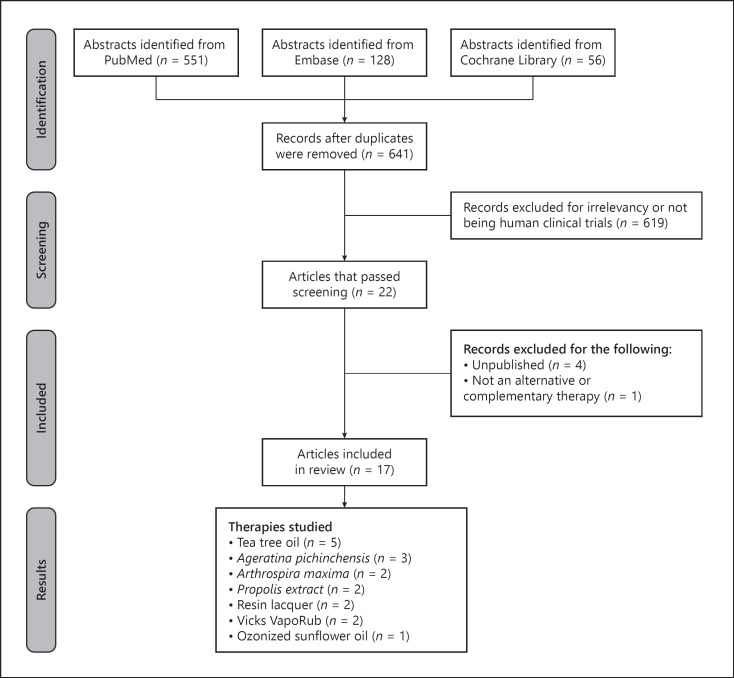
Results: We identified 17 articles studying a complementary and alternative therapy for onychomycosis, including tea tree oil (n = 5), Ageratina pichinchensis (n = 3), Arthrospira maxima (n = 2), natural coniferous resin lacquer (n = 2), Vicks VapoRub® (n = 2), propolis extract (n = 2), and ozonized sunflower oil (n = 1).
Conclusion: Given the rise of antifungal resistance, complementary and alternative therapies should continue to be studied as adjunctive or alternative therapy for onychomycosis. While preliminary evidence exists for several complementary and alternative therapies in the treatment of onychomycosis, large-scale, randomized, placebo-controlled trials are needed prior to endorsing their use to patients.
Keywords: Ageratina pichinchensis; Arthrospira maxima; Complementary and alternative medicine; Onychomycosis; Tea tree oil.
Copyright © 2022 by S. Karger AG, Basel.
Conflict of interest statement
The authors have no conflicts of interest to declare.
Figures
References
-
- Gupta AK, Jain HC, Lynde CW, Macdonald P, Cooper EA, Summerbell RC. Prevalence and epidemiology of onychomycosis in patients visiting physicians' offices: a multicenter canadian survey of 15,000 patients. J Am Acad Dermatol. 2000 Aug;43((2 Pt 1)):244–8. - PubMed
-
- Lipner SR, Scher RK. Onychomycosis: clinical overview and diagnosis. J Am Acad Dermatol. 2019 Apr;80((4)):835–51. - PubMed
-
- Gupta AK, Stec N. Emerging drugs for the treatment of onychomycosis. Expert Opin Emerg Drugs. 2019 Dec;24((4)):213–20. - PubMed
-
- Gupta AK, Renaud HJ, Quinlan EM, Shear NH, Piguet V. The growing problem of antifungal resistance in onychomycosis and other superficial mycoses. Am J Clin Dermatol. 2021 Mar;22((2)):149–57. - PubMed
-
- Phan K, Kaur K, Wright K, Tran S, Stewart B, Brown M, et al. The penetrance of topical nail therapy: limitations and current enhancements. Clin Podiatr Med Surg. 2021 Oct;38((4)):535–40. - PubMed
Publication types
LinkOut - more resources
Full Text Sources
