


How is leadership behavior associated with organization-related variables? Translation and psychometric evaluation of the implementation leadership scale in German primary healthcare
- PMID: 35986273
- PMCID: PMC9391066
- DOI: 10.1186/s12913-022-08434-z
How is leadership behavior associated with organization-related variables? Translation and psychometric evaluation of the implementation leadership scale in German primary healthcare
Abstract
Background: The Implementation Leadership Scale (ILS) was developed to assess leadership behavior with regard to being proactive, knowledgeable, supportive, or perseverant in implementing evidence-based practices (EBPs). As part of a study on the implementation of a digitally supported polypharmacy management application in primary care, the original ILS was translated and validated for use in the German language.
Rationale: This study aimed to translate the original ILS into German and evaluate its psychometric properties.
Methods: The validation sample consisted of 198 primary care physicians in a cluster-randomized controlled trial in which the intervention group implemented a digitally supported clinical decision support system for polypharmacy management. The ILS was assessed using a 12-item scale. The study included a process evaluation with two evaluation waves between 2019 and 2021. The ILS was used within this process evaluation study to assess the leadership support with regard to the implementation of the polypharmacy management. The ILS was translated in a multi-step process, including pre-testing of the instrument and triple, back-and-forth translation of the instrument. We tested the reliability (Cronbach's alpha) and validity (construct and criterion-related validity) of the scale.
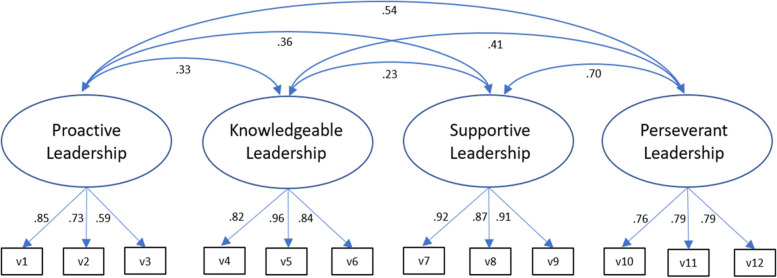
Results: The four-dimensional structure of the instrument was confirmed (comparative fit index = .97; root mean square error of approximation = .06). Convergent validity was demonstrated by correlations with organizational innovation climate, social capital, and workload, which was consistent with the proposed hypothesis. Criterion-related validity of the ILS was demonstrated by predicting the organizational readiness for change scores using structural equation modeling. The reliability of the scale was good (α = .875).
Conclusion: The German version of the ILS created in this study is a reliable and valid measure. The original four-dimensional structure of the ILS was confirmed in a primary care setting. Further psychometric testing is needed to establish the validity and reliability of the ILS and to transfer it to other health care settings. It is a useful tool for identifying the areas for implementation leadership development. Further research is needed on how, why, and when distinct types of leadership behaviors have different effects on healthcare organizations in implementation processes.
Keywords: Change management; Digital technology; Innovation climate; Leadership; Medication therapy management; Organizational culture; Social Capital.
© 2022. The Author(s).
Conflict of interest statement
Prof. Holger Pfaff is a member of the editorial board of BMC Health Services Research. All other authors declare that they have no competing interests.
Figures

References
-
- Bass BM. Two decades of Research and Development in transformational leadership. Euro J Work Orga Psych. 1999;8:9–32. doi: 10.1080/135943299398410. - DOI
-
- Ayolio BJ, Bass BM. The full range leadership development prograns: basic and advanced manuals. Avolio & Associates, Binghamton, NY: Bass; 1991.
-
- Jung DI, Chow C, Wu A. The role of transformational leadership in enhancing organizational innovation: hypotheses and some preliminary findings. Leadersh Q. 2003;14:525–544. doi: 10.1016/S1048-9843(03)00050-X. - DOI
Publication types
MeSH terms
LinkOut - more resources
Full Text Sources
Research Materials
