Review
. 2022 Aug 19;14(1):96.
doi: 10.1186/s13073-022-01100-3.

Clinical implications of host genetic variation and susceptibility to severe or critical COVID-19

Affiliations
Review

Clinical implications of host genetic variation and susceptibility to severe or critical COVID-19

Caspar I van der Made et al. Genome Med. .

Abstract

Since the start of the coronavirus disease 2019 (COVID-19) pandemic, important insights have been gained into virus biology and the host factors that modulate the human immune response against severe acute respiratory syndrome coronavirus 2 (SARS-CoV-2). COVID-19 displays a highly variable clinical picture that ranges from asymptomatic disease to lethal pneumonia. Apart from well-established general risk factors such as advanced age, male sex and chronic comorbidities, differences in host genetics have been shown to influence the individual predisposition to develop severe manifestations of COVID-19. These differences range from common susceptibility loci to rare genetic variants with strongly predisposing effects, or proven pathogenic variants that lead to known or novel inborn errors of immunity (IEI), which constitute a growing group of heterogeneous Mendelian disorders with increased susceptibility to infectious disease, auto-inflammation, auto-immunity, allergy or malignancies. The current genetic findings point towards a convergence of common and rare genetic variants that impact the interferon signalling pathways in patients with severe or critical COVID-19. Monogenic risk factors that impact IFN-I signalling have an expected prevalence between 1 and 5% in young, previously healthy individuals (<60 years of age) with critical COVID-19. The identification of these IEI such as X-linked TLR7 deficiency indicates a possibility for targeted genetic screening and personalized clinical management. This review aims to provide an overview of our current understanding of the host genetic factors that predispose to severe manifestations of COVID-19 and focuses on rare variants in IFN-I signalling genes and their potential clinical implications.


Conflict of interest statement

The authors declare that they have no competing interests.

Figures
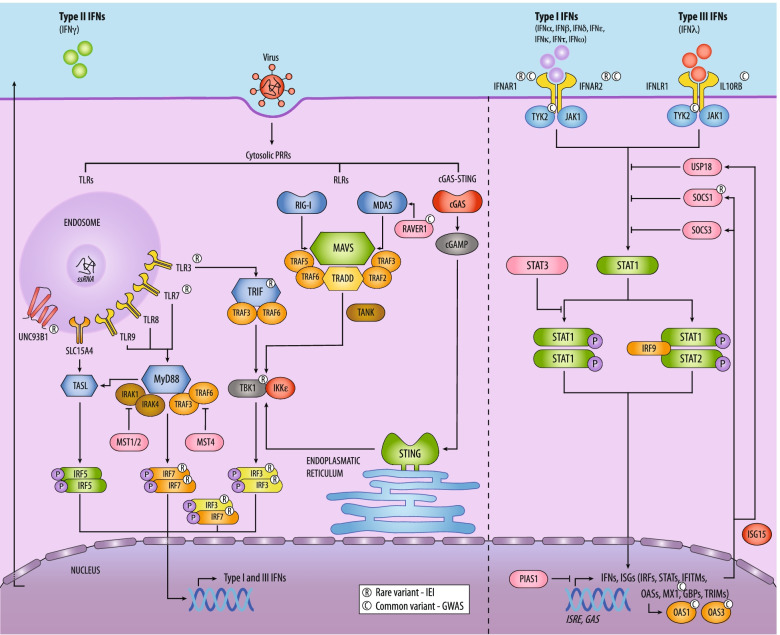
Fig. 1
Fig. 1
A schematic representation of interferon signalling with display of current genetic findings. The left section of the figure points out the three major cytosolic pattern recognition receptor (PRR) signalling pathways that recognize viruses and culminate in the production of defensive type I and III interferons (IFNs). These routes consist of Toll-like receptor (TLR), RIG-I-like receptor (RLR) and cGAS-STING signalling pathways that utilize distinct adaptor complexes with associating kinases and ubiquitin ligases for their signal transduction. These TASL, MyD88, TRIF and MAVS complexes subsequently lead to the phosphorylation of interferon regulatory factors (IRFs) that initiate transcription of IFNs. Furthermore, the production of the type II IFN interferon gamma (IFNγ) is induced through TLR7-IRF7-dependent signalling. The right section shows autocrine and paracrine signalling of type I and III IFNs through the respective IFNAR1/2 and IFNLR1/IL10RB receptors. This activation leads to the formation of either STAT1 homo- or STAT1/2 heterodimers that recruit IRF9 to induce transcription of IFNs and a plethora of interferon-stimulated genes (ISGs). Several inhibitory proteins are highlighted in pink to illustrate a selection of the negatively regulating feedback loops in this highly regulated pathways. Lastly, symbols above selected proteins indicate whether rare or common variants have been identified in the genes from which these proteins are encoded. P, phosphatase; STAT, signal transducer and activator of transcription; IFITM, interferon-induced transmembrane protein; OAS, oligoadenylate synthase; MX1, interferon-induced GTP-binding protein; GBP, guanylate-binding protein; TRIM, tripartite motif protein; ISRE, interferon-stimulated response element; GAS, gamma-activated sequence
Fig. 2
Fig. 2
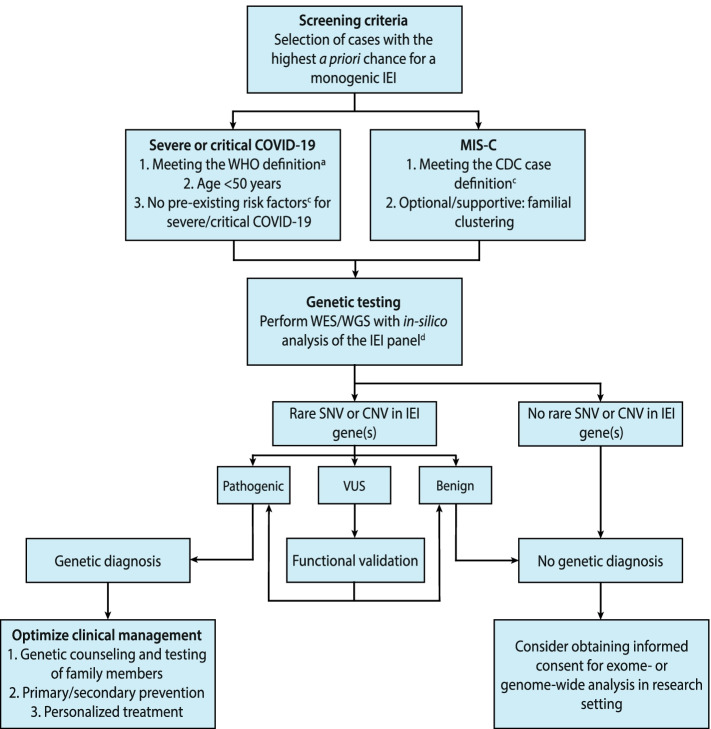
Clinical screening criteria for the implementation of genetic testing to discover rare host genetic factors predisposing to severe/critical COVID-19 or MIS-C. This flowchart proposes genetic screening criteria and a strategy for genetic testing in patients with severe forms of COVID-19 that are suspected of having an underlying IEI. aThe diagnostic clinical criteria for severe or critical COVID-19 have been defined according to the WHO definition [133]. bRisk factors that have been associated with severe or critical COVID-19 include chronic comorbidities such as hypertension, diabetes mellitus, obesity (BMI ≥30kg/m2), heart failure, chronic lung disease and chronic kidney disease. cThe diagnostic clinical criteria for MIS-C have been defined according to the CDC case definition [134]. dThe in silico IEI gene panel should contain the genes listed by the most recent update of the International Union for Immunological Societies [67]

References

    1. Guan W-J, Ni Z-Y, Hu Y, Liang W-H, Ou C-Q, He J-X, et al. Clinical characteristics of coronavirus disease 2019 in China. N Engl J Med. 2020;382(18):1708–1720. doi: 10.1056/NEJMoa2002032. - DOI - PMC - PubMed
    1. Richardson S, Hirsch JS, Narasimhan M, Crawford JM, McGinn T, Davidson KW, et al. Presenting characteristics, comorbidities, and outcomes among 5700 patients hospitalized with COVID-19 in the New York City area. JAMA. 2020;323(20):2052–2059. doi: 10.1001/jama.2020.6775. - DOI - PMC - PubMed
    1. Casanova J-L, Su HC, Abel L, Aiuti A, Almuhsen S, Arias AA, et al. A global effort to define the human genetics of protective immunity to SARS-CoV-2 infection. Cell. 2020;181(6):1194–1199. doi: 10.1016/j.cell.2020.05.016. - DOI - PMC - PubMed
    1. The C-HGI The COVID-19 Host Genetics Initiative, a global initiative to elucidate the role of host genetic factors in susceptibility and severity of the SARS-CoV-2 virus pandemic. Eur J Hum Genet. 2020;28(6):715–718. doi: 10.1038/s41431-020-0636-6. - DOI - PMC - PubMed
    1. Tay MZ, Poh CM, Rénia L, MacAry PA, Ng LFP. The trinity of COVID-19: immunity, inflammation and intervention. Nat Rev Immunol. 2020;20(6):363–374. doi: 10.1038/s41577-020-0311-8. - DOI - PMC - PubMed

Publication types

Substances