. 2022 Nov 15;36(21):e9380.
doi: 10.1002/rcm.9380.

Micro-punches versus micro-slices for serial sampling of human dentine: Striking a balance between improved temporal resolution and measuring additional isotope systems

Affiliations

Micro-punches versus micro-slices for serial sampling of human dentine: Striking a balance between improved temporal resolution and measuring additional isotope systems

Christina Cheung et al. Rapid Commun Mass Spectrom. .

Abstract

Rationale: The last decade has seen a dramatic increase in the application of serial sampling of human dentine in archaeology. Rapid development in the field has provided many improvements in the methodology, in terms of both time resolution as well as the ability to integrate more isotope systems in the analysis. This study provides a comparison of two common sampling approaches, allowing researchers to select the most suitable approach for addressing specific research questions.

Methods: Two common approaches for sequential sampling of human dentine (micro-punches and micro-slices) are compared in terms of viability and efficacy. Using archaeological deciduous second molars and permanent first molars, this study demonstrates how the two approaches capture aspects of the weaning process in different ways. In addition, different aspects related to the extraction protocols, such as the thickness of the central slide and the solubilisation step, are also evaluated.

Results: While both approaches show similar intra-tooth isotopic patterns, the micro-punches approach is preferable for research that requires a very fine temporal resolution, while the micro-slices approach is best for research where δ34 S values are needed, or when the samples are poorly preserved. In addition, the solubilisation step has a large effect on collagen yield, and, to a lesser extent, on isotopic compositions. Therefore, it is important to ensure that only samples that have undergone the same pre-treatment protocol are directly compared.

Conclusions: We present the pros and cons of the two micro-sampling approaches and offer possible mitigation strategies to address some of the most important issues related to each approach.


Figures

FIGURE 1
FIGURE 1
(A) The demineralised ‘central slide’ of a first molar (T3 – 199) and (B) a schematic drawing of the tooth showing the general direction of dental growth, the three anatomical regions, and their respective estimated growth periods. The growth layers and age estimations are adapted from Czermak et al [Color figure can be viewed at wileyonlinelibrary.com]
FIGURE 2
FIGURE 2
Pictures of T6 (BLR19 – M1) at various stages of preparation for serial sampling. (A) Before demineralisation, the tooth is cut into three parts along the longitudinal axis: (i) the buccal slide; (ii) the lingual slide; (iii) the central (sampling) slide. (B) The demineralised middle slide. (C) The thickness of the middle slide shown next to a biopsy pen [Color figure can be viewed at wileyonlinelibrary.com]
FIGURE 3
FIGURE 3
Unfiltered dentine collagen from the roots of T8 (BLR23 ‐ M1). The sample was solubilised and spun down using a mini‐centrifuge before the lyophilisation step. Note the precipitates collected at the bottom of the lyophilised collagen [Color figure can be viewed at wileyonlinelibrary.com]
FIGURE 4
FIGURE 4
Sampling of T3. (A) Schematic of the sampling site. P refers to micro‐punches; S refers to micro‐slices. A total of 21 micro‐punches and 11 micro‐slices are obtained from this tooth. (B) The tooth after micro‐punches were taken [Color figure can be viewed at wileyonlinelibrary.com]
FIGURE 5
FIGURE 5
Comparisons of the δ13C values of the three standards measured at the two laboratories and different analytical sessions. Shaded red areas are the expected values of each respective standard. Post hoc pairwise comparisons are performed using the Wilcoxon test, with the p values of each test shown above the respective pairing [Color figure can be viewed at wileyonlinelibrary.com]
FIGURE 6
FIGURE 6
Weight of samples plotted against their measured atomic C/N ratios. Open circles represent unsolubilised dentine samples; filled circles represent solubilised dentine samples. (A) Samples sent to Iso‐Analytical for CN analysis. (B) Samples sent to SFU for CNS analysis. Blue dash‐dotted lines indicate the theoretical ideal threshold of atomic C/N ratio for quality control at 3.3. Red line in (A) indicates the recommended analytical weight threshold for isotope analysis at 0.3 mg [Color figure can be viewed at wileyonlinelibrary.com]
FIGURE 7
FIGURE 7
Stable isotope compositions of all four Early Modern teeth (T1–T4). The subsections, indicated by ①, ②, and ③, refer to the three anatomical sections: crown, cervix, and roots, respectively. (A) Stable carbon isotope compositions of micro‐samples plotted against sampling locations, (B) Stable nitrogen isotope compositions of micro‐samples plotted against sampling locations. (C) Stable sulfur isotope compositions of micro‐samples plotted against sampling locations. (D) Images of each tooth post‐demineralisation and prior to sampling [Color figure can be viewed at wileyonlinelibrary.com]
FIGURE 8
FIGURE 8
Stable isotope compositions of the four Neolithic teeth (T5–T8). T5 and T6 come from the same individual (BLR19), whereas T7 and T8 come from another individual (BLR23). T5 and T7 are both deciduous second molars (dm2), whereas T6 and T8 are permanent first molars (M1) [Color figure can be viewed at wileyonlinelibrary.com]
FIGURE 9
FIGURE 9
Collagen lost in % (black) and in mg (red) after the solubilisation step. Trend lines shown are logarithmic; shaded areas are the confidence level intervals, set at 0.95 [Color figure can be viewed at wileyonlinelibrary.com]
FIGURE 10
FIGURE 10
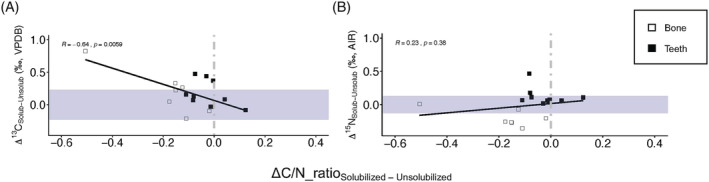
Effect of solubilisation on the isotopic measurements and elemental concentrations of bones and teeth. (A) Net changes in δ 13C values (Δ13C) of tested bone and teeth samples plotted against net changes in the atomic C/N ratios of each tested sample after solubilisation. (B). Net changes in δ 15N values (Δ15N) of tested bone and teeth samples plotted against net changes in the atomic C/N ratios of each tested sample after solubilisation. Shaded areas indicate instrumental analytical errors (±0.23‰ for δ13C and ±0.13‰ for δ15N) [Color figure can be viewed at wileyonlinelibrary.com]

References

    1. Clayton F, Sealy J, Pfeiffer S. Weaning age among foragers at Matjes river rock shelter, South Africa, from stable nitrogen and carbon isotope analyses. Am J Phys Anthropol. 2006;129(2):311‐317. doi:10.1002/ajpa.20248 - DOI - PubMed
    1. Fahy G, Richards M, Fuller B, Deschner T, Hublin J‐J, Boesch C. Stable nitrogen isotope analysis of dentine serial sections elucidates sex differences in weaning patterns of wild chimpanzees (Pan troglodytes). Am J Phys Anthropol. 2014;153(4):635‐642. doi:10.1002/ajpa.22464 - DOI - PubMed
    1. Stantis C, Buckley H, Commendador A, Dudgeon J. Expanding on incremental dentin methodology to investigate childhood and infant feeding practices on Taumako (Southeast Solomon Islands). J Archaeol Sci. 2021;126:105294. doi:10.1016/j.jas.2020.105294 - DOI
    1. Guiry E, Hepburn J, Richards M. High‐resolution serial sampling for nitrogen stable isotope analysis of archaeological mammal teeth. J Archaeol Sci. 2016;69:21‐28. doi:10.1016/j.jas.2016.03.005 - DOI
    1. Makarewicz C. Winter pasturing practices and variable fodder provisioning detected in nitrogen (δ15N) and carbon (δ13C) isotopes in sheep dentinal collagen. J Archaeol Sci. 2014;41:502‐510. doi:10.1016/j.jas.2013.09.016 - DOI

LinkOut - more resources