


FunAndes - A functional trait database of Andean plants
- PMID: 35987763
- PMCID: PMC9392769
- DOI: 10.1038/s41597-022-01626-6
FunAndes - A functional trait database of Andean plants
Abstract
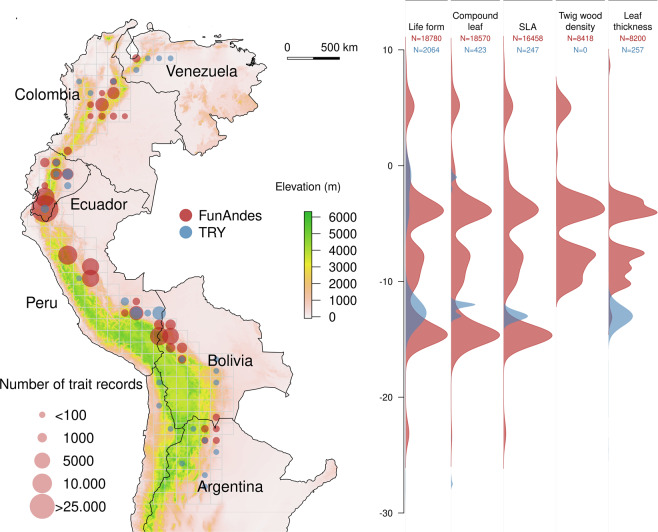
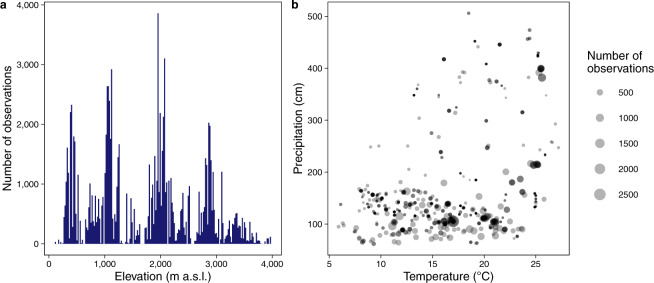
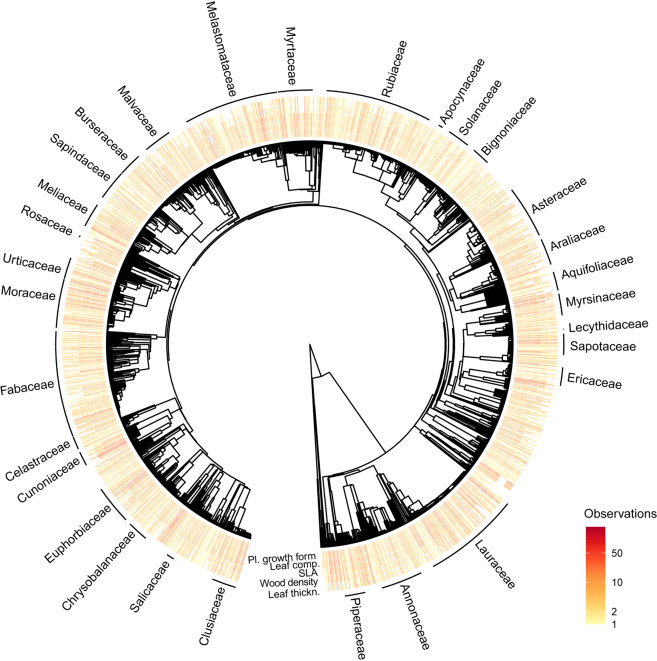
We introduce the FunAndes database, a compilation of functional trait data for the Andean flora spanning six countries. FunAndes contains data on 24 traits across 2,694 taxa, for a total of 105,466 entries. The database features plant-morphological attributes including growth form, and leaf, stem, and wood traits measured at the species or individual level, together with geographic metadata (i.e., coordinates and elevation). FunAndes follows the field names, trait descriptions and units of measurement of the TRY database. It is currently available in open access in the FIGSHARE data repository, and will be part of TRY's next release. Open access trait data from Andean plants will contribute to ecological research in the region, the most species rich terrestrial biodiversity hotspot.
© 2022. The Author(s).
Conflict of interest statement
The authors declare no competing interests.
Figures
References
-
- Violle C, et al. Let the concept of trait be functional! Oikos. 2007;116:882–892. doi: 10.1111/j.0030-1299.2007.15559.x. - DOI
-
- Enquist, B. J. et al. In Advances in Ecological Research Vol. Volume 52 (eds G., Woodward, S., Pawar & Dell Anthony, I.) 249–318 (Academic Press, 2015).
-
- Suding KN, et al. Scaling environmental change through the community-level: a trait-based response-and-effect framework for plants. Global Change Biology. 2008;14:1125–1140. doi: 10.1111/j.1365-2486.2008.01557.x. - DOI
-
- Reich PB. The world-wide ‘fast–slow’ plant economics spectrum: a traits manifesto. Journal of Ecology. 2014;102:275–301. doi: 10.1111/1365-2745.12211. - DOI
Publication types
MeSH terms
LinkOut - more resources
Full Text Sources
