


Optimising a multi-strategy implementation intervention to improve the delivery of a school physical activity policy at scale: findings from a randomised noninferiority trial
- PMID: 35987776
- PMCID: PMC9392334
- DOI: 10.1186/s12966-022-01345-6
Optimising a multi-strategy implementation intervention to improve the delivery of a school physical activity policy at scale: findings from a randomised noninferiority trial
Erratum in
-
Correction: Optimising a multi‑strategy implementation intervention to improve the delivery of a school physical activity policy at scale: findings from a randomised noninferiority trial.Int J Behav Nutr Phys Act. 2025 Aug 13;22(1):110. doi: 10.1186/s12966-025-01776-x. Int J Behav Nutr Phys Act. 2025. PMID: 40804389 Free PMC article. No abstract available.
Abstract
Background: To maximise their potential health benefits, school-based physical activity policies need to be implemented at scale. This paper describes the third in a sequence of trials that sought to optimise an effective strategy (PACE) to assist schools' implementation of a physical activity policy. Specifically, it aimed to determine the probability that a multi-strategy intervention adapted to reduce in-person contact (Adapted PACE) was "as good as" the original intervention (PACE) in increasing the weekly minutes of structured physical activity implemented by classroom teachers.
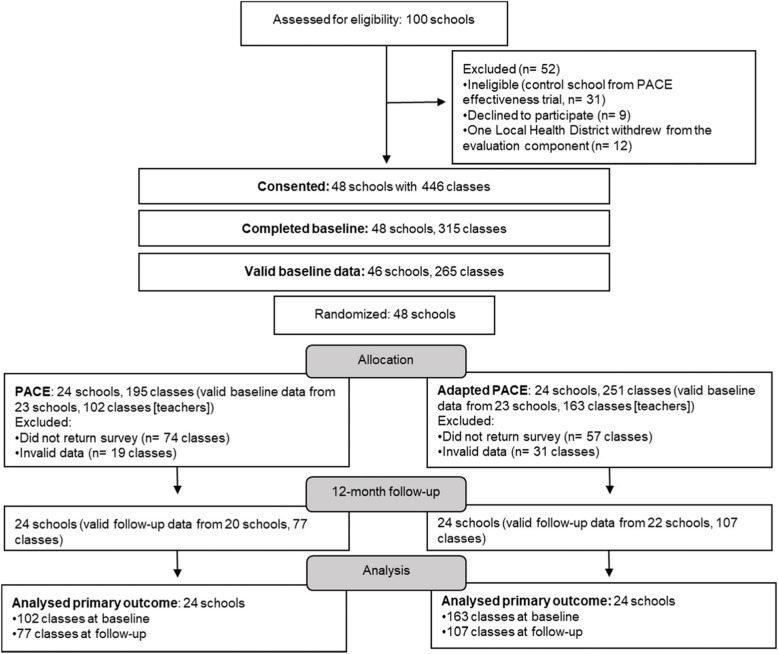
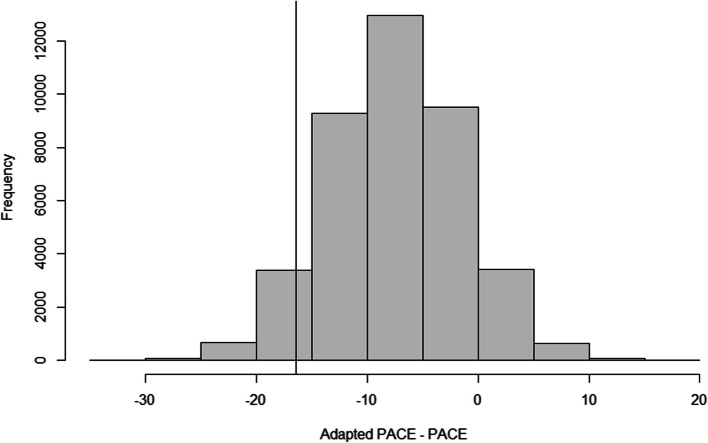
Methods: A noninferiority cluster randomised controlled trial was undertaken with 48 primary schools in New South Wales, Australia. Schools were randomised to receive PACE or a model with adaptations made to the delivery modes (Adapted PACE). Teachers' scheduled minutes of weekly physical activity was assessed at baseline (Oct 2018-Feb 2019) and 12-month follow-up (Oct-Dec 2019). The noninferiority margin was set at - 16.4 minutes based on previous data and decision panel consensus. A linear mixed model analysed within a Bayesian framework was used to explore noninferiority between the two PACE models. A cost minimisation analysis was conducted from the health service provider perspective, using the Australian dollar (AUD).
Results: The posterior estimate for the between group difference at follow-up was - 2.3 minutes (95% credible interval = - 18.02, 14.45 minutes). There was an estimated 96% probability of Adapted PACE being considered noninferior (only 4% of the posterior samples crossed the noninferiority margin of - 16.4 minutes). That is, the minutes of physical activity implemented by teachers at Adapted PACE schools was not meaningfully less than the minutes of physical activity implemented by teachers at PACE schools. The mean total cost was AUD$25,375 (95% uncertainty interval = $21,499, $29,106) for PACE and AUD$16,421 (95% uncertainty interval = $13,974, $19,656) for Adapted PACE; an estimated reduction of AUD$373 (95% uncertainty interval = $173, $560) per school.
Conclusions: It is highly probable that Adapted PACE is noninferior to the original model. It is a cost-efficient alternative also likely to be a more suitable approach to supporting large scale implementation of school physical activity policies.
Trial registration: Retrospectively registered with the Australian New Zealand Clinical Trials Registry (ACTRN12619001229167).
Keywords: adaptations; children; implementation; noninferiority; optimisation; physical activity; policy; scale-up; school.
© 2022. The Author(s).
Conflict of interest statement
The authors declare that they have no competing interests.
Figures
References
-
- World Health Organization. Global action plan on physical activity 2018–2030: more active people for a healthier world. Geneva: World Health Organization; 2018. Available from: https://apps.who.int/iris/handle/10665/272722
-
- Stylianou M, Walker JL. An assessment of Australian school physical activity and nutrition policies. Aust N Z J Public Health. 2018;42(1):16–21. - PubMed
-
- Carlson JA, Sallis JF, Chriqui JF, Schneider L, McDermid LC, Agron P. State policies about physical activity minutes in physical education or during school. J Sch Health. 2013;83(3):150–6. - PubMed
-
- Nørager Johansen DL, Neerfeldt Christensen BF, Fester M, Koch B, Lund Kristensen P, Runge Larsen L, et al. Results from Denmark's 2018 report card on physical activity for children and youth. J Phys Act Health. 2018;15(s2):S341–S3. - PubMed
Publication types
MeSH terms
LinkOut - more resources
Full Text Sources
Medical
Research Materials
