


Malnutrition Imparts Worse Outcomes in Patients With Diverticulitis: A Nationwide Inpatient Sample Database Study
- PMID: 35989747
- PMCID: PMC9381886
- DOI: 10.7759/cureus.26973
Malnutrition Imparts Worse Outcomes in Patients With Diverticulitis: A Nationwide Inpatient Sample Database Study
Abstract
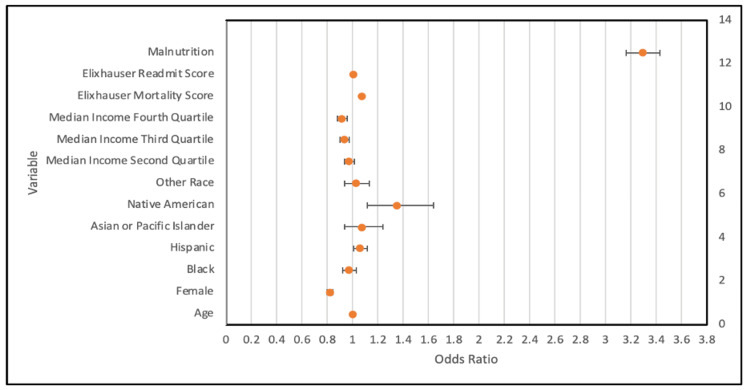
Introduction Studies show that malnutrition can lead to worsening morbidity and mortality in patients. However, to our knowledge, no large database study has been conducted describing the effects of malnutrition in patients with diverticulitis. In this article, we aim to assess the impact of pre-existing malnutrition on outcomes of patients admitted for diverticulitis. Methods Data between 2008 and 2014 from the Nationwide Inpatient Sample database were extracted. Inclusion criteria for both groups included patients with a primary diagnosis of diverticulitis using the International Classification of Diseases, Ninth Revision codes. Exclusion criteria included all patients less than 18 years of age. The test group consisted of patients with a primary diagnosis of diverticulitis and a concurrent diagnosis of malnutrition. In-hospital mortality, length of stay, total cost, and complications, including various forms of sepsis, perforation, bleeding, and GI bleeding, were compared between the two groups. Univariate and multivariate analyses were used to generate odds ratios. Multivariate analysis included age, sex, race, income quartile, and calculated Elixhauser scores. Elixhauser comorbidity scores predicting mortality and readmission were calculated based on weighted scores from 29 different comorbidities. Scores were compared between the two groups using univariate analysis. Results There were a total of 1,520,919 patients in the study, of which 427,679 (2.8%) had a pre-existing diagnosis of malnutrition. On univariate analysis, there was a significant increase in mortality in patients with malnutrition (OR: 10.2, p < 0.01). Additionally, patients with malnutrition appeared to have longer lengths of stay (mean: 12.9, p < 0.01) and greater cost of hospitalization (mean: 194436.82, p < 0.01). Patients with malnutrition had greater rates of sepsis events (OR: 12.0, p < 0.01), perforation (OR: 2.8, p < 0.01), and GI bleed (OR: 1.84, p < 0.01). On multivariate analysis, malnutrition appeared to significantly increase mortality (OR: 3.3, p < 0.01). Discussion Patients who present with diverticulitis with malnutrition appear to have significantly worse outcomes. We hypothesize that malnutrition leads to a shift in the gut microbiota, resulting in increased inflammation. As a result, these patients may have an increased risk of worse outcomes, such as sepsis and death. Addressing nutrition in patients with diverticulosis or those with a history of diverticulitis may improve outcomes. This abstract was previously presented at the Digestive Disease Week Conference on May 22, 2022. Abstracts accepted at the conference were published in supplements of the journals Gastroenterology and GIE: Gastrointestinal Endoscopy.
Keywords: diverticulitis; gastroenterology; internal medicine; malnutrition; sepsis.
Copyright © 2022, Shaikh et al.
Conflict of interest statement
The authors have declared that no competing interests exist.
Figures
References
-
- The pathology of diverticulosis coli. West AB, Losada M. J Clin Gastroenterol. 2004;38:0–6. - PubMed
-
- Diagnosis and management of acute diverticulitis. Wilkins T, Embry K, George R. https://www.aafp.org/pubs/afp/issues/2013/0501/p612.html. Am Fam Physician. 2013;87:612–620. - PubMed
-
- Colonic diverticular disease. Steel M. https://search.informit.org/doi/10.3316/informit.370579200187236. Aust Fam Physician. 2004;33:983–986. - PubMed
-
- Acute colonic diverticulitis. Swanson SM, Strate LL. Ann Intern Med. 2018;168:0–80. - PubMed
LinkOut - more resources
Full Text Sources
Research Materials