


Potential modifiable factors associated with late-life cognitive trajectories
- PMID: 35989918
- PMCID: PMC9381981
- DOI: 10.3389/fneur.2022.950644
Potential modifiable factors associated with late-life cognitive trajectories
Abstract
Objective: There is variability across individuals in cognitive aging. To investigate the associations of several modifiable factors with high and low cognitive performance.
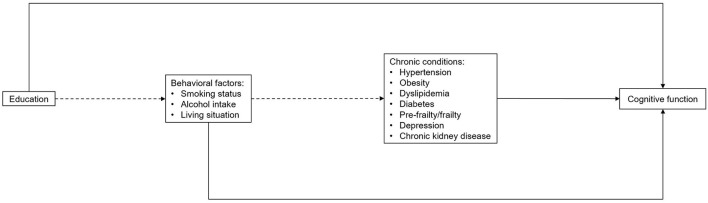
Methods: Data came from 17,724 community-dwelling individuals aged 65-98 years. Global cognition, verbal fluency, episodic memory, and psychomotor speed were assessed over up to seven years. Group-based multi-trajectory modeling identified distinct cognitive trajectories. Structural equation modeling examined the direct/indirect associations of social/behavioral factors and several chronic conditions with cognitive trajectories.
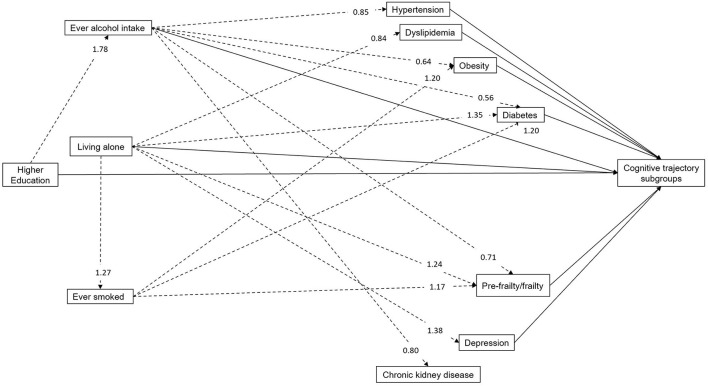
Results: Seven trajectory subgroups were identified. In the structural equation modeling we compared two subgroups-participants with the highest (14.2%) and lowest (4.1%) cognitive performance with the average subgroup. Lower education, never alcohol intake, and frailty directly predicted increased risk of low performance, and decreased likelihood of high performance. Hypertension (RR: 0.69, 95%CI: 0.60-0.80), obesity (RR: 0.84, 95%CI: 0.73-0.97), diabetes (RR: 0.69, 95%CI: 0.56-0.86) and depression (RR: 0.68, 95%CI: 0.54-0.85) only predicted lower likelihood of high cognitive performance, while dyslipidemia was only associated with low performance (RR: 1.30, 95%CI: 1.07-1.57). Living alone predicted increased risk of low cognitive performance and several comorbidities. Smoking did not predict cognitive trajectories but was associated with increased risk of diabetes, obesity and frailty. Findings were similar when examining the direct associations between modifiable risk factors and all seven cognitive subgroups.
Conclusions: Although several modifiable factors were associated with high performance, and reversely with low performance, this was not observed for obesity, hypertension and dyslipidemia. Further, health behaviors may affect cognitive function indirectly, via geriatric conditions. This indicates that strategies to promote healthy cognitive aging, may be distinct from those targeting dementia prevention.
Keywords: aging; association; behavior; cognitive function; social support; structural equation modeling.
Copyright © 2022 Wu, Woods, Chong, Orchard, McNeil, Shah, Wolfe, Murray, Storey and Ryan.
Conflict of interest statement
Author AM reports receiving consulting fees from Alkahest, Inc. and grants from the National Institute on Aging. RS reports grants for clinical research regarding dementia and Alzheimer's disease from the National Institutes of Health, the Centers for Medicare and Medicaid Services, the Department of Defense, and the Illinois Department of Public Health; being as a non-compensated member of the Board of Directors of the Alzheimer's Association–Illinois Chapter; and being as a site principal investigator or sub-investigator for clinical trials and research studies for which his institution (Rush University Medical Center) is sponsored (Amylyx Pharmaceuticals, Inc., Eli Lilly and Co., Inc., Genentech, Inc., Lundbeck, Inc., Merck and Co., Inc., Navidea Biopharmaceuticals, Novartis Pharmaceuticals, Inc., Roche Holdings AG, and Takeda Development Center Americas, Inc.). The remaining authors declare that the research was conducted in the absence of any commercial or financial relationships that could be construed as a potential conflict of interest.
Figures
References
Grants and funding
LinkOut - more resources
Full Text Sources
