Review
. 2022 Aug 15;23(1):457-472.
doi: 10.1080/14686996.2022.2106156. eCollection 2022.

Biocompatibility of titanium from the viewpoint of its surface

Affiliations
Review

Biocompatibility of titanium from the viewpoint of its surface

Takao Hanawa. Sci Technol Adv Mater. .

Abstract

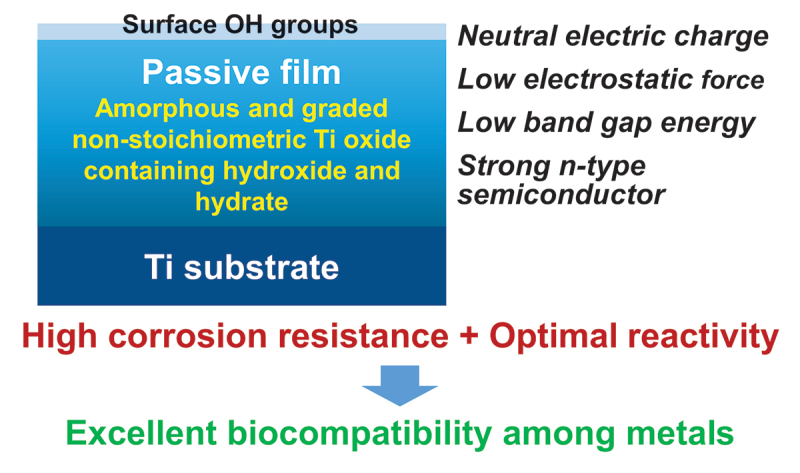
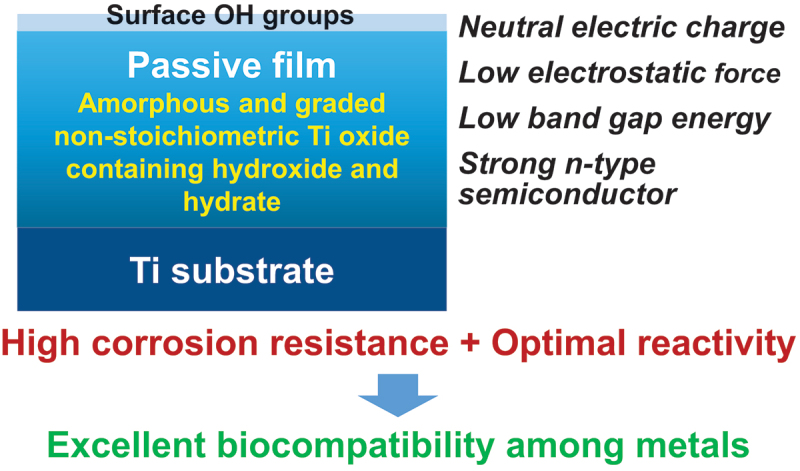
Among metals, Ti and majority of its alloys exhibit excellent biocompatibility or tissue compatibility. Although their high corrosion resistance is a factor in the biocompatibility of Ti and Ti alloys, it is clear that other factors exist. In this review, the corrosion resistance and passive film of Ti are compared to those of other metallic biomaterials, and their band gap energies, Egs, are compared to discuss the role of Eg in the reactivity with living tissues. From the perspective of the material's surface, it is possible to explain the excellent biocompatibility of Ti by considering the following factors: Ti ions are immediately stabilized not to show toxicity if it is released to body fluids; good balance of positive and negative charges by the dissociation of surface hydroxyl groups on the passive film; low electrostatic force of the passive film inducing a natural adsorption of proteins maintaining their natural conformation; strong property as n-type semiconductor; lower band gap energy of the passive film on Ti generating optimal reactivity; and calcium phosphate formation is caused by this reactivity. The results suggest that due to the passive oxide film, the optimal balance between high corrosion resistance and appropriate reactivity of Ti is the predominate solution for the excellent biocompatibility of Ti.

Keywords: Titanium; band gap energy; biocompatibility; corrosion resistance; electrostatic force; passive film; surface electric charge.


Conflict of interest statement

No potential conflict of interest was reported by the author(s).

Figures
None
Graphical abstract
Figure 1.
Figure 1.
Illustration of items reviewed and explained in this review.
Figure 2.
Figure 2.
Corrosion resistance and mechanical property as necessary condition for the biocompatibility and biofunction.
Figure 3.
Figure 3.
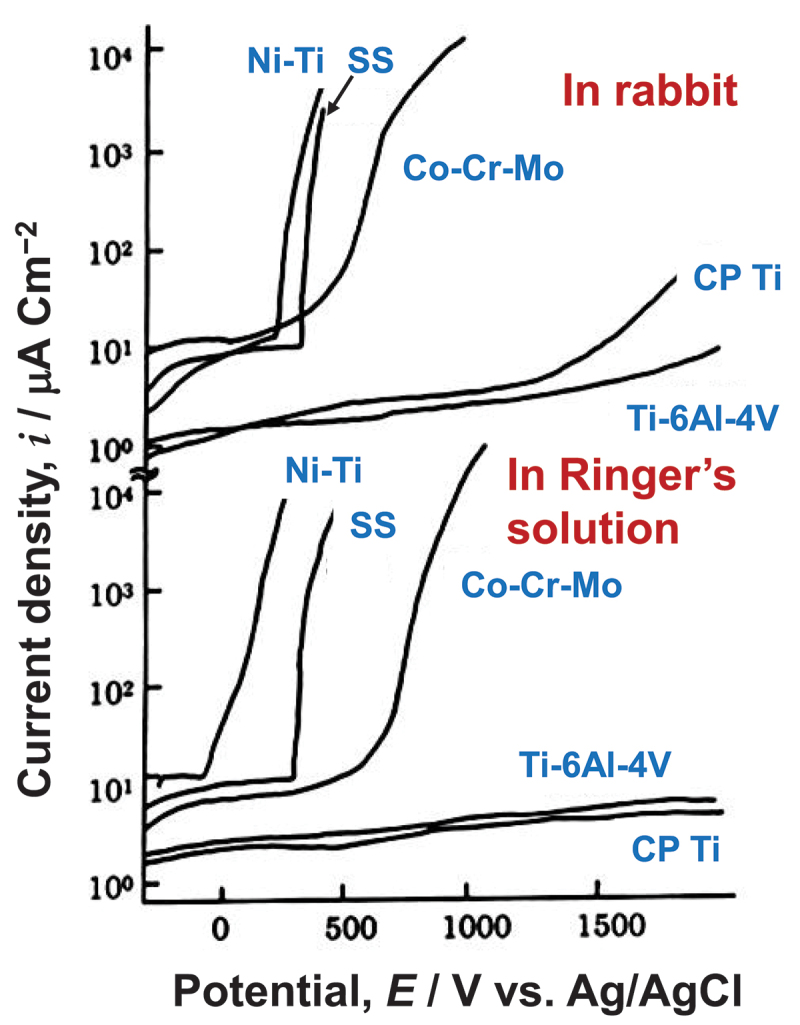
Anodic polarization curves of CP Ti, Ti−6Al−4V alloy, Co−Cr−Mo alloy, type 316L stainless steel (SS), and pure Ni in rabbit and Ringer’s. Reproduced by permission from [13], copyright [1989, Elsevier].
Figure 4.
Figure 4.
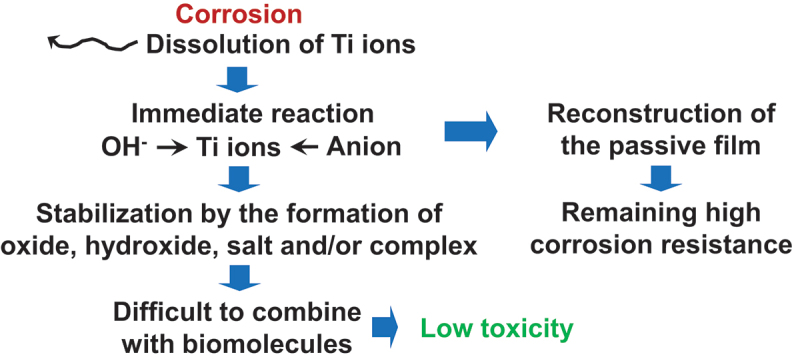
Mechanism remaining low toxicity even though Ti is corroded.
Figure 5.
Figure 5.
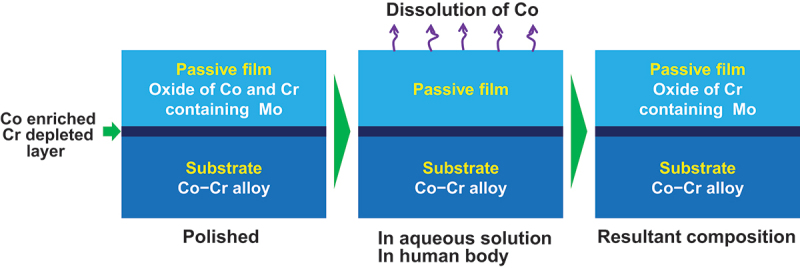
Co ions are released from initial passive film in aqueous solutions or the human body and the resultant passive film is Cr oxide containing small amount of Mo.
Figure 6.
Figure 6.
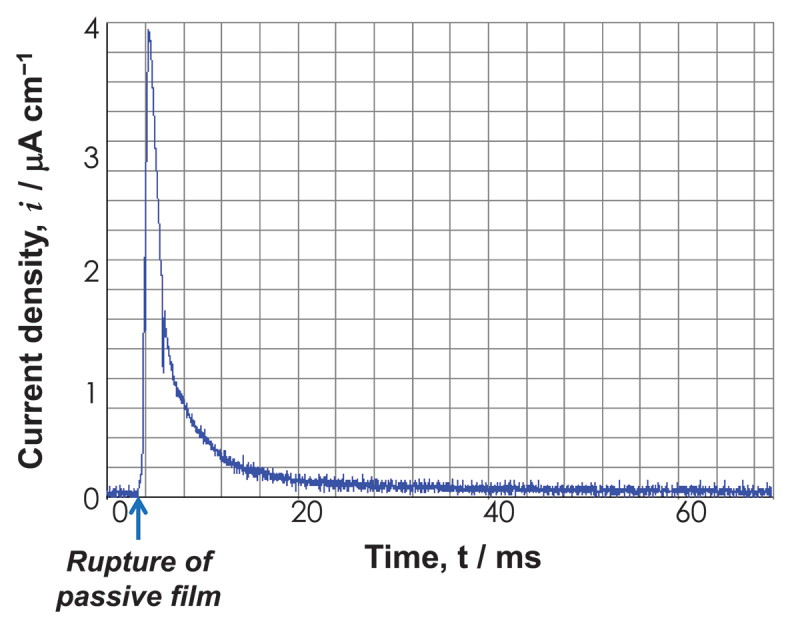
Time transient of current density of Ti after rupturing the passive film by abrasion in Hanks’ solution at 1 V vs. SCE. Positive current is generated both by ion dissolution and the formation of the passive film.
Figure 7.
Figure 7.
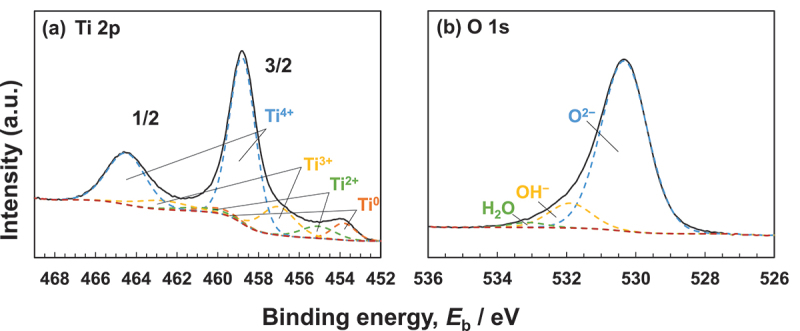
Ti 2p (a) and O 1s (b) electron energy region spectra obtained from Ti immersed in pure water for 1 d and their de-convolutions into component peaks [56].
Figure 8.
Figure 8.
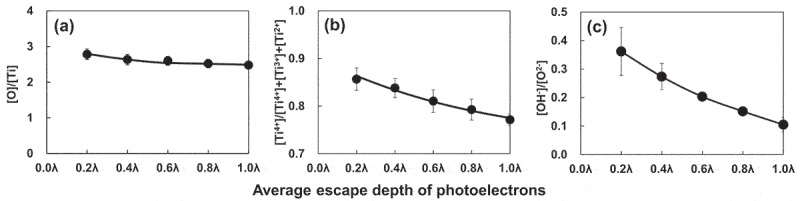
The ratios of [O]/[Ti] (a), [Ti4+]/([Ti4+]+[Ti3+]+[Ti2+]) (b), and [OH]/[O2] (c), plotted against the average escape depth of photoelectrons (n = 3) [56]. The angle-resolved technique for XPS was applied to Ti at the photoelectron take-off angles of 12°, 24°, 37°, 53°, and 90°, corresponding to the detection depths of 0.2λ, 0.4λ, 0.6λ, 0.8λ, and 1.0λ, where λ was the photoelectrons’ effective mean free path. The effective escape depth was estimated as λ times the sine of the take-off angle. The take-off angle was defined as the angle between the direction of the photoelectron path to the electron spectrometer and the specimen surface.
Figure 9.
Figure 9.
(a) Valence band region spectra of Ti after polarization at 0 V in Hanks for 1 h and the determination of the maximum energy of the valence band, Ev [66] . (b) Relationship among Eg, Ev, and EF in the band structures of the passive film on Ti, rutile TiO2, and anatase TiO2.
Figure 10.
Figure 10.
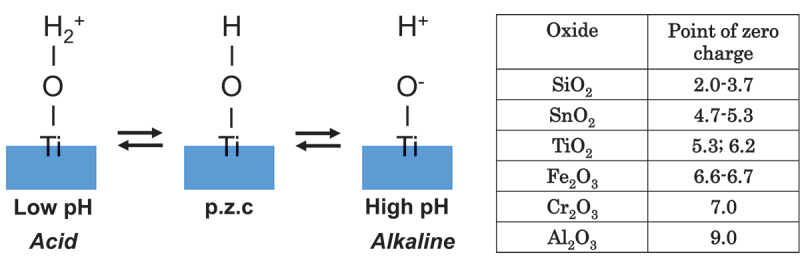
Point of zero charge (p.z.c.) of surface hydroxyl groups on TiO2 and their dissociation in aqueous solutions according to pH. The p.z.c. values of metal oxides are listed in the table.
Figure 11.
Figure 11.
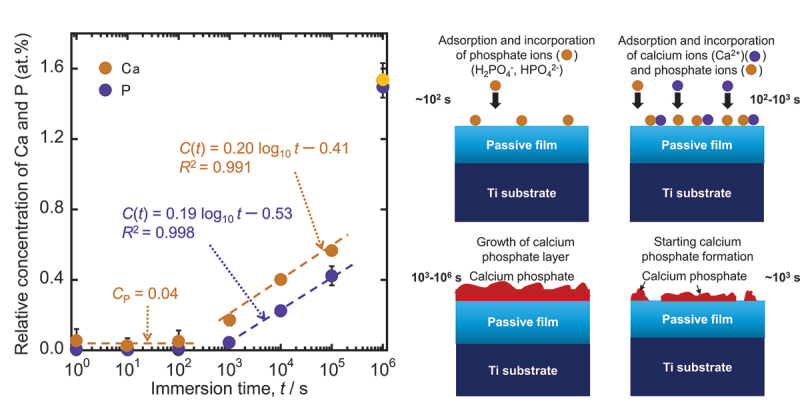
Change in the relative concentrations of calcium and phosphorus in the surface layers of Ti immersed in Hanks’ solution (n=3) and illustration of the formation process of calcium phosphate on Ti in Hanks’ solution [63].
Figure 12.
Figure 12.
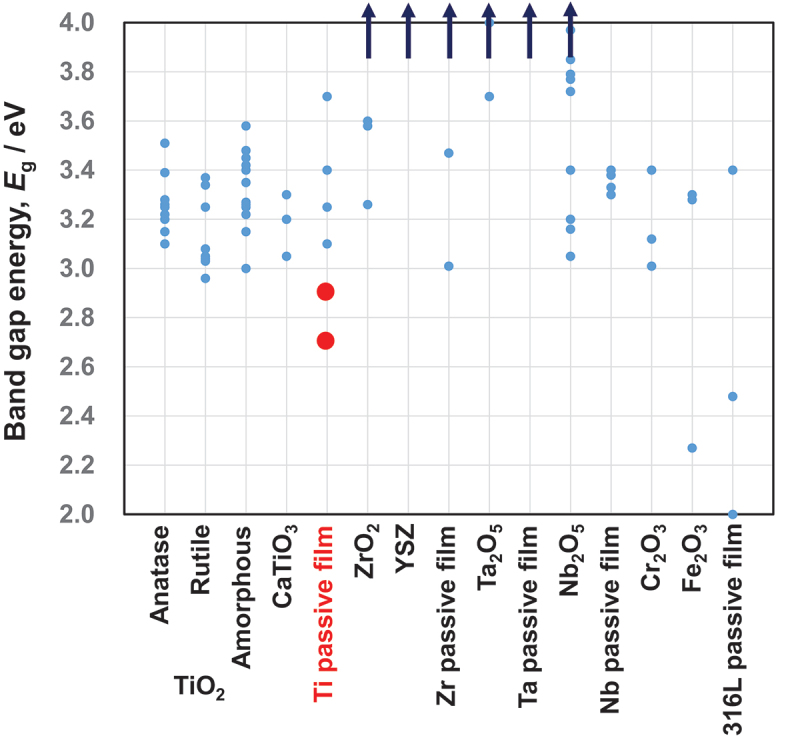
Band gap energies of various oxides and passive films on metals. This figure was originally drawn based on band gap energy data in published papers. The band gap energy of the passive film on Ti in simulated bioliquids (red circles) is relatively low, which may contribute to the reactivity of Ti.
Figure 13.
Figure 13.
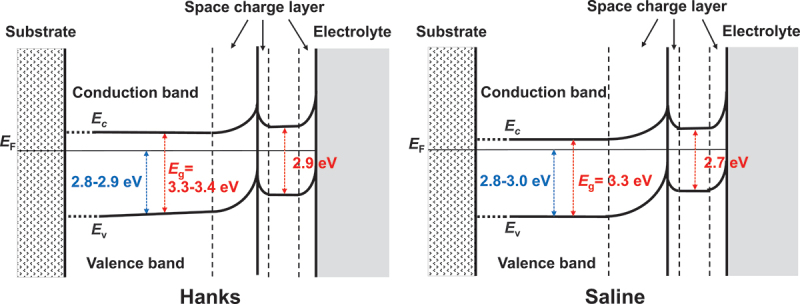
Electronic band structures of passive films formed on Ti in Hanks’ solution and saline [68].

References

    1. Brunette DM, Tenvall P, Textor M, et al. Titanium in medicine. Berlin: Springer; 2001. DOI:10.1007/978-3-642-56486-4 - DOI
    1. Hanawa T. Titanium-Tissue interface reaction and its control with surface treatment. Front Bioeng Biotechnol. 2019;7:170. - PMC - PubMed
    1. Hanawa T. Zirconia versus titanium in dentistry: A review. Dent Mater J. 2020;39(1):24–36. - PubMed
    1. Tschernitschek H, Borchers L, Geurtsen W. Nonalloyed titanium as a bioinert metal—a review. J Prosth Dent. 2006;96(1):12. - PubMed
    1. William DF. Definitions in biomaterials. Proceedings of a Consensus Conference of the European Society for Biomaterials, Vol. 4, Chester, England, New York, NY: Elsevier; 1987.

LinkOut - more resources