. 2022 Jul 20;25(8):104773.
doi: 10.1016/j.isci.2022.104773. eCollection 2022 Aug 19.

Chemoproteomics reveals berberine directly binds to PKM2 to inhibit the progression of colorectal cancer

Affiliations

Chemoproteomics reveals berberine directly binds to PKM2 to inhibit the progression of colorectal cancer

Shi-Hai Yan et al. iScience. .

Abstract

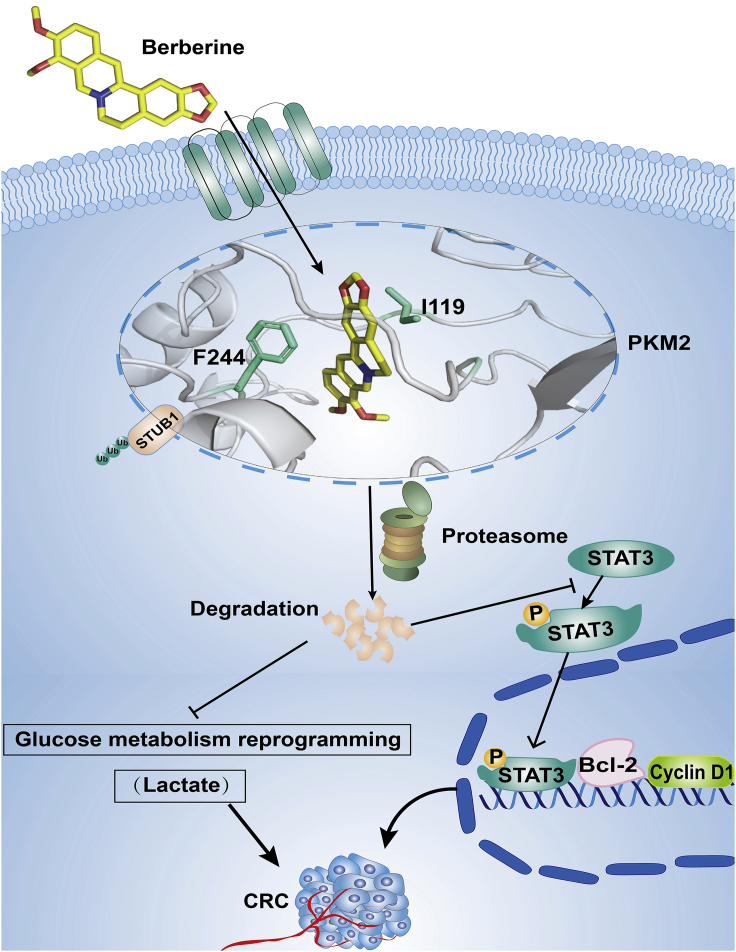
Colorectal cancer is one of the most serious tumors and berberine can inhibit the recurrence and transformation of colorectal adenoma into colorectal cancer. However, the direct binding target proteins of berberine in inhibiting colorectal cancer remain unclear. In this study, the chemical proteomics method was used and demonstrated that berberine is directly bound to pyruvate kinase isozyme type M2 (PKM2) in colorectal cancer cells. The triangular N-O-O triangular structure of berberine contributed to hydrophobic interaction with I119 amino acid residues and π-π interaction with F244 amino acid residues of PKM2 protein. Moreover, berberine was shown to inhibit the reprogramming of glucose metabolism and the phosphorylation of STAT3, down regulate the expression of Bcl-2 and Cyclin D1 genes, ultimately inhibiting the progression of colorectal cancer. This study uncovered the direct binding target protein and mechanism of berberine to improve metabolic reprogramming in colorectal cancer, which is helpful to guide the optimization of berberine.

Keywords: Biochemistry; Biomolecules; Molecular biology.


Conflict of interest statement

The authors declare no competing interests.

Figures

None
Graphical abstract
Figure 1
Figure 1
Berberine inhibits colorectal cancer with improved metabolism (A) Chemical structure of Berberine. (B) Berberine inhibits the proliferation of HT29 cells. (C) Berberine inhibits lactate production in HT29 cells. (D–J) Berberine inhibits tumor growth in HT29 cell-bearing mice intraperitoneally injected with berberine (5 or 10 mg/kg body weight) for 28 days, including (D) Tumor pictures; (E) Tumor volume; (F) Tumor weight; (G) Representative FDG PET/CT images; (H) SUV of FDG in tumor indicating glucose uptake; (I) Tumor pyruvate production. (J) Tumor lactate production. The data are shown as the mean ± SD of three independent experiments. Statistics differences were analyzed by one-way ANOVA followed by Dunnett’s post-hoc test. ∗p < 0.05, ∗∗p < 0.01.
Figure 2
Figure 2
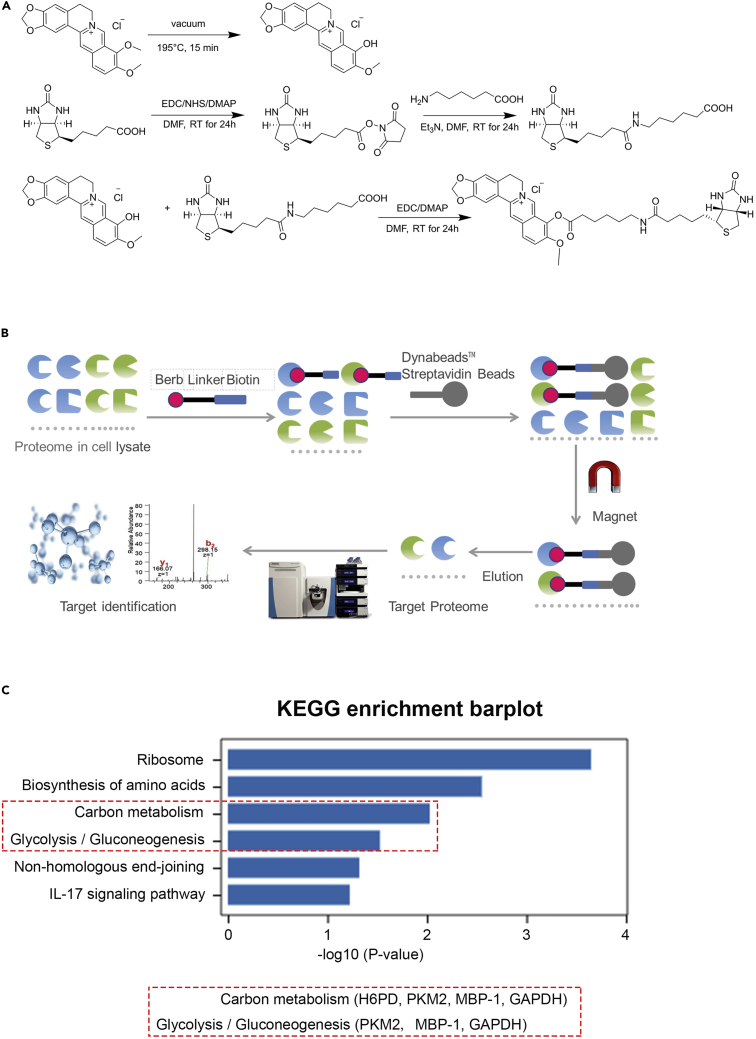
Chemoproteomic identification of direct binding target proteins of berberine in colorectal cancer cells (A) Synthesis pathway diagram of biotinylated berberine. (B) Flow chart of chemical proteomics study. (C) Top six of pathway enrichment through bioinformatics analyses. The data are shown from three independent experiments.
Figure 3
Figure 3
Berberine interacts directly with PKM2 (A–D) Effect of berberine on the proliferation of HT29 cells after knockdown of metabolic pathway proteins H6PD, PKM2, MBP-1, or GAPDH. (E–H) The effect of berberine on the lactate production of HT29 cells after knockdown of metabolic pathway proteins H6PD, PKM2, MBP-1, or GAPDH. (I) Thermal migration method to detect the interaction of berberine with PKM2 in HT29 cell (n = 3). (J) Determination of berberine bound with PKM2 of HT29 cells co-incubated with vehicle or berberine (5 μM) for 30 min. (K) Co-localization of PKM2 and biotinylated berberine was detected by Immunofluorescence after HT29 cells were incubated with biotinylated berberine for 30 min. Scale bar, 10 μm. The data are shown as the mean ± SD of three independent experiments. Statistics differences were analyzed by one-way ANOVA followed by Dunnett’s post-hoc test. ∗p < 0.05, ∗∗p < 0.01.
Figure 4
Figure 4
Direct binding of berberine to PKM2 promotes ubiquitination to inhibit the pathway in colorectal cancer (A) The effect of berberine on PKM2, PKM1, Bcl-2, Cyclin D1 expression in HT29 cells was studied using Western blot analysis. (B) Berberine promotes PKM2 ubiquitination. (C) PKM2 mRNA levels (n = 6). (D) PKM1 mRNA levels (n = 6). (E) Bcl-2 mRNA levels (n = 6). (F) Cyclin D1 mRNA levels (n = 6). (G) The effect of Sh PKM2 on Bcl-2, Cyclin D1, and STAT3 phosphorylation in HT29 cells was studied using Western blot analysis. The data are shown as the mean ± SD of three independent experiments. Statistics differences were analyzed by unpaired t test. ∗p < 0.05, ∗∗p < 0.01.
Figure 5
Figure 5
Structural model study of berberine-PKM2 binding (A) Spatial conformation of berberine-PKM2 binding. (B) Effect of berberine on cell proliferation after the knockdown or mutation of the PKM2 amino acid site (n = 6). (C) Effect of berberine on lactate production after the knockdown or mutation of the PKM2 amino acid site (n = 6). (D) Effect of berberine on the expression of PKM2 and p-STAT3 in HT29 cells after the knockdown or mutation of the PKM2 amino acid site. (E) Effect of berberine on the ubiquitination of PKM2 after the knockdown or mutation of the PKM2 amino acid site. The data are shown as the mean ± SD of three independent experiments. Statistics differences were analyzed by unpaired t test. ∗p < 0.05, ∗∗p < 0.01.
Figure 6
Figure 6
CDX models to validate berberine-PKM2 binding site inhibition in colorectal cancer cell HT29 Nude mice were inoculated with Sh/OE PKM2 (homologous mutation) HT29 cells, Sh/OE PKM2 (F244A) HT29 cells, or Sh/OE PKM2 (I199S) HT29 cells to construct xenograft mouse models and intraperitoneally injected with vehicle or berberine (10 mg/kg body weight) for 28 days. (A) Tumor pictures. Scale bar, 1 cm. (B) Tumor weight (n = 6). (C) Representative FDG PET/CT images. (D) SUV of FDG in tumor indicating glucose uptake (n = 6). (E) Lactate production (n = 6). (F) PKM2 and p-STAT3 expression. (G) Representative Western blot analysis of PKM2 and downstream proteins after amino acid site mutation. Scale bar, 50 μm. The data are shown as the mean ± SD of three independent experiments. Statistics differences were analyzed by one-way ANOVA followed by Dunnett’s post-hoc test. ∗p < 0.05, ∗∗p < 0.01.
Figure 7
Figure 7
PDX models confirm that berberine promotes PKM2 ubiquitination to inhibit colorectal cancer PDX models were established using intestinal cancer tissues from three different patients and intraperitoneally injected with vehicle or berberine (10 mg/kg body weight) for 28 days. (A) Tumor pictures. Scale bar, 1 cm. (B) Tumor weight (n = 6). (C) Representative FDG PET/CT images. (D) SUV of FDG in tumor indicating glucose uptake (n = 6). (E) PKM2 ubiquitination. (F) Lactate Production (n = 6). (G) Representative Western blot analysis of PKM2 and downstream proteins. (H) PKM2 and p-STAT3 expression. Scale bar, 50 μm. The data are shown as the mean ± SD of three independent experiments. Statistics differences were analyzed by one-way ANOVA followed by Dunnett’s post-hoc test. ∗p < 0.05, ∗∗p < 0.01.
Figure 8
Figure 8
Illustration of the mechanism of berberine inhibition of colorectal cancer progression Berberine enters the cell and directly targets PKM2. The N-O-O triangle structure of berberine contributes to hydrophobic interaction with I119 amino acid residues and π-π interaction with F244 amino acid residues of PKM2 protein, forming a sandwich-like overall structure, resulting in an increase in ubiquitination and degradation of PKM2. As a result, berberine further inhibits the reprogramming of glucose metabolism as well as the phosphorylation of STAT3, down-regulates the expression of Bcl-2 and cyclin D1 genes, suppresses cell proliferation, and promotes cell apoptosis, ultimately inhibiting the progression of colorectal cancer.

References

    1. Abegg D., Frei R., Cerato L., Prasad Hari D., Wang C., Waser J., Adibekian A. Proteome-Wide profiling of targets of cysteine reactive small molecules by using ethynyl benziodoxolone reagents. Angew. Chem. Int. Ed. Engl. 2015;54:10852–10857. - PubMed
    1. Bessi I., Bazzicalupi C., Richter C., Jonker H.R.A., Saxena K., Sissi C., Chioccioli M., Bianco S., Bilia A.R., Schwalbe H., Gratteri P. Spectroscopic, molecular modeling, and NMR-spectroscopic investigation of the binding mode of the natural alkaloids berberine and sanguinarine to human telomeric G-quadruplex DNA. ACS Chem. Biol. 2012;7:1109–1119. - PubMed
    1. Bray F., Ferlay J., Soerjomataram I., Siegel R.L., Torre L.A., Jemal A. Global cancer statistics 2018: GLOBOCAN estimates of incidence and mortality worldwide for 36 cancers in 185 countries. CA. Cancer. J. Clin. 2018;68:394–424. - PubMed
    1. Case D.A., Betz R.M., Cerutti D.S., Cheatham T.E., Darden T.A., III, Duke R.E., Giese T.J., Gohlke H., Goetz A.W., Homeyer N., et al. University of California; 2016. AMBER 2016.
    1. Chen C., Tao C., Liu Z., Lu M., Pan Q., Zheng L., Li Q., Song Z., Fichna J. A randomized clinical trial of berberine hydrochloride in patients with diarrhea-predominant irritable bowel syndrom. Phytother Res. 2015;29:1822–1827. - PubMed