Review
. 2023 Jan;39(1):113-124.
doi: 10.1007/s12264-022-00934-6. Epub 2022 Aug 22.

Parkinson's Disease: A Multisystem Disorder

Affiliations
Review

Parkinson's Disease: A Multisystem Disorder

Helena Nunes Costa et al. Neurosci Bull. 2023 Jan.

Abstract

The way sporadic Parkinson's disease (PD) is perceived has undergone drastic changes in recent decades. For a long time, PD was considered a brain disease characterized by motor disturbances; however, the identification of several risk factors and the hypothesis that PD has a gastrointestinal onset have shed additional light. Today, after recognition of prodromal non-motor symptoms and the pathological processes driving their evolution, there is a greater understanding of the involvement of other organ systems. For this reason, PD is increasingly seen as a multiorgan and multisystemic pathology that arises from the interaction of susceptible genetic factors with a challenging environment during aging-related decline.

Keywords: Blood-brain barrier; Gut microbiome; Intestinal barrier; Parkinson's disease; α-Synuclein.


Conflict of interest statement

All authors claim that there are no conflicts of interest.

Figures
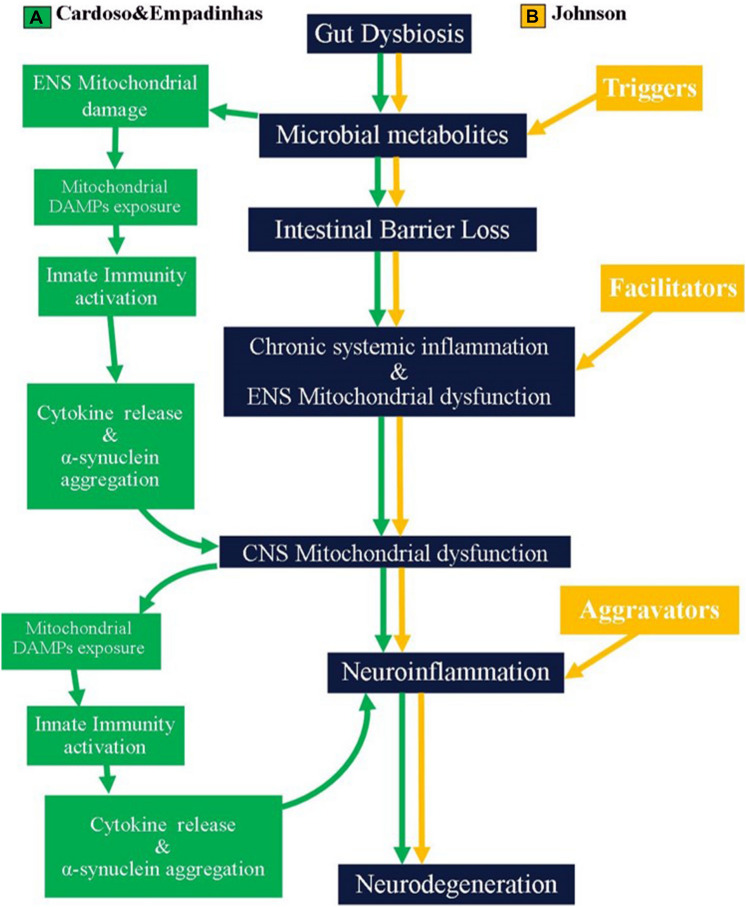
Fig. 1
Fig. 1
Schematic of the Cardoso & Empadinhas and Johnson et al. hypotheses proposing gut dysbiosis as a trigger of PD. A The Cardoso & Empadinhas hypothesis proposes that exogenous microbial toxins or those produced by the gut microbiome, in the context of gut dysbiosis, lead to mitochondrial damage. Consequently, the release of mitochondrial DAMPs leads to neuronal sterile inflammation via activation of Toll-like receptors (TLRs) and Nod-like receptors (NLRs). Ultimately, this inflammation leads to neurodegeneration of the ENS and CNS [28]; B Johnson and colleagues describes 3 phases that include triggers, facilitators, and aggravators. Triggers act transiently, e.g. trauma and exposure to toxins or pathogens, and although they are insufficient to generate the disease, they allow it to develop in the presence of facilitators. In turn, facilitators, such as mitochondrial dysfunction or gene mutations associated with PD, are conditions that precede or are concomitant to triggers, allowing CNS involvement and leading to a state of chronic systemic inflammation. Finally, aggravators include changes in autophagy and neuroinflammation that are associated with the progression of the pathology [2].
Fig. 2
Fig. 2
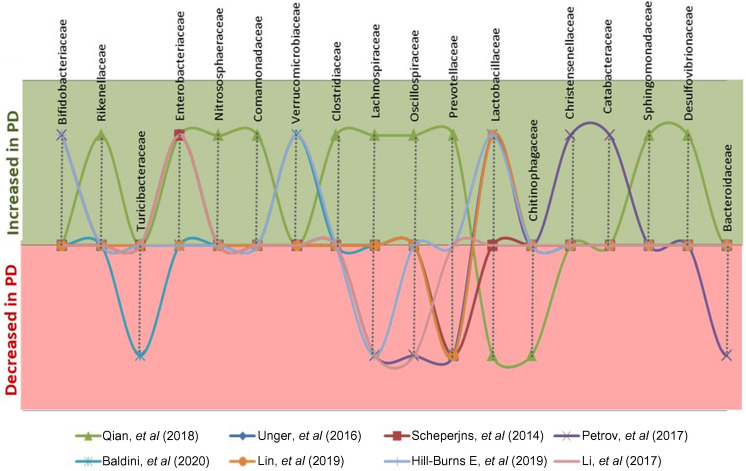
Summary of PD microbiome profiles obtained in eight studies. Increased relative abundance of Enterobacteriaceae in four studies and decreased Prevotellaceae in PD patients reported in five studies are noteworthy. Four studies detected increased abundance of Lactobacillaceae, but one study found decreased levels in PD. The relative abundance of Lachnospiraceae was decreased in PD patients in three studies, with one study coming to opposite conclusions.

References

    1. Nandipati S, Litvan I. Environmental exposures and Parkinson's disease. Int J Environ Res Public Health. 2016;13:881. doi: 10.3390/ijerph13090881. - DOI - PMC - PubMed
    1. Johnson ME, Stecher B, Labrie V, Brundin L, Brundin P. Triggers, facilitators, and aggravators: redefining Parkinson's disease pathogenesis. Trends Neurosci. 2019;42:4–13. doi: 10.1016/j.tins.2018.09.007. - DOI - PMC - PubMed
    1. Kustrimovic N, Comi C, Magistrelli L, Rasini E, Legnaro M, Bombelli R, et al. Parkinson's disease patients have a complex phenotypic and functional Th1 bias: cross-sectional studies of CD4+ Th1/Th2/T17 and Treg in drug-naïve and drug-treated patients. J Neuroinflammation. 2018;15:205. doi: 10.1186/s12974-018-1248-8. - DOI - PMC - PubMed
    1. Chen Z, Chen S, Liu J. The role of T cells in the pathogenesis of Parkinson's disease. Prog Neurobiol. 2018;169:1–23. doi: 10.1016/j.pneurobio.2018.08.002. - DOI - PubMed
    1. Postuma RB, Berg D, Stern M, Poewe W, Olanow CW, Oertel W, et al. MDS clinical diagnostic criteria for Parkinson's disease. Mov Disord. 2015;30:1591–1601. doi: 10.1002/mds.26424. - DOI - PubMed

Substances