. 2022 Aug;12(8):e996.
doi: 10.1002/ctm2.996.

Manipulating adrenergic stress receptor signalling to enhance immunosuppression and prolong survival of vascularized composite tissue transplants

Affiliations

Manipulating adrenergic stress receptor signalling to enhance immunosuppression and prolong survival of vascularized composite tissue transplants

Minhyung Kim et al. Clin Transl Med. 2022 Aug.

Abstract

Background: Vascularized composite tissue allotransplantation (VCA) to replace limbs or faces damaged beyond repair is now possible. The resulting clear benefit to quality of life is a compelling reason to attempt this complex procedure. Unfortunately, the high doses of immunosuppressive drugs required to protect this type of allograft result in significant morbidity and mortality giving rise to ethical concerns about performing this surgery in patients with non-life-threatening conditions. Here we tested whether we could suppress anti-graft immune activity by using a safe β2 -adrenergic receptor (AR) agonist, terbutaline, to mimic the natural immune suppression generated by nervous system-induced signalling through AR.

Methods: A heterotopic hind limb transplantation model was used with C57BL/6 (H-2b) as recipients and BALB/c (H-2d) mice as donors. To test the modulation of the immune response, graft survival was investigated after daily intraperitoneal injection of β2 -AR agonist with and without tacrolimus. Analyses of immune compositions and quantification of pro-inflammatory cytokines were performed to gauge functional immunomodulation. The contributions to allograft survival of β2 -AR signalling in donor and recipient tissue were investigated with β2 -AR-/- strains.

Results: Treatment with the β2 -AR agonist delayed VCA rejection, even with a subtherapeutic dose of tacrolimus. β2 -AR agonist decreased T-cell infiltration into the transplanted grafts and decreased memory T-cell populations in recipient's circulation. In addition, decreased levels of inflammatory cytokines (IFN-γ, IL-6, TNF-α, CXCL-1/10 and CCL3/4/5/7) were detected following β2 -AR agonist treatment, and there was a decreased expression of ICAM-1 and vascular cell adhesion molecule-1 in donor stromal cells.

Conclusions: β2 -AR agonist can be used safely to mimic the natural suppression of immune responses, which occurs during adrenergic stress-signalling and thereby can be used in combination regimens to reduce the dose needed of toxic immunosuppressive drugs such as tacrolimus. This strategy can be further evaluated for feasibility in the clinic.

Keywords: immunosuppression; stress signalling; vascularized composite tissue allotransplantation; β2-adrenergic receptors.


Conflict of interest statement

The authors reported no proprietary or commercial interest in any product mentioned or concept discussed in the article.

Figures
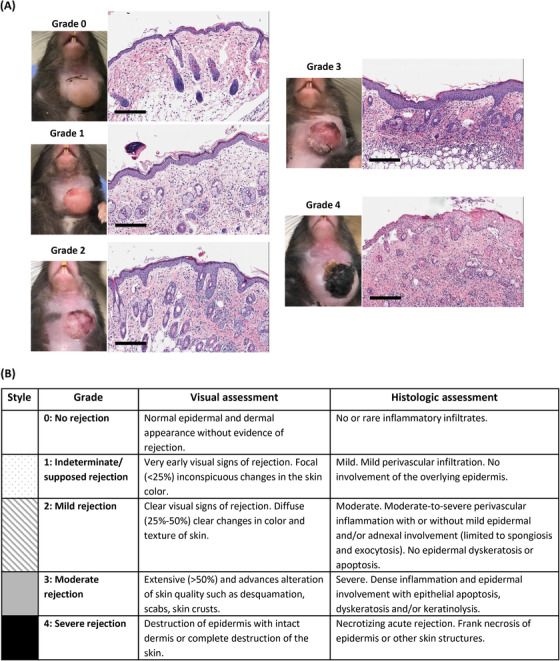
FIGURE 1
FIGURE 1
Visual and histologic grading systems for assessment of rejection after vascularized composite tissue allotransplantation (VCA). (A) Examples of each clinical and histologic rejection grade in a murine heterotopic hind limb transplant performed in a total major histocompatibility complex (MHC)‐mismatch. Scale bar: 50 µm. (B) The Banff 2007 working classification of skin‐containing composite tissue allograft pathology
FIGURE 2
FIGURE 2
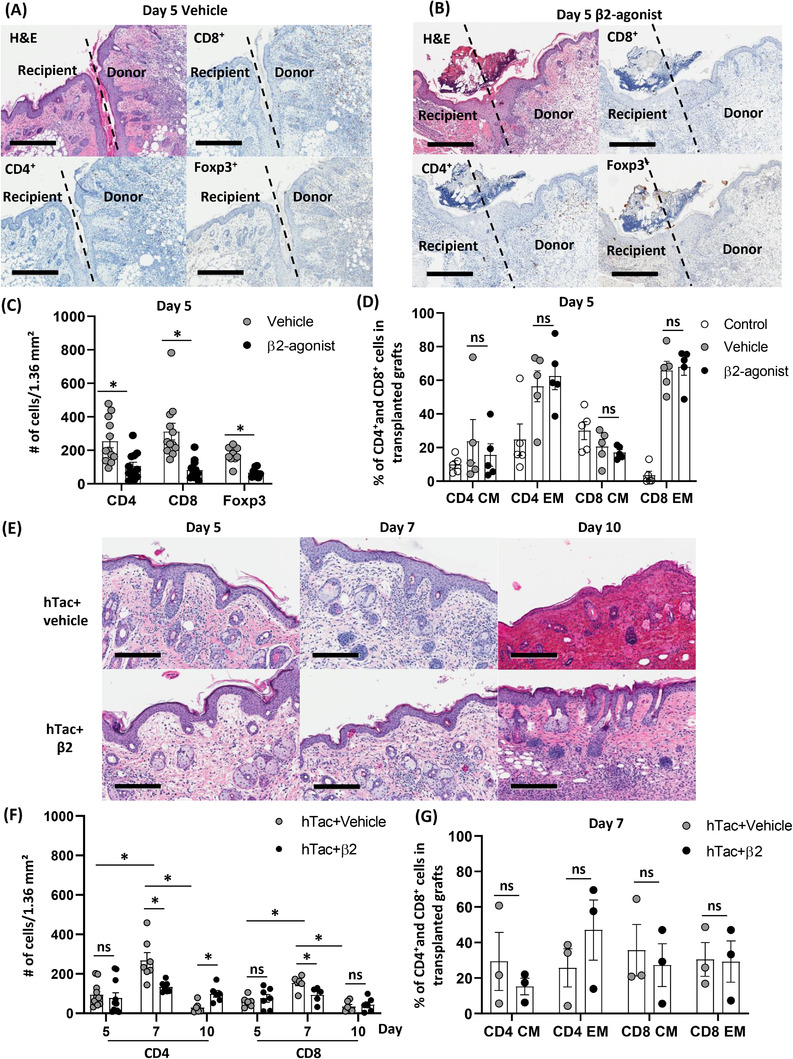
β2‐Adrenergic receptors (ARs) agonist decreases T‐cell infiltration in transplanted grafts along with lower numbers of Foxp3 positive cells compared to the vehicle‐injected group. (A and B) Representative figures for haematoxylin and eosin (H&E) and immunohistochemistry (IHC) with CD8, CD4, and Foxp3 antibodies with either vehicle or β2‐agonist treatment for 5 days. The borderline (black dotted line) differentiates recipient and donor, scale bar: 400 µm. (C) Numbers of CD4, CD8 and Foxp3 positive cells in grafts 5 days after vascularized composite tissue allotransplantation (VCA). Over eight fields from three mice/group. Error bar, standard error of the mean. *p < .05 by Student's t test. (D) Compositions of CD4+/CD8+ central memory (CM) and effector memory (EM) T‐cell populations in transplanted grafts 5 days after VCA. Control, non‐vascularized donor grafts; n = 5. ns, not significant; error bar, standard error of the mean. *p < .05 by Student's t test. (E) Representative figures for H&E stain at different time points after VCA. Scale bar: 200 µm. (F) Numbers of CD4+ and CD8+ T cells in grafts 5, 7 and 10 days after VCA in the hTac + vehicle and the hTac + β2‐agonist‐treated groups. Over five fields from n = 3/group. Error bar, standard error of the mean. *p < .05 by Student's t test. (G) Compositions of CD4+/8+ CM and EM T‐cell populations in transplanted grafts 7 days after treatment either with hTac or hTac + β2‐agonist. n = 3. ns, not significant; error bar, standard error of the mean
FIGURE 3
FIGURE 3
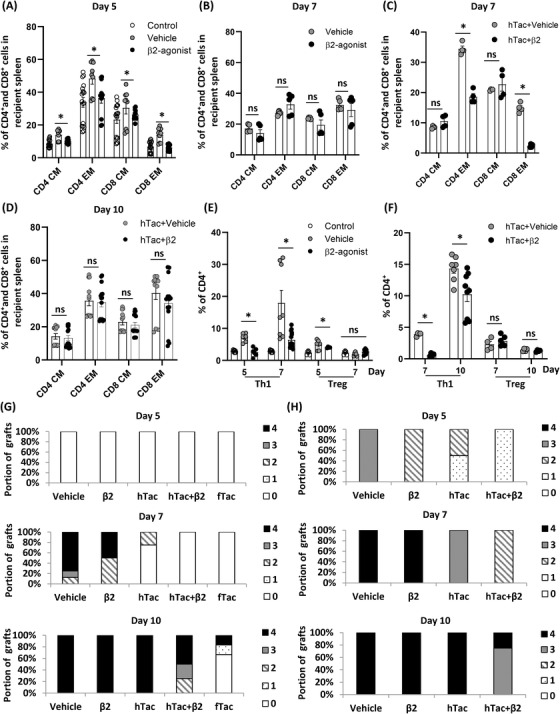
β2‐Adrenergic receptor (AR) agonist decreases CD4+/CD8+ effector memory (EM) T‐ and Th1‐cell populations and significantly decreases cytokine levels such as IFN‐γ, IL‐6 and TNF‐α compared to the vehicle group in recipients’ blood. (A and B) Compositions of CD4+/CD8+ central memory (CM)/EM T‐cell populations in the blood 5 and 7 days either with vehicle or β2‐agonist after vascularized composite tissue allotransplantation (VCA) without tacrolimus. Day 5, n ≥ 9; day 7, n = 5; control, non‐transplanted animals. ns, not significant; error bar, standard error of the mean. *p < .05 by Student's t test. (C and D) Compositions of CD4+/CD8+ CM/EM T‐cell populations in the blood 7 and 10 days with either vehicle or β2‐agonist after VCA with a half dose of tacrolimus (hTac). Day 7, n = 4; day 10, n ≥ 12. ns, not significant; error bar, standard error of the mean. *p < .05 by Student's t test. (E and F) Th1‐ and Treg‐cell populations in CD4+ T cells without and with tacrolimus after VCA with either vehicle or β2‐agonist treatments. Day 7, n ≥ 6; day 10, n ≥ 4. ns, not significant; error bar, standard error of the mean. *p < .05 by Student's t test. (G) Gross (clinical) rejection grades depending on different treatments after VCA. Vehicle, n = 8; β2, n = 4; hTac, n = 4; hTac + β2, n = 4; fTac, n = 6. (H) Histologic rejection grades depending on different treatments after VCA, n = 4/group
FIGURE 4
FIGURE 4
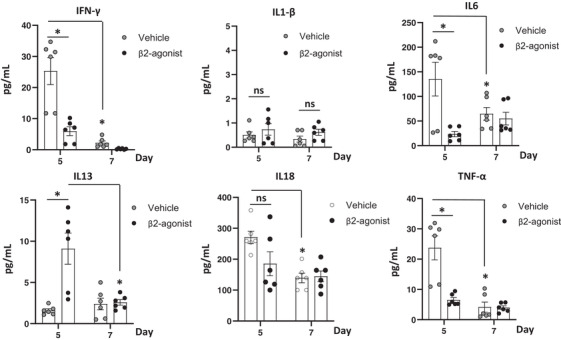
β2‐Adrenergic receptor (AR) modulation decreases inflammatory cytokine productions in recipients. In the setting of wild‐type (WT) donors and WT recipients vascularized composite tissue allotransplantation (VCA) without tacrolimus, various cytokine levels were analysed 5 and 7 days after transplant by Luminex assay. n = 6; pooled data from duplicate samples. Error bar; standard error of the mean. *p < .05 by Student's t test
FIGURE 5
FIGURE 5
β2‐Adrenergic receptor (AR) agonist injected group achieves significantly longer graft survival than the vehicle injected group. (A) Wild type (WT) recipients having WT donor grafts were treated with a full dose (optimal) of tacrolimus (fTac) for 14 days and then treated with either vehicle or β2‐agonists (terbutaline and bambuterol) after cessation of fTac. (B) CD4+/CD8+ central memory (CM) and effector memory (EM) T‐cell compositions were analysed in the blood 21 days after vascularized composite tissue allotransplantation (VCA), 7 days after treatment with either vehicle or β2‐agonist. n = 5. ns, not significant; error bar, standard error of the mean. *p < .05 by Student's t test. (C) Graft survival curves. n = 5. ns, not significant. *p < .05 by log‐rank test using GraphPad Prism. (D) WT recipients were treated with a half dose (subtherapeutic) of tacrolimus along with vehicle or β2‐agonists (terbutaline and bambuterol) after 14‐day fTac injections. (E) CD4+/CD8+ CM and EM T‐cell compositions were analysed in the blood 28 days after VCA, 14 days after treatment with either vehicle or β2‐agonist. n = 5. ns, not significant by Student's t test; error bar, standard error of the mean. (F) Graft survival curves. n = 5. *p < .05 by log‐rank test with GraphPad Prism
FIGURE 6
FIGURE 6
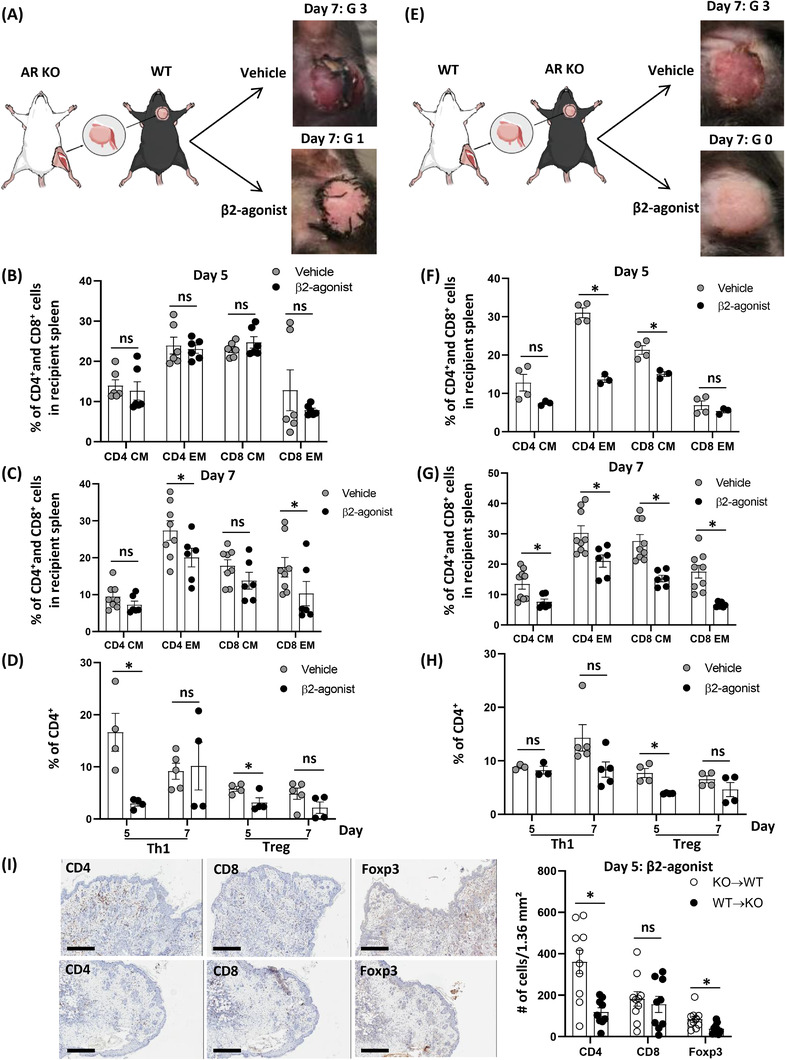
Modulation of β2‐adrenergic receptor (AR) signalling in donors is more effective to delay rejection responses than the modulation in recipients. (A) BALB/c β2‐AR knock‐out (KO) donors were transplanted to C57BL/6 recipients with either vehicle or β2‐agonist injections. (B and C) Compositions of CD4+/CD8+ central memory (CM)/effector memory (EM) T‐cell populations in the spleen 5 and 7 days with either vehicle or β2‐agonist after vascularized composite tissue allotransplantation (VCA) without tacrolimus in wild‐type (WT) recipients receiving BALB/c β2‐AR KO grafts. Day 5, n = 6; day 7, n ≥ 6. ns, not significant; error bar, standard error of the mean. *p < .05 by Student's t test. (D) Th1‐ and Treg‐cell populations in CD4+ T cells after vehicle or β2‐agonist treatments in WT recipients receiving BALB/c β2‐AR KO grafts. n ≥ 4. ns, not significant; error bar, standard error of the mean. *p < .05 by Student's t test. (E) BALB/c WT donors were transplanted to C57BL/6 β2‐AR KO recipients with either vehicle or β2‐agonist injections. (F and G) Compositions of CD4+/CD8+ CM/EM T‐cell populations in the spleen 5 and 7 days with either vehicle or β2‐agonist after VCA without tacrolimus in β2‐AR KO recipients receiving BALB/c WT grafts. Day 5, n ≥ 3; day 7, n ≥ 6. ns, not significant; error bar, standard error of the mean. *p < .05 by Student's t test. (H) Th1‐ and Treg‐cell populations in CD4+ T cells with either vehicle or β2‐agonist treatments in β2‐AR KO recipients receiving BALB/c WT grafts. n ≥ 3. ns, not significant; error bar; standard error of the mean. *p < .05 by Student's t test. (I) Representative figures for immunohistochemistry (IHC) with CD4, CD8 and Foxp3 antibodies with β2‐agonist treatment for 5 days in WT recipients bearing AR KO donor's grafts (KO → WT) and AR KO recipients bearing WT donor's grafts (WT → KO). Over nine fields from n = 3/group. ns, not significant; error bar, standard error of the mean; scale bar: 400 µm. *p < .05 by Student's t test
FIGURE 7
FIGURE 7
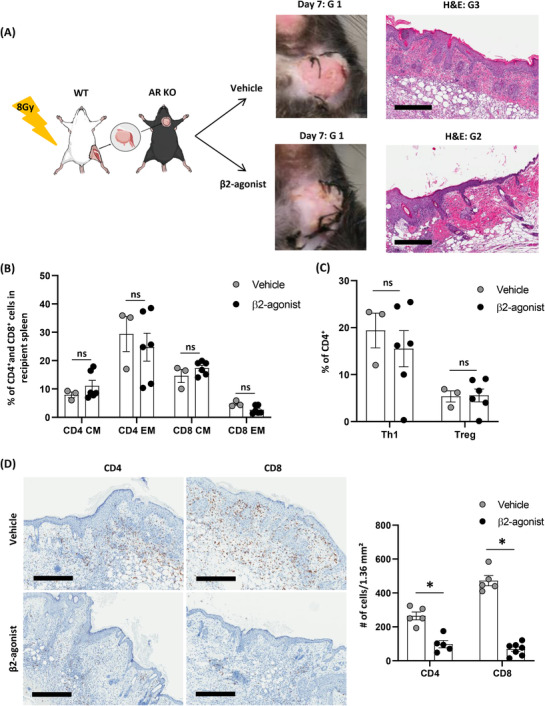
β2‐Adrenergic receptor (AR) agonist has effects with donor's stromal cells to inhibit T‐cell trafficking into transplanted grafts. (A) BALB/c wild‐type (WT) mice as a donor were exposed to 8‐Gy irradiation the day before surgery, the composite graft was transplanted to C57BL/6 β2‐AR knock‐out (KO) recipients with either vehicle or β2‐agonist treatments without tacrolimus. (B) Compositions of CD4+/CD8+ CM and (C) effector memory (EM) T‐cell populations and Th1 and Treg populations. n ≥ 3. ns, not significant; error bar, standard error of the mean. *p < .05 by Student's t test. (D) Immunohistochemistry (IHC) with CD4/CD8 antibodies, and cells were counted by ImageJ programme. Over five fields from n = 3/group. ns, not significant; error bar, standard error of the mean; scale bar: 400 µm. *p < .05 by Student's t test
FIGURE 8
FIGURE 8
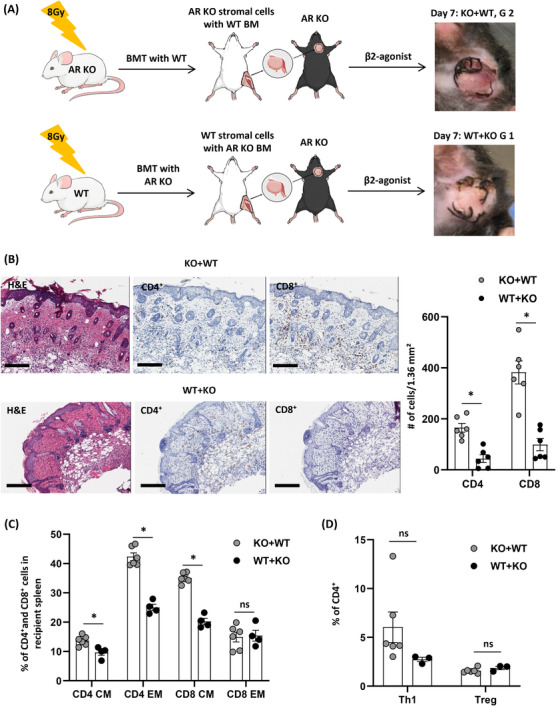
β2‐Adrenergic receptor (AR) agonist has effects with donor's stromal cells to inhibit T‐cell trafficking into transplanted grafts. (A) BALB/c AR knock‐out (KO) and wild‐type (WT) donors were exposed to 8 Gy irradiation, and then BALB/c WT and AR KO bone marrow (BM) were transplanted respectively. After 8‐week bone marrow transplantation (BMT), vascularized composite tissue allotransplantation (VCA) was performed on C57BL/6 AR KO recipients followed by β2‐agonist treatment for 7 days. (B) Haematoxylin and eosin (H&E) and immunohistochemistry (IHC) with CD4 and CD8 antibodies, six fields from n = 3/group. Error bar, standard error of the mean; scale bar: 200 µm. *p < .05 by Student's t test. (C) Systemic compositions of CD4+/CD8+ central memory (CM)/effector memory (EM) T‐cell populations and (D) Th1‐ and Treg‐cell populations in CD4+ T cells 7 days after VCA with β2‐agonist treatment in C57BL/6 AR KO recipients having a graft from either BALB/c β2‐AR KO with WT BMT (KO + WT) or BALB/c WT with AR KO BMT (WT + KO). n ≥ 3. ns, not significant; error bar, standard error of the mean. *p < .05 by Student's t test
FIGURE 9
FIGURE 9
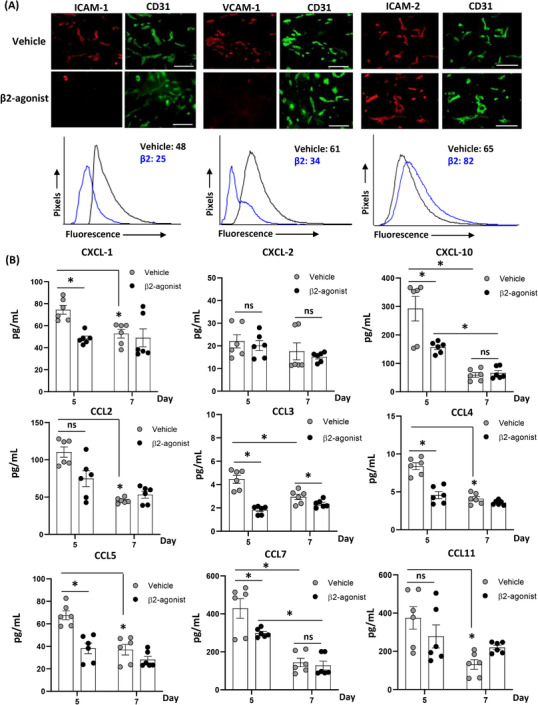
β2‐Adrenergic receptor (AR) agonist suppresses intercellular adhesion molecule‐1 (ICAM‐1) and vascular cell adhesion molecule‐1 (VCAM‐1) expression in donor grafts and significantly decreases CXCL‐1, CCL4 and CCL5 in recipients’ blood. (A) Immunofluorescence (IF) and image quantification were performed 5 days after vascularized composite tissue allotransplantation (VCA) with wild‐type (WT) donors and recipients followed by either vehicle or β2‐agonist injections. ICAM‐1, VCAM‐1, ICAM‐2 and CD31 antibodies were used. Histograms depict quantification of IF intensity of each antibody in all CD31+ vessels; numbers denote micro‐flow imaging (MFI). All data are representative of duplicate experiments, n = 3; scale bar: 100 µm. (B) Using Luminex assay, in the setting of WT donors and WT recipients VCA without tacrolimus, various chemokine levels were analysed 5 and 7 days after transplant. n = 6; pooled data from duplicate samples. ns, not significant; error bar, standard error of the mean. *p < .05 by Student's t test

Similar articles

Cited by

References

    1. Fleming ME, Bharmal H, Valerio I. Regenerative medicine applications in combat casualty care. Regen Med. 2014;9(2):179‐190. - PubMed
    1. Fleming M, Waterman S, Dunne J, et al. Dismounted complex blast injuries: patterns of injuries and resource utilization associated with the multiple extremity amputee. J Surg Orthop Adv. 2012;21(1):32‐37. - PubMed
    1. Gawande A. Casualties of war–military care for the wounded from Iraq and Afghanistan. N Engl J Med. 2004;351(24):2471‐2475. - PubMed
    1. Petit F, Minns AB, Dubernard JM, et al. Composite tissue allotransplantation and reconstructive surgery: first clinical applications. Ann Surg. 2003;237(1):19‐25. - PMC - PubMed
    1. Siemionow M, Kulahci Y. Facial transplantation. Semin Plast Surg. 2007;21(4):259‐268. - PMC - PubMed

Publication types